{ font: $(body.font); color: $(body.text.color); background: $(body.background); padding: opx; $(body.background.override) } expr:class='"loading" + data:blog.mobileClass'>
Showing posts with label obscure. Show all posts

Friday, December 18, 2015

Comb or Tent Graves

Today, I am shifting gears as I explore an interesting history and region of the United States known as the Cumberland Plateau.

When I visualize the region of which I am writing, I envision wide spances of continuous mountain ranges, rocky cliffs and un-populated sprawling beauty.  I think of John Denver singing of the Blue Ridge Mountains; of Native Americans (the Swanee and Cherokee) who hunted elk, buffalo and deer; and finally, I think of Daniel Boone who was famous for hunting and trapping in this vicinity.

Image source:  city-data.com
The Cumberland Plateau comprises of some of the largest stretches of adjoining forests in the eastern United States. It's location is generally in the southern portion of the Alleghany Mountains, however, it's geographic location is difficult to pinpoint, as it shares its location with several states. The forests are rich with oak, hickory and pine.  It is also rich with various North American trees such as beech, basswood, black walnut, red oak and Magnolia trees.  Plant and animal life are abundant.   


It is also difficult to describe the original settlers and people of this region, as the unfriendly, sandy soil of this region, discouraged farming.  Many early explorers and families sought this region as a place of new settlement, and those who tried to stay found only heartbreak and hardship.  We know this, because of the unique tomb stones that can be found only in this area of the United States, and the close proximity of time that deaths that occurred, especially pertaining to children.

The grave sites in this region are called "tent graves" or "comb graves".  The significance of these graves is that they are "the most outstanding style of folk graves to develop in this region.  A typical grave consists of two flat sandstone slabs leaned together to form a protective roof along the full length of the grave."   

Tent / Comb grave  [definition]- A stone structure built over an in-ground grave that is triangular in shape. It most often consists of two rectangular sandstone slabs placed together to form a gabled roof over the grave.
- Source: preserveala.org


"Graveyards of the Cumberland region are noteworthy for the variety of covered graves that have been found here... Comb graves are clearly the most outstanding style of folk graves to develop in the region.  Comb graves in the Rock Island-McMinnville area employ triangular end stones underneath to support the side slabs... most combs are accompanied by an engraved headstone, but in the Sparta area a number of cemeteries feature combs with the inscription cut on one of the side slabs." - Source: Richard Finch, Rural Life and Culture of the Cumberland region; rayhutchison.blogspot.com


Also, on Ray Hutchison's blog, he makes reference to the Spears Family Cemetery off of Old Walton Road, that is known to be the first traversed road along the Plateau, and is located near Buck Mountain, in Tennesee.  


Image source: flickr, depicting a cross, or something else?
He wrote, "The Spears cemetery is sometimes referred to as the Witches Cemetery because a number of the gravestones include a pentagram -- not likely associated with witchcraft, as this is a common symbol in comb tombstones from several other cemeteries in the region, but, combined with the unusual location of the cemetery, certainly makes for a good story."


Upon seeing this, I had to wonder, as there is apparently little known of the origin of these unique graves, except their existence by the locals.  Though, I assume the inscribed symbol shown on the grave stone above, is intended to be a Christian cross, but what if the "pentagram" symbol is a reference to the seven pointed star of the Cherokee Nation, or as seen in the picture below, of the Shawnee tribe?  I could be all wrong, but it is worth considering, since the original inhabitants were both from these Native American tribes.  



The photo (above) is from tngenweb.org/darkside and pictured, is a tin-roof tent grave, David Belle explains that he travels around that countryside exploring unusual sites and legends, and happened across this. This grave is in an abandoned cemetery with the "last known burial being a civil war veteran", and is known under the surname of Whistman, in Kentucky. 


This photo is in the same general vicinity of the previous picture, showing the interior of a grave from the Carroll graveyard, also from Kentucky.  The stick you see is actually a tree that has sprouted from under the burial site. 


Image Source: darkfiber.com, Dahlonega, Georgia
- the author of this blog is always seeking more information
about the whereabouts of these graves.


http://www.darkfiber.com/tomb/ is a fantastic resource, with a lot of information, if you are interested in learning more about these unusual graves. 

Tuesday, December 16, 2014

KRAMPUS - The Christmas Devil


"Krampus is a beast-like creature from the folklore of Alpine countries thought to punish children during the Christmas season who had misbehaved, in contrast with Saint Nicholas, who rewards well-behaved ones with gifts. Krampus is said to capture particularly naughty children and drag them off into the black forest." -wiki


Carrying on an old tradition, pictured here are two men dressed up as Krampus and St. Nick.

Notice St. Nicholas in the window as Krampus arrives at the door.

This image would be particularly offensive in America, today.


"Krampus isn't exactly the stuff of dreams: Bearing horns, dark hair, and fangs, the anti-St. Nicholas comes with a chain and bells that he lashes about, along with a bundle of birch sticks meant to swat naughty children. He then hauls the bad kids down to the underworld."


What are the origins of this "Christmas Devil"?

Krampus, whose name is derived from the German word krampen, meaning claw, is said to be the son of Hel in Norse mythology. The legendary beast also shares characteristics with other scary, demonic creatures in Greek mythology, including satyrs and fauns.


The legend is part of a centuries-old Christmas tradition in Germany, where Christmas celebrations begin in early December.

Krampus was created as a counterpart to kindly St. Nicholas, who rewarded children with sweets. Krampus, in contrast, would swat "wicked" children and take them away to his lair." -national geographic


Although Krampus appears in many variations, most share some common physical characteristics. He is hairy, usually brown or black, and has the cloven hooves and horns of a goat. His long pointed tongue lolls out.

Krampus carries chains, thought to symbolize the binding of the Devil by the Christian Church. He thrashes the chains for dramatic effect. The chains are sometimes accompanied with bells of various sizes. Of more pagan origins are the ruten, bundles of birch branches that Krampus carries and occasionally swats children with.  The ruten have significance in pre-Christian pagan initiation rites. The birch branches are replaced with a whip in some representations. Sometimes Krampus appears with a sack or a washtub strapped to his back; this is to cart off evil children for drowning, eating, or transport to Hell.


The Feast of St. Nicholas is celebrated in parts of Europe on 6 December. In Alpine countries, Saint Nicholas has a devilish companion named Krampus.  On the preceding evening, Krampus Night or Krampusnacht, the hairy devil appears on the streets. Sometimes accompanying St Nicholas and sometimes on his own, Krampus visits homes and businesses. The Saint usually appears in the Eastern Rite vestments of a bishop, and he carries a ceremonial staff. Unlike North American versions of Santa Claus, in these celebrations Saint Nicholas concerns himself only with the good children, while Krampus is responsible for the bad. Nicholas dispenses gifts, while Krampus supplies coal and the ruten bundles.


The Judgment - Naughty or Nice?

A Krampuslauf is a run of celebrants dressed as the beast, often fueled by alcohol. It is customary to offer a Krampus schnapps, a strong distilled fruit brandy. These runs may include perchten, similarly wild pagan spirits of Germanic folklore and sometimes female in representation, although the perchten are properly associated with the period between winter solstice and 6 January.


Woodcut of Krampus
Krampuskarten


Europeans have been exchanging greeting cards featuring Krampus since the 1800s. Sometimes introduced with Gruß vom Krampus (Greetings from the Krampus), the cards usually have humorous rhymes and poems. Krampus is often featured looming menacingly over children. He is also shown as having one human foot and one cloven hoof. 


Vintage Krampus Greeting Cards:


In some, Krampus has sexual overtones; he is pictured pursuing buxom women. Over time, the representation of Krampus in the cards has changed; older versions have a more frightening Krampus, while modern versions have a cuter, more Cupid-like creature. Krampus has also adorned postcards and candy containers."


"In case you weren’t aware, Christmas is celebrated slightly differently all over the world, and with various offshoot characters in regards to the whole St. Nick deal. Case in point: the Krampus."


Listverse.com wraps up the Krampus concept, quite humorously: 

"Primarily derived from Germanic folklore, this demon is Santa’s right-hand man on Christmas Eve. He accompanies the fat man to all the children’s houses, where they put the kids on trial for their ability to obey their parents. If you’ve been a good little boy or girl, you get a lovely wooden horse or something. If you’ve been a prick, into Krampus’ bag you go, later to be devoured in his lair, which is located behind Dick Cheney’s house. Other translations have the beast just cutting out the middle man and taking you to hell, or beating the crap out of you with a bundle of birch branches."  

Sunday, December 14, 2014

Deliciously Dark Films

Following are 5 unbelievably great films that you may have never seen.  Take a break from the fast, exhausting pace of today's movies and check out some true, often obscure, classics.


I also highly recommend these books on which some of these movies were based:

Henry James' "Turn of the Screw" on which the movie "The Innocents" was based. James' careful structuring and very emotional writing is actually a difficult read, but I still highly recommend it.

"Jane Eyre", by Charlotte Bronte = Meet the misunderstood orphan, Jane Eyre, being raised by cruel relatives; and watch her evolve from a shy shrinking-violet type into a glowing and passionate woman.  Her love for Edward Rochester is the fuel for this story, but the sub-plots are equally enchanting.

If you have never read Daphne Du Maurier's novel, "Rebecca", then you are certainly in for a treat.  Take yourself back into time and empathize with the second Mrs. DeWinter, who actually is never named! Intense, emotional - complete with an evil 'step-mother type'.  A classic you must read. 


WARNING:  ALL PLOTS ARE SPOILERS!!!!


The Effects of Gamma Rays on Man-In-The-Moon Marigolds

Paul Newman produced and directed a film adaptation of the play from a screenplay by Alvin Sargent. Newman cast his wife, Joanne Woodward, and one of their daughters, Nell Potts [as Matlida a.k.a. "Tillie"], in two of the lead roles.

"Tillie"
"Beatrice"

"Ruth"
PLOT

The play revolves around the dysfunctional family consisting of single mother Beatrice [Joanne Woodward] and her two daughters, Ruth [Roberta Wallach]  and Tillie, who try to cope with their abysmal status in life. The play is a lyrical drama, reminiscent of Tennessee Williams' style.
Shy Matilda "Tillie" Hunsdorfer prepares her experiment, involving marigolds raised from seeds exposed to radioactivity, for the science fair. She is, however, constantly thwarted by her mother Beatrice, who is self-centered and abusive, and by her extroverted and unstable sister Ruth, who submits to her mother's will.

Over the course of the play, Beatrice constantly tries to stamp out any opportunities Tillie has of succeeding, due to her own lack of success in life. As the play progresses, the paths of the three characters diverge: Tillie wins the science fair through perseverance; Ruth attempts to stand up to her mother but has a nervous collapse at the end of the play, and Beatrice—driven to the verge of insanity by her deep-seated enmity towards everyone—kills the girls' pet rabbit Peter and ends up wallowing in her own perceived insignificance. Despite this, Tillie (who is much like her project's deformed but beautiful and hardy marigolds) secretly continues to believe that everyone is valuable.

You can watch the original movie by clicking this link:

https://www.youtube.com/watch?v=MLlGZQkU3ak


Séance on a Wet Afternoon

Séance on a Wet Afternoon is a 1964 British film directed by Bryan Forbes, based on the novel by Mark McShane, in which an unstable medium convinces her husband to kidnap a child so she can help the police solve the crime and achieve renown for her abilities. The film stars Richard Attenborough (who was also the film's co-producer), Kim Stanley, Nanette Newman, Mark Eden and Patrick Magee.


PLOT

Myra Savage (Kim Stanley) is a medium who holds séances in her home. Her husband Billy (Richard Attenborough), unable to work because of asthma and cowed by Myra's domineering personality, assists in her séances. Myra's life and psychic work are dominated by her relationship with the spirit of her son Arthur, who died at birth.

At Myra’s insistence, Billy kidnaps the young daughter (Judith Donner) of a wealthy couple (Mark Eden and Nanette Newman), confining her in a room in the Savage home dressed as a hospital ward. Myra impersonates a nurse to deceive the girl into believing she is hospitalised. Myra insists she is "borrowing" the girl to demonstrate her psychic abilities to the police in helping them find her. Although they ask for a £25,000 ransom, they plan to return the money with the girl after Myra has become famous for helping find her.

Myra's plan goes awry as her unsteady mental health begins to fray.  She tells Billy to kill the girl, and he takes her into the woods and leaves her body under a tree.

When the police ask Myra to conduct a séance to help them find the missing girl – as she had hoped they would – she breaks down during the séance and reveals, as if in a psychic trance, what she and Billy have done. Billy tells the police where he hid the ransom money and reveals that he did not kill the girl, but left her unconscious where she would be found by scouts camping nearby.

1964 Original Trailer:  https://www.youtube.com/watch?v=W6dbk6RXALI


The Innocents

The Innocents is a 1961 British supernatural gothic horror film directed and produced by Jack Clayton, and starring Deborah Kerr, Michael Redgrave and Megs Jenkins. Based on the novella The Turn of the Screw by Henry James, the plot follows a governess who watches over two children and discovers that the house is haunted by ghosts and that the two children are being possessed. The title of the film was taken from William Archibald's stage adaptation of James' novella. Falling within the sub-genre of psychological horror, the film achieves its effects through lighting, music and direction rather than conventional shocks. Its atmosphere was created by cinematographer Freddie Francis, who employed deep focus in many scenes, as well as bold, minimal lighting. It was partly shot on location at the Gothic mansion of Sheffield Park in Sussex.  The Innocents pioneered the use of synthesised electronic sound, generated by Daphne Oram.

A frightening scene from the movie:  https://www.youtube.com/watch?v=rDYtZUj2sMk

PLOT

Miss Giddens (Deborah Kerr) applies for a job as a governess. It is to be her first position, but the wealthy bachelor interviewing her (Michael Redgrave) is unconcerned with her lack of experience. He values his freedom to travel and socialise and unabashedly confesses that he has "no room, mentally or emotionally" for his niece and nephew, who were orphaned and left in his care as infants, and whom he keeps at Bly, his country estate. The previous governess, Miss Jessel, died suddenly less than a year ago. All he cares about is that Miss Giddens accept full responsibility for the children, never troubling him with whatever problems may arise.

At Bly, Miss Giddens is instantly taken with Flora. She also forges a friendship with Mrs. Grose (Megs Jenkins), the kindly housekeeper. The boy, Miles, is away at boarding school, though Flora delightedly insists that her brother is coming home. Sure enough, Miss Giddens receives a letter saying that Miles has been expelled from school because of his bad influence on the other boys. Mrs. Grose says she can't imagine Miles being a bad influence, and when Miss Giddens meets the boy herself, she too thinks his teachers must have exaggerated. He seems charming and mature – though perhaps too mature, with flirtatious flattery toward his governess.

The children are friendly and polite, but Miss Giddens is disturbed by their occasional odd behaviours. They seem to be sharing secrets. She is upset by unexplained voices and by several visions of a woman and man, whom Mrs. Grose identifies, from their descriptions, as Miss Jessel and Peter Quint – the uncle's valet until his death. Eventually, Mrs. Grose reveals that Quint was abusive to Miss Jessel, and that they were indiscreet, performing sexual acts in plain sight of the other servants and even, perhaps, the children. After Quint's death, Miss Jessel went into a deep depression and drowned herself.


When Miles recites a poem invoking a "lost lord" to rise from the grave, Miss Giddens concludes that the ghosts of Quint and Miss Jessel inhabit the bodies of the children so they can continue their relationship. She is determined to rescue them from this possession.

One night Miss Giddens finds Flora at a window, watching Miles, who is walking in the garden. When Miss Giddens escorts him to bed, he kisses her goodnight, in a disturbingly adult manner.
The next day Miss Giddens finds Flora dancing alone by the lake – and again sees the figure of Miss Jessel staring at them from across the water. Convinced that the children will be freed from the possession if they will confess what is happening, Miss Giddens begs Flora to admit that Miss Jessel is there. Flora begins to scream and cry, calling Miss Giddens wicked and insane. Hours later, Flora is still hysterical, and when Mrs. Grose finally leaves her bedside, she says she can't imagine where Flora learned such obscenities. Miss Giddens orders her to take Flora away from Bly. She is certain that Miles is on the brink of confessing his ordeal to her and that she must be left alone with him.

That night, alone with Miles, Miss Giddens presses him to talk about the ghosts, and then about why he was expelled from school. Initially, and as usual, Miles is glib and evasive, but he eventually admits that he frightened the other boys with violence and vulgar language. Miss Giddens enjoins him to say who taught him this language and behaviour. Miles suddenly begins yelling obscene insults and laughing maniacally, and Peter Quint's face appears in the window behind him, joining in the boy's laughter. Miles then runs outside; Miss Giddens follows, calling that all he has to do is "say his name" and it will all be over. Quint appears on the hedge nearby, but Miles does not seem to see him and screams that she is insane. He finally shouts Quint's name, then the hand of Quint appears. Miles grows still and falls to the ground. Miss Giddens cradles him and assures him that he is free. She then realises that Miles is dead. Sobbing in horror, she leans over him and kisses him on the lips.


Jane Eyre

Jane Eyre is an American film adaptation of Charlotte Brontë's 1847 novel of the same name, released by 20th Century Fox. It was directed by Robert Stevenson and produced by William Goetz, Kenneth Macgowan, and Orson Welles (uncredited). The film stars Welles and Joan Fontaine. Elizabeth Taylor made an early, uncredited appearance.

The screenplay was written by John Houseman, Aldous Huxley, Henry Koster, and Robert Stevenson, based on a radio adaptation of the novel presented on The Mercury Theatre on the Air, on which John Houseman collaborated. The music score was by Bernard Herrmann and the cinematography by George Barnes.


PLOT

Orphaned, unloved, and unwanted ten-year old Jane Eyre (Peggy Ann Garner) lives with her cruel and selfish, uncaring paternal aunt, Mrs. Reed (Agnes Moorehead) of Gateshead Hall. Both Jane and her aunt are glad when Mrs. Reed arranges for Jane to be sent to Lowood Institution, a charity boarding school for young girls, run by the harsh Reverend Brocklehurst (Henry Daniell).

Based on what Mrs. Reed has told him, Mr. Brocklehurst labels Jane a liar in front of all the inmates and has her stand on a stool for the rest of her first day. She is comforted and befriended by another student, Helen Burns (Elizabeth Taylor). Later, Jane protests when Brocklehurst orders that Helen's naturally curling hair be cut. As a result, both are punished by being made to walk around and around in the rain. Dr. Rivers (John Sutton), a sympathetic physician who periodically checks on the students, brings them back inside, but it is too late for Helen; she tragically dies that night.

Ten years later, in 1840, 20-year old Jane (Joan Fontaine) turns down Brocklehurst's offer of the position of teacher. She advertises for and accepts the position of governess for a young girl named Adele (Margaret O'Brien). When she first arrives at Thornfield, a gloomy, isolated mansion, she initially mistakes Mrs. Fairfax (Edith Barrett) for her employer, but she is only the housekeeper for her absent master.

Jane goes for a walk one night, only to startle a horse into throwing and slightly injuring its rider and her employer, Edward Rochester (Orson Welles). Back in Thornfield, he interviews her.
That night, Jane is awakened by strange laughter. When she investigates, she discovers Mr. Rochester's bed curtains on fire. She rouses the sleeping man and, together, they put out the fire without rousing anyone else. Rochester bids her wait while he goes to another wing of the house, where mysterious seamstress Grace Poole (an uncredited Ethel Griffies) keeps to herself. When he returns, he tells her nothing other than that the matter is under control. The next morning, he leaves Thornfield.

A winter and spring go by before he returns with a large group of guests; Jane is greatly saddened when Mrs. Fairfax confides to her that everyone expects Rochester to marry Blanche Ingram (Hillary Brooke). However, Rochester informs Jane of his conviction that Miss Ingram is attracted only by his great wealth.

When a man named Mason (an uncredited John Abbott) of Spanish Town, Jamaica, shows up, Jane can see that Rochester is disturbed. That night, a scream awakens everyone. Rochester assures his guests it is just a servant's reaction to a nightmare, but after they go back to their rooms, he has Jane secretly tend a bleeding Mason, while he fetches a doctor. Jane assumes Grace is responsible. Rochester has the doctor take Mason away.

Rochester has a private conversation with Blanche, in which he bluntly asserts that she is after him for his wealth. She is offended, and the guests leave. Unaware of this development, Jane broaches the topic of her future employment after Rochester gets married. He then reveals that it is she herself he intends to marry.

During the wedding ceremony, however, an attorney announces that Rochester has a wife still alive named Bertha, and who is mentally ill and deranged. This is confirmed by Mason, her elder brother. Defeated, Rochester takes them back to Thornfield and shows them his insane spouse, guarded by Grace Poole. Jane rejects his offer to leave England together and departs Thornfield.

With her funds exhausted, she returns to Gateshead. She finds that her aunt has suffered a stroke, caused by worry over the ruinous behavior of her own son, who then committed suicide. There is a reconciliation. After Mrs. Reed dies, Jane is pondering what to do with herself when she hears an anguished and beloved male voice from thin air calling her name.

She travels to Thornfield, which she finds in ruins. Mrs. Fairfax informs her that the lunatic escaped, set the place on fire, and fled to the roof. When Rochester tried to rescue her, she jumped and was killed. He was blinded when the burning stairway collapsed underneath him. With no other impediments, she joyfully returns to him. She narrates that, when their son was born, his vision was sufficiently restored for him to see their child.

The full movie can be viewed here:  https://www.youtube.com/watch?v=z8FNQ5J4qOI


Rebecca

Rebecca is a novel by English author Daphne du Maurier. A moderate best-seller, there were 2,829,313 copies of Rebecca sold between 1938 and 1965 and the book has never gone out of print. The novel is remembered for the character Mrs. Danvers, the fictional estate Manderley, and its opening lines:

"Last night I dreamt I went to Manderley again... I came upon it suddenly; the approach masked by the unnatural growth of a vast shrub that spread in all directions... There was Manderley, our Manderley, secretive and silent as it had always been, the gray stone shining in the moonlight of my dream, the mullioned windows reflecting the green lawns and terrace. Time could not wreck the perfect symmetry of those walls, nor the site itself, a jewel in the hollow of a hand."

"With those famous opening lines of Rebecca... [du Maurier] created one of the classic Gothic romances." Rebecca "remains Daphne du Maurier's best-loved novel."


PLOT

A naïve young woman (Joan Fontaine), whose name is never mentioned, is in Monte Carlo working as a paid companion to Edythe Van Hopper (Florence Bates) when she meets the aristocratic but brooding widower Maximilian "Maxim" de Winter (Laurence Olivier). They fall in love, and within two weeks they are married.

She is now the second "Mrs. de Winter"; Maxim takes her back to Manderley, his country house in Cornwall. The housekeeper, Mrs. Danvers (Judith Anderson), is domineering and cold, and is obsessed with the beauty, intelligence and sophistication of the first Mrs. de Winter, the eponymous Rebecca, preserving her former bedroom as a shrine. Rebecca's so-called "cousin", Jack Favell (George Sanders), visits the house while Maxim is away.

The new Mrs. de Winter is intimidated by her responsibilities and begins to doubt her relationship with her husband. The continuous reminders of Rebecca overwhelm her; she believes that Maxim is still deeply in love with his first wife. She also discovers that her husband sometimes becomes very angry at her for apparently insignificant actions.

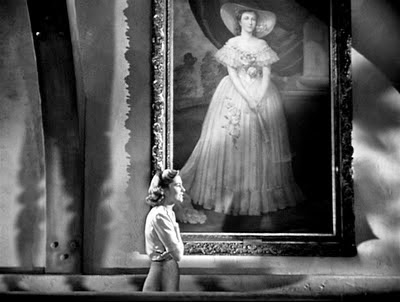
Trying to be the perfect wife, the young Mrs. de Winter convinces Maxim to hold a costume party, as he had done with Rebecca. The heroine wants to plan her own costume, but Mrs. Danvers suggests she copy the beautiful outfit in the ancestral portrait of Caroline de Winter. At the party, when the costume is revealed, Maxim is appalled; Rebecca wore the same outfit at the ball a year ago, shortly before her death.

The heroine confronts Danvers, who tells her she can never take Rebecca's place, and almost manages to convince her to jump to her death. An airborne flare reveals that a ship has hit the rocks. The heroine rushes outside, where she hears that during the rescue a sunken boat has been found with Rebecca's body in it.

Maxim admits to his new wife that he had earlier misidentified another body as Rebecca's, in order to conceal the truth. His first marriage, until now viewed by the world as ideal, was in fact a sham. At the very beginning of their marriage Rebecca had told Maxim she intended to continue the scandalous life she had previously lived. He hated her for this, but they agreed to an arrangement: in public she would pretend to be the perfect wife and hostess, and he would ignore Rebecca's promiscuity. However, Rebecca grew careless, including an ongoing affair with her "cousin" Jack Favell. One night, Rebecca told Maxim she was pregnant with Favell's child. During the ensuing heated argument she fell, hit her head and died. Maxim took the body out in her boat, which he then scuttled.

Shedding the remnants of her girlish innocence, Maxim's wife coaches her husband how to conceal the mode of Rebecca's death from the authorities. In the police investigation, deliberate damage to the boat points to suicide. However Favell shows Maxim a note from Rebecca which appears to prove she was not suicidal; Favell tries to blackmail Maxim. Maxim tells the police, and then falls under suspicion of murder. The investigation reveals Rebecca's secret visit to a London doctor (Leo G. Carroll), which Favell assumes was due to her illicit pregnancy. However, the police interview with the doctor establishes that Rebecca was not actually pregnant; the doctor had told her she was suffering from a late-stage cancer instead.

The coroner renders a finding of suicide. Only Frank Crawley (Maxim's best friend and manager of the estate), Maxim, and his wife know the full story: that Rebecca told Maxim she was pregnant with another man's child in order to try to goad him into killing her, an indirect means of suicide that would also have ensured her husband's ruination and possible execution.

As Maxim returns home from London to Manderley, he sees that the manor is on fire, set alight by the deranged Mrs. Danvers. The second Mrs. de Winter and the staff escape the blaze, but Danvers is killed when a floor collapses. Finally a silk nightdress case on Rebecca's bed, with a beautifully embroidered "R", is consumed by flames.

Here is the link to the full movie:  https://www.youtube.com/watch?v=7cf0-GsXDzI


Source: wikipedia