{ font: $(body.font); color: $(body.text.color); background: $(body.background); padding: opx; $(body.background.override) } expr:class='"loading" + data:blog.mobileClass'>
Showing posts with label Rutland. Show all posts

Friday, May 15, 2015

West Rutland Art Park

W.R.A.P.

If you are traveling through the Rutland area, or live in Rutland County, treat yourself to a very quick and unique experience.  Take the road to Middletown Springs in West Rutland, and about only a mile or two down the road on the right, you will see a white figure with bright overalls that are all the colors of the rainbow.  It sits upon the hillside watching the cars go by.  

Go ahead, take the right turn immediately after him or her, sitting on the hill, and check out this wonderful little park that was the inspiration of one woman, and the reality of artists from around the world!   Sometimes it's nice to take  a little culture break!

You can visit their website by clicking here. 
There are links to the artists websites, respectfully.  

 And here is a link to the blog, to learn more. 

"HOPE"
Artist: Ayla Turan  (Turkey) 

"VENUS"  
Vermont White Marble -
Artist: Filin Gheorgui (Italy)   

"Bridge of Winds"
Vermont White Marble
Artist: Nando Alvarez (Spain)  


 "DANCE"  Vermont White Marble
Artist:  Liliya Pobornikova, (Bulgaria) 


"Across Time and Space"
Vermont Found Steel
Artist:  Guohua Xu, (China)  
"OPEN DISK 5"
Painted Steel
Artist:  Xuxo (Spain)
"Spirit of the Green Mountains" (Vermont Verde Antique)
Artist: Jo Kley (Germany)


Friday, June 27, 2014

Green Mount Cemetery - Montpelier, Vermont

A few weeks ago, I wandered into this cemetery with the sole purpose of taking pictures of a few of the statues, other than John Kellogg's "Black Agnes".  What I didn't know was how incredibly peaceful this site is, and how many wonderful statues there are to behold!  Please forgive some of the photography, as it was a very hazy morning, and the rain had just stopped.  All in all, I am quite pleased with the results.

History

"The thirty-five acres on which the Green Mount Cemetery is located were bought in 1854. Of the purchase price of $2,210, $1,000 was donated by Calvin Keith, a Montpelier lawyer and $1,210 was put up by the town. In 1905, the Chapel-Vault building was erected from a generous bequest of John E. Hubbard. The Vault portion can hold up to 60 entombments and the chapel can accommodate 60 people for funeral services. Since this time, Green Mount Cemetery proudly exhibits many terraced lots, 2.5 miles of curved roads, and many pleasant shade trees and ornamental shrubs. There are many sculptured works which are memorials to the talents of our area's artisans both past and present."  Source:
http://www.montpelier-vt.org/page/279.html


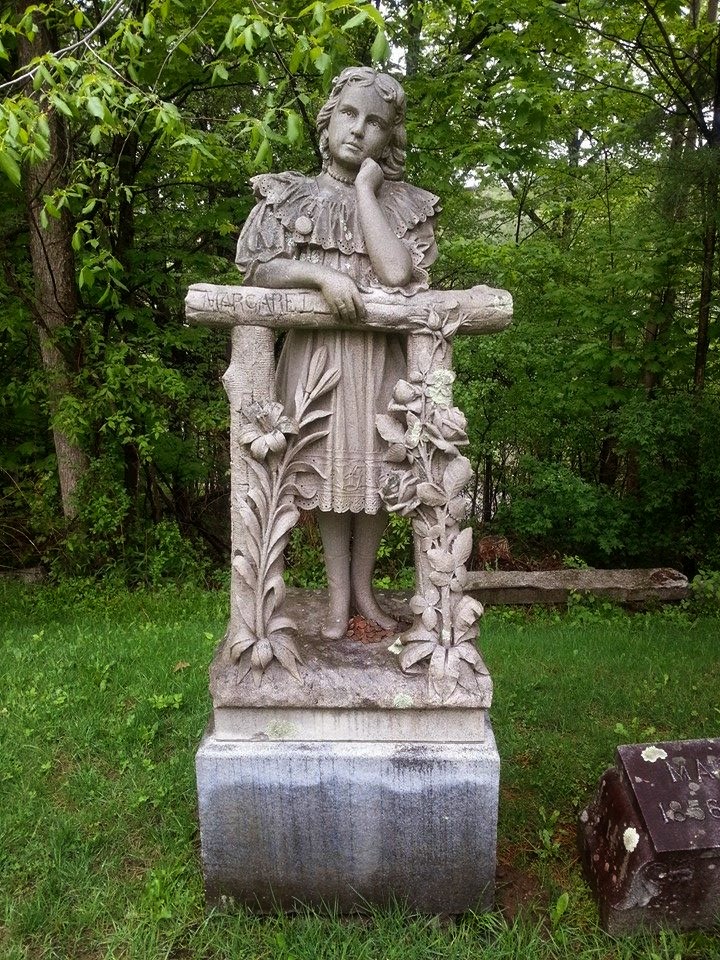
Below this lovely statue are hand-carved stairs (you can see them above the statue), which is an architectural site of interest in this location. 


This monument was originally carved with a wreath on top, though it is difficult to see it now, as the carving is now entombed in moss.


An amazing rendition of La Pieta


Saturday, January 4, 2014

FBI Mystery in Rutland Vermont 1934

UNSOLVED???  MYSTERY!!!

A friend of mine sent me this link on Facebook, and it was so well written, so very intriguing and interesting  that I am re-posting it, word for word from Urban Post Mortem.

If anyone has any information about this and would like to add to the mystery or help solve it, feel free to leave a comment! ~Denise

Strange visitors: Rutland’s Pine Hill Mystery

Saturday, April 21, 1934. Rutland, Vt. 14 year old Raymond Webster is walking around Rutland’s Pine Hill area when he finds a newspaper protruding oddly from the ground. But this is no an ordinary piece of litter — there was something strange about this find. Beneath the paper, the dirt seemed to be fresh, as if something were buried beneath it.

Curious, Webster returns later with a few friends. They manage to extract two boxes from a shallow hole, both wrapped in newspaper. But their wonder is short lived when, almost instantly, two strange men suddenly emerge from the nearby woods and walk towards them. Fearing for their lives, the boys drop the boxes and run.
The strange men call after them and order them to stop, but the boys kept running. Seconds later, they hear the sound of gunfire.
What Webster didn’t know at the time was his terrifying encounter wasn’t unique. Something odd was happening in Rutland in April 1934; other residents noticed it, too. They also began to notice a group of visitors who suddenly appeared in the community — a group whose seemingly strange behavior distressed whomever encountered them.

On April 26, 1934, the Rutland Herald ran this front page headline: “20 mystery sleuths upset Rutland’s calm.” The story revealed that the skulking intruders were FBI agents. Now, concerned residents all had one question on their minds: What was the FBI doing in Rutland?

The Herald and the local authorities weren’t talking — mostly because neither had any answers. The rumors began to spread. Kidnappings, extortion or illegal narcotics all seemed like plausible explanations.

But as details about the FBI’s presence slowly began to leak out, the situation took a turn for the bizarre. The Herald reported they were ordered to keep quiet about the FBI’s arrival until two days after the fact.

When the local police contacted FBI offices to inquire about it, they were told that the agents were only taking instructions from Washington, and any additional information was classified. Local police were then instructed to carry out any arrests the FBI agents called on them to make — without question.

Around the city

Rutland residents soon began to notice that the agents were focusing their investigations on the area of the city around the Rutland Country Club and Pine Hill. People began to speak eagerly of their sightings. Residents saw agents lurking around the country club, and another staking out the area with a pair of binoculars from atop a silo on Grove Street.

Others reported seeing agents using the barn at the Fitzgerald farm on Grove Street as some sort of base camp. Agents were seen entering the barn and exiting shortly after wearing different clothes.
According to some witnesses, agents would return at least four times a day to change their clothing and leave again. These clothing changes appeared to be part of some undercover operation where agents were disguising themselves as hobos, like those who frequented the local railroads and hitched free rides on from Rutland to Ludlow.

Over in Proctor a West Rutland resident recalled a bizarre encounter of his own, which was thought to be related to the mysterious activities in Rutland. One night, as he was hitchhiking on Route 3 in Proctor, he approached a car on the side of the road near a bridge. Concealed by bushes and the shadows of the night, the vehicle would have never been visible unless another car hadn’t driven past with its high beams on. When the lights illuminated the suspicious vehicle, he noted four men inside the car, waiting for something unknown.

What was going on here? Who or what were they looking for?

The interrogations

While paranoia spread throughout the community, the FBI began to seek out certain individuals for questioning. Among the first to be questioned was Webster, whose startling encounter near Pine Hill had piqued the Feds’ interest.

What was so important about those mysterious boxes buried near Pine Hill? Speculations abound. Soon, there was little distinction between fact and myth. One rumor held that federal agents were trying to catch an extortionist who had been told that there would be ransom money waiting for him at the country club — in the exact spot where Webster found those strange packages.

Another theory posited the agents were sent to Rutland to prevent a kidnapping. The alleged kidnappers were said to have used the Rutland Country Club as a drop site for the ransom money. With the Lindbergh kidnapping captivating the nation at the time, an extortion case in Rutland seemed easy to believe.

After Raymond, FBI agents brought in 28 other young men for questioning at the local federal building. Cloaked in secrecy, the Herald dubbed these interrogations the “Star Chamber Sessions.” The boys’ parents were prohibited from attending these meetings.
Soon, caddies from the Rutland Country Club and several more young men were also brought in for questioning. The interrogations weren’t random; the Feds were looking for someone.

Rumors began to circulate about these clandestine hearings. It was said that everyone who was brought in was fingerprinted and asked to produce a specific writing sample for the agents. The content of the sample was revealed on April 27 when the Herald printed the full text of the cryptic note on the front page. It read:

“If you were co-operate in giving your fingerprints and help us out, it will make the country safer for you and your family. If you meet us at Union Station in Albany on Thursday, Friday or Saturday of the last week in April, your troubles will be over and we will never trouble you again. On your arrival in Albany, you will receive $1,000 for your troubles.”

What did this odd message mean? Why were all who were brought in for questioning required to rewrite it? And what did the FBI intend to do with it?

On April 28, Rutland’s mystery gained national attention as out of state papers such as The New York Times began reporting the story, calling it “The Pine Hill Mystery.”

More puzzling events

Strange things kept happening, and everyone was speculating. Supposedly, a man approached a Rutland businessman and made him a suspicious offer. He offered him $40 for every $100 in $5 and $10 bills he circulated around the city. Naturally suspicious, the businessman went to alert the police, but before he could, the mystery man had disappeared.

Up the road in Forest Dale, a local man made another alarming discovery — this one far more sinister. Reports of explosives concealed in a mattress were found on the side of the road. According to police, they found two tin cans filled with a grayish powder inside. The amount of powder was enough to level a large city block.

Who left these explosives on a back road in Forest Dale? Were they forgotten, or were the mysterious owners planning on coming back for them? Most importantly, were they related to the FBI’s presence in the area?

The notes

Eventually, the FBI agreed to reveal that they were sent to Rutland to investigate mysterious notes that were sent to the Bureau. Though the Feds refused to release the name of the target, they did reveal the contents of the notes they received. All of them threatened death or kidnapping if the victim refused to pay the amount of money that was demanded. Every note was simply signed “The Gang.”

By this point, the Herald had determined that this was an extortion case and ruled out any other possibilities. But if that was the case, then who were the targets — and what did “The Gang” want?
Rumors continued to spread. People spoke of a few Proctor residents who had also received mysterious kidnapping notes. Soon, other so-called extortion letters were reportedly found. The authorities traced the letters to post offices in Fair Haven and Poultney. Federal agents now were spreading their investigations across Rutland County. Newspaper boys from across the county were also brought in for questioning, as the FBI worked to figure out whether the local newspapers were hiding some sort of coded message.

Meanwhile, in Brandon, George H. Young received a death threat instructing him to leave a specific amount of money at a chosen location at Neshobe Country Club. George contacted the police who sent him to the country club to place a dummy package in the designated spot. It was never picked up.

Later, the investigation uncovered an abandoned camp in the woods near a green at the Neshobe Country Club. This secluded woodside perch provided an excellent view of the clubhouse and surrounding area.

Apparently, when George Young dropped off the dummy package at the golf course, the extortionists were observing him the entire time. When they gathered that police were involved, they decided not to retrieve the package.

Among the many who allegedly received kidnapping notes was Redfield Proctor Jr., a well-known local figure, who was formerly a Vermont governor and owner of the Vermont Marble Company. But the Proctor family denied such accusations. A plot against Proctor would have made sense; the well-respected businessman was incredibly wealthy and had great influence. Nevertheless, the Proctors remained silent.

Rutlanders and a gaining population of curious followers across the country were baffled. People wanted answers. Despite the massive scale of the investigation, no information was turning up and no answers were being given — at least to the public.

Undeterred, the Herald continued to seek answers. The paper sent a telegram to the FBI offices in Washington demanding an explanation. The reply was, not surprisingly, vague and didn’t yield any new information.

Instead, the Bureau accused the Herald of exaggerating the story, and attempted to diminish the scope of the investigation by asserting they had only sent 12 agents as opposed to the actual 20 who were currently in the city. The Herald would later print the FBI’s reply.

And then there were none

Just as mysteriously as the mysterious occurrences in the spring of 1934 started, they seemed to stop. Though the FBI held Rutland in gripping tension for two months, the Herald never reported any arrests or any breaks in the case. By May, stories about “The Pine Hill Mystery” seemed to fade.

Then on May 25, four men were reported driving around the town of Proctor for several days in a car with New Hampshire plates. Witnesses also reported seeing a machine gun within the car. But the car and its occupants seemed to simply disappear — as did the federal agents.

After two intense months of shocking encounters and gripping newspaper headlines, the Herald stopped reporting on “The Pine Hill Mystery.”

Now, we are left to ask what happened. Why did the FBI come to Rutland? Was there actually an extortion case? If so, who was the target, and was it ever solved? Or was this a cover-up for something far more sinister?

Despite the case running cold, there is an interesting footnote to the story. Years later, former Herald editor Kendall Wild reached out to his high school classmate, Sam Willson, for some answers. Earl V.K. Willson, Sam’s father, was a successful Rutland businessman, who, at one time, lived with his family in the mansion at 1 Shadow Lane in Rutland.

According to Willson, his family was allegedly one of the targets of the extortionists. But his father never spoke a word of it. It was their mother who, decades later, finally told her children about it.
At time, Willson assumed his mother was making it all up until Wild contacted him. Amused, if not a little taken back, Willson was now able to recall some peculiar events from his childhood that suddenly took on another meaning to him. He remembered his parents buying a German shepherd for him, to keep him company. In hindsight, the dog was a likely protector more than companion.

His parents also hired a nanny for him and his younger brother so there would always be an adult supervising them.

But the strangest thing he recalled was the big black sedan that parked for a time at the top of Shadow Lane, blocking the rear entrance of their driveway. Willson now believes his parents kept silent about the case because they didn’t want to scare them.
To this day, no one seems to have any answers, and the FBI isn’t talking. Rutland author Mary Fregosi, who first investigated this strange tale for the Rutland Historical Society in 2007, attempted to contact the FBI for some answers. Their reply stated that their records on this case were destroyed in 1998, leaving this great mystery just that.

So were any arrests ever made? And did the FBI find what they were looking for among Rutland’s residential neighborhoods and manicured golf links? We’ll most likely never know, making this startling mystery an eternal reminder of man’s fight against evil.
(Information for this story was gathered in part from the Rutland Historical Society Quarterly Vol. 38, No. 2, 2008, by Mary Fregosi.)

Sunday, November 24, 2013

Maude Manning - My Great Grandmother (RE: Eddy Brothers, Chittenden, VT)

Today, I was searching my files for some notes that I had written down for this blog.  I never found the file, because I came across a file was marked *Eddy Family.  It was one of my father's files that I obtained when he passed away in late December of 2011.
 
* More on my family tree and interesting ancestors can be found at http://www.heatherbdesign.com/blog/2013/11/25/the-eddys-my-spooky-famous-ancestors
(Posted by my bright and beautiful cousin, Heather B)

The file contains photocopies of several magazine articles such as a January, 1987 Yankee Magazine article entitled "When the Spirit World Touched Chittenden", by Jay Stevens; a "Vermont Life" story entitled "Beyond Belief" by Joseph Citro, Autumn, 1999; a typed copy Genealogy of Manning and Eddy (the Hinckley-Manning connection to the Eddy's); a couple of Eddy obituaries and a transcribed interview of  Maude Eddy that was the subject of the Chittenden Historical Society Meeting on June 8, 1989.  

The transcribed interview was originally conducted by my father, Gerald Hinckley, with his grandmother, (my great-grandmother) Maude Eddy.  The topic was "The Eddy Brothers of Chittenden"


Genealogy:

Maude May Eddy was born on December 15, 1881 at Holden, Vermont.  She was the first born from her father's second wife.

Father:  Daniel Webster Eddy (born September 17, 1853 at Chittenden, Vermont, died September 5, 1925).  Daniel was a brother of William and Horatio Eddy. 

Married Eva J. Hausted at Ridge Mills, New York (she was the daughter of R. Rennsalaer and Sara Mills, born circa 1851).  They had one child, Warren Eddy, born April 13, 1876 at Chittenden, Vermont.  I do not have a record of Eva's death, even after searching "Find A Grave", it is still unknown.  This is quite sad.

Daniel Webster Eddy's second wife was Mary Josephine Rivers, born June 24, 1862 at Brandon, Vermont.  She died at "age 62 years, 5 months, 29 days.  She was the daughter of Julius and Mary (Baker) Rivers.

Daniel and Mary Josephine had 9 children together:

Maude May (my great-grandmother), Grace, Daniel, James Henry, George Willis, Warren F., Mabel Lizzie, Jessie, Stella, and adopted one boy, Homer Allen Statson Eddy.

Daniel Webster Eddy's Mother was the "Spirit Medium" *Jula Ann McCombs.  His father was Zephaniah Eddy.  They had 11 children: *William H. Eddy, John Westley Eddy, Francis Lightfoot Eddy, Maranda D, Eddy, *Sophia Jane Eddy, *Horatio G. Eddy, Mary C. Eddy, James H Eddy, Delia M Eddy, Daniel Webster Eddy, Alice Julia Eddy.

* Spirit Mediums

Horatio and William Eddy

          AMERICAN FARMER mediums of Chittenden, a small hamlet near Rutland, Vermont. In 1874 the New York Daily Graphic assigned Col. Henry Olcott to investigate the rumours of strange happenings in their house. After ten weeks in the Vermont home Col. Olcott, who had had no psychic experience before, came away with a dislike of his gruff hosts and a remarkable story which he told in 15 articles. These articles were later published in book form under the title People from the Other World. To it and to Mrs. M. D. Shindler's book, A Southerner Among the Spirits, Memphis, 1877, we owe most of our knowledge of the Eddy Brothers.
William and Horatio Eddy
The family tree, according to Col. Olcott, showed psychic powers for generations back. In 1692, in Salem, their grandmother four times removed was sentenced to the pyre as a witch. In Horatio and William the psychic "taint" made its appearance in infancy. A fanatic father tried to suppress it with the utmost cruelty. He employed means of torture to break their trance, poured boiling water over them or placed red hot coal on their heads. When the children grew older the father realised the money-making possibilities in their strange gift and hired them out as mediums.

As an eloquent evidence of the treatment they received at the hands of ignorant investigators Col. Olcott saw grooves of ligatures, scars of hot scaling wax and marks of handcuffs on their limbs. They exhibited every phenomenon of physical mediumship from raps to perfect materialisation. Col. Olcott saw in ten weeks' time about four hundred apparitions of all sizes, sexes and races issue from their cabinet. The chief apparition was a giant Indian named Santum and an Indian woman by the name of Honto.


Col. Olcott
Olcott had every facility for investigation, measured the height and weight of the apparitions, roamed freely about and became quite satisfied that the explanation of impersonation was insufficient. He found that the production of materialised forms was William Eddy's strong feature. Horatio Eddy usually sat before a cloth screen, not a cabinet, and, contrary to his brother, was always in sight. Musical instruments were played behind the screen and phantom hands showed themselves over the edge. If the same séance was held in darkness the phenomena became very powerful. Mad Indian dances shook the floor and the room resounded with yells and whoops. "As an exhibition of pure brute force," he wrote, "this Indian dance is probably unsurpassed in the annals of such manifestation." Nevertheless, Col. Olcott was very careful and hesitative in drawing his final conclusions.


Frank Podmore in Modern Spiritualism characterises Col. Olcott's account as an imaginative history and quotes in confirmation C. C. Massey's account of a fortnight stay with the Eddy Brothers which thus describes the nightly apparition of a deceased relative of someone present:
"A dusky young man would look out and we had to say in turn, all round the circle 'Is it for me?' When the right person was reached three taps would be given and the fortunate possessor of the ghost would gaze doubtfully, upon which the ghost would look grieved, and that generally softened the heart of the observer, and brought about a recognition in the remark 'Lor, so you be.' And that sort of thing went on night after night at the Eddy's."
By Col. Olcott's later adventures in theosophy some colour is lent to the charge of gullibility. Nevertheless, it is impossible to read his evidently sincere account without gaining the conviction that the Eddy Brothers possessed the gift of true and powerful mediumship. Source: http://survivalafterdeath.info/mediums/eddy.htm 


Following is the interview that my Dad did with his grandmother, regarding the "Eddy Brothers" in 1969.  I never knew that William Eddy lived in my grandmothers house, until I read this!  

 The pictures are jpgs - I hope to upload an Adobe file, in the near future.   Please forgive the mess!


UPDATE.... The forces are still with us....

5 Generation picture:  L-R:  Top Gertrude (Manning) Hinckley, Gertrude's son (my uncle) Burt Hinckley
L-R:  Janet (Hinckley) Tonneson (my Uncle Burt's daughter);  Maude May (Eddy) Manning (My great-grandmother)
Baby:  Heather Tonneson

Strangely, I went into my Facebook account to obtain the above picture for this blog, and my cousin Heather had been doing her own research - on the Eddy's.  Here is her post:

  • Conversation started today
  • Heather Boissonneau
    Heather Boissonneau

    Hello Hinckley Clan,
    I've been spending entirely too much time on Ancestry.com and I've discovered a couple of interesting things that I thought I'd share (that you might already know).
    1. We are descended from Governor Thomas Hinckley who was the Governor of the Plymouth Colony.
    2. Our ten or eleven greats grandmother was Anne Hutchinson, who was banished from the Massachusetts Bay Colony for holding seances. She went to Rhode Island and then to New York where she was killed by Indians. You can google her. Her maiden name was Marbury.
    3. You probably know this, but Grandma Manning's father, Daniel Webster Eddy, was the brother of William and Horatio Eddy, the world famous spiritists located in Chittenden, Vermont. The book "People from the Other World" by Henry Steel Olcott is available on google books for free. http://books.google.com/books/about/People_from_the_Other_World.html?id=ruzy2w1ba0kC
    4. William, Horatio, and Daniel Webster Eddy's father, Zephaniah Eddy's parents, James Eddy and Mary Salisbury are cousins, they share a great, great, great grandmother, Susannah Cotton. So that's one place where our family tree meets.
    5. Zephaniah Eddy and Mary Salisbury are the branch of the family that has Anne Hutchinson.
    If I find out other interesting things, I'll let you know.
-