{ font: $(body.font); color: $(body.text.color); background: $(body.background); padding: opx; $(body.background.override) } expr:class='"loading" + data:blog.mobileClass'>
Showing posts with label Vampires. Show all posts

Saturday, June 11, 2016

Vampire Defense


“Evil is a point of view. We are immortal. And what we have before us are the rich feasts that conscience cannot appreciate and mortal men cannot know without regret. God kills, and so shall we; indiscriminately He takes the richest and the poorest, and so shall we; for no creatures under God are as we are, none so like Him as ourselves, dark angels not confined to the stinking limits of hell but wandering His earth and all its kingdoms.”  ― Anne Rice, Interview with the Vampire


The vampire is a loathsome creature, who appears in human form, and is sustained by drinking the blood (also known as "feeding") from living beings, like you and I.   Naturally, we want to defend ourselves from an immortal existence and there are many ways in which we can employ self-protection.


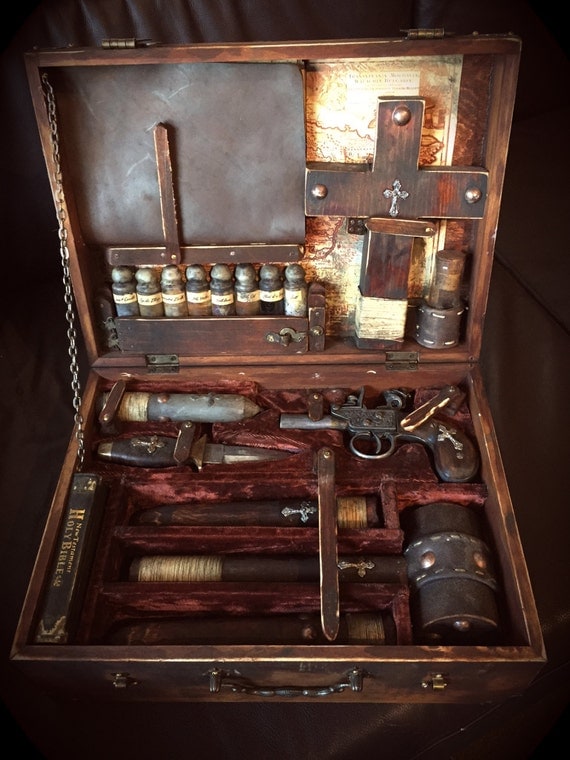
Today, one can easily find, online at auction or generally for sale, "Vampire Hunter Kits" - also known as - "Vampire Defense Kits".  Some kits may be vintage, but are not actually an authentic tool used during the height of this superstition.   These kits are most likely made in the 1930's or perhaps even later and were made to look older than they actually are.   These kits can even be "made to order", today.  Speculation is that they were produced after the publication of Bram Stoker's "Dracula" in 1897, and were more likely intended as souvenirs or novelties.    Buyer, Beware!


If the contents were indeed real, here are the many ways in which you may use to defend yourself against the un-dead. There are also many superstitions that may grant you some form of protection against these evil beings.  

"Apotropaics" or apotropaic magic are a means in which one may defend against evil or harm, and may deflect misfortune.  If you have a lucky charm, or sprinkle salt over your shoulder, or hang a horseshoe over your door, you are practicing this type of magic!  Common items, such as garlic or holy water that are supposedly used to ward off those who returned from the dead and are common in vampire folklore. 


Branch of a wild rose - may harm or ward off a vampire


Candles

Used for ceremonies like exorcisms, prayers, and seeing in the dark.


Crossbow and Bolts

Crossbows were useful when employed for range.  The tip of the bolt may be dipped in silver, however, silver is not effective means to ward off the vampire. 


Crucifix

A symbol of Christ, it was commonly held facing toward the vampire, who balked in its presence. Sometimes, it was attached to a chain from which the slayer could rapidly pull it out.  The crucifix was often made of silver.   This tool is one of the most important manners in which one can repel a vampire, and if it touches the skin of the undead, it will burn them similar to an acid.


Decapitation / Dismemberment

One of the easiest methods to kill a vampire is to simply lob off its head, and then to burn it along with the remaining body (which should also be dismembered). See "Fire". Decapitation was also the means in which one could expedite the departure of one's soul. 


Entry

It is common knowledge that a vampire will not enter your home, unless you invite him/her.  Once the invitation is extended, however, they may enter or leave at will. 


Eucharist 

Holy wafers are used to place over the lips of the dead, as a form of protection against vampirism; or, may be placed around the grave as a circle of protection so that the undead may not enter. 


Fire

The method of burning a vampire is used in conjunction with the decapitation and dismemberment method.  After the body is in pieces, the remaining parts must be thoroughly burned. 



Garlic

Garlic has been used in defense against vampirism, as they notoriously despise this herb and repel against it.  Consequently, garlic was placed into a deceased person's mouth to prevent a vampire from feeding upon the victim.


Graveyard

A vampire will not be able to use his power on consecrated grounds such as a church yard or a cemetery.  You will be safe to retreat to these places.


Hammer

Some hammers were fashioned with a crucifix styled into the head. Its size was approximately six to seven inches long, and was what is used to drive a stake into the body of the vampire.


Holy Water

This was used to sprinkle on the vampire for both protection of the hunter, the surrounding area in which they occupied, or used directly on the vampire to harm it.


Incense

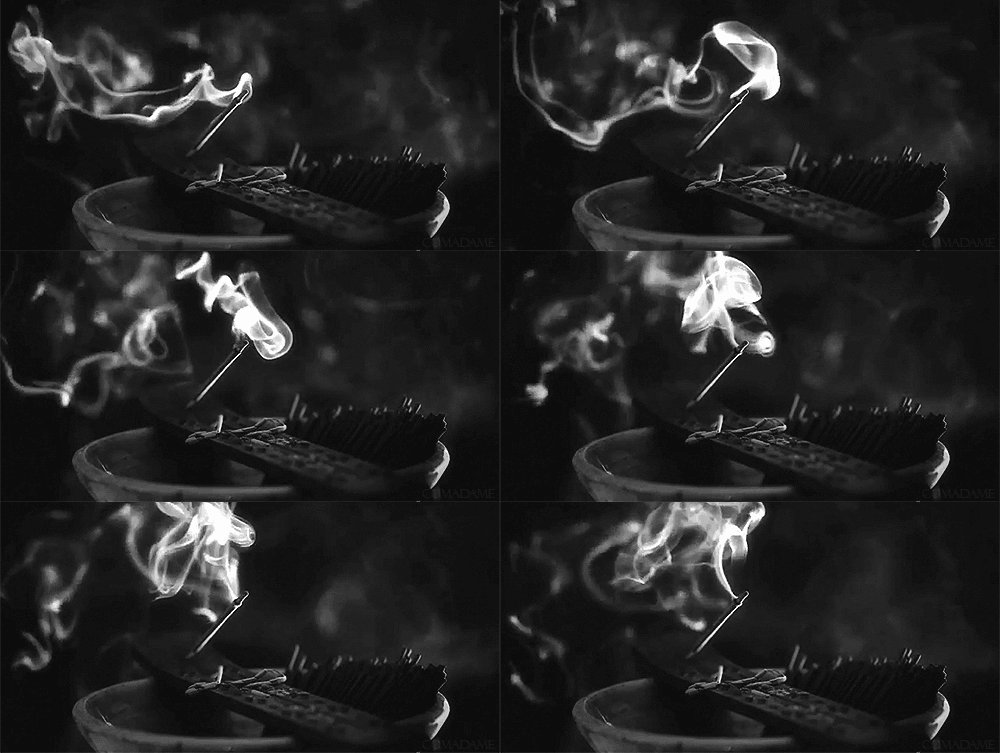
The pungent odor arising from this may have been used ceremoniously, whether it be used for protection or to ward off the evil spirit which lay in the vampire’s body.


Knives and Daggers

Some were used for throwing while others were specifically used for close combat.


Lemon

In Saxon regions of Germany, a lemon was placed in the mouth of suspected vampires.


Metal Teeth Pliers

Nothing more than a common tool, these were used to remove the long teeth or fangs of vampires.  


Mirrors

Mirrors are used to ward off vampires when placed facing outwards, on a door.  You can also verify if the individual is indeed a vampire, as they do not have a reflection, or they may not cast a shadow which helps to substantiate their lack of having a soul.    


Mustard Seed

Sprinkled over the roof of one's home will protect you against these intruders.


Oils and Ointments

Commonly used as repellents, any consecrated oil or ointment can be used to place directly on oneself or an object


Prayer Book or Bible

Holy verses, quotes or readings may be used for performing exorcisms.


Pistols

Everyone knows that bullets do NOT kill vampires.  Bullets - exclusively silver bullets - are used to kill werewolves, never vampires.
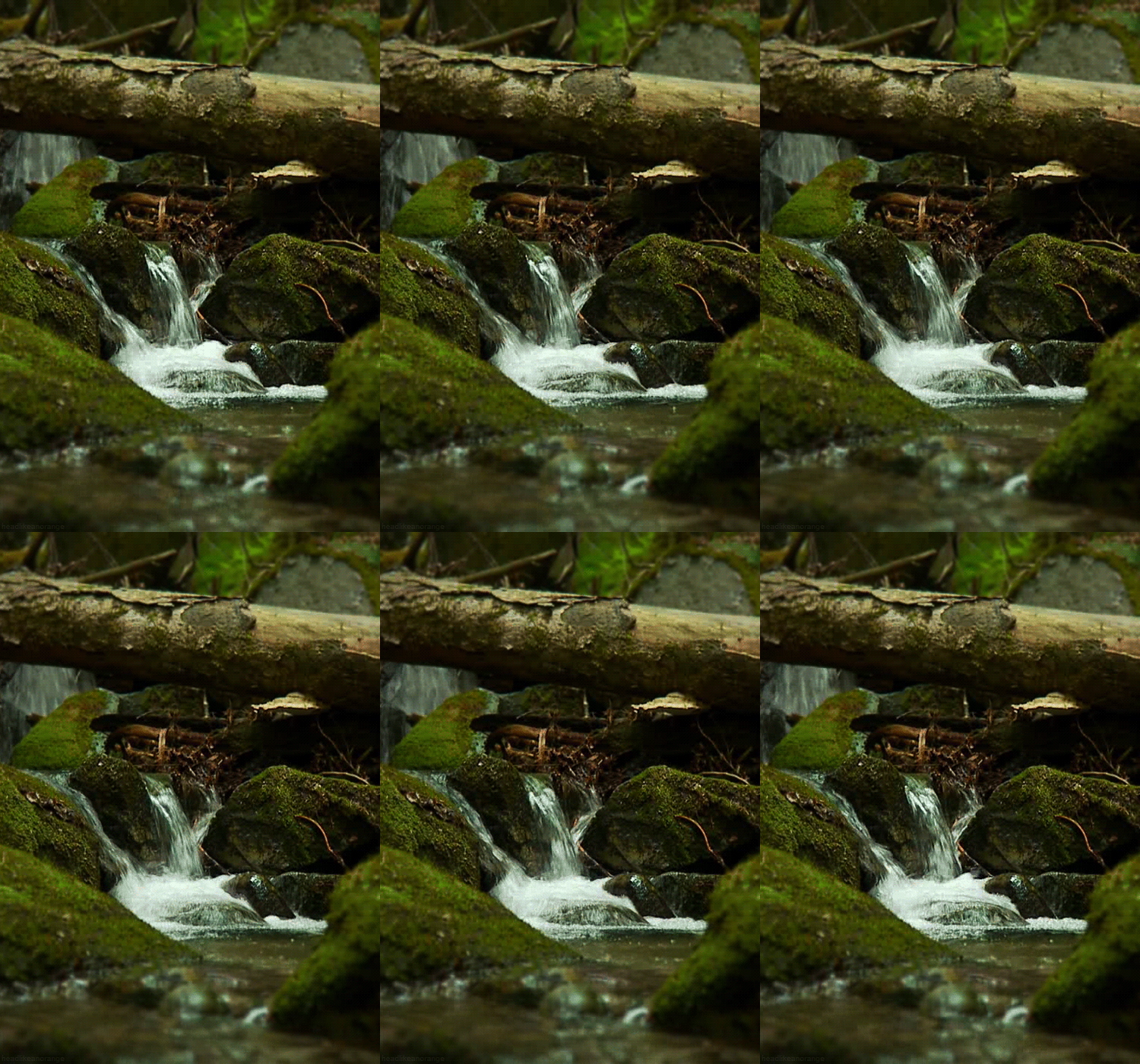


Running Water

Such as a brook or stream - vampires will not cross either.  I would caution you, however, to not rely on this as a means of defense, as a vampire can not only change forms, such as transforming into a bat or wolf, I would suggest that there is no reason why he would not leap over running water, if his thirst was great; or perhaps, his anger, high.


Stakes

Stakes were driven into the hearts of the vampires by use of the hammer.  A suspected vampire's grave could be unearthed and a stake would be driven through the corpse, to pin it to the ground. Holy water, Eucharists, and/or oils or ointments could be administered directly onto its body to prevent it from reanimating and could be either driven through the mouth, the heart or the stomach depending upon from what region the superstition came.  Popular choices of wood to make stakes were Ash, Hawthorne or Oak.



Sunlight

One of the most vulnerable aspects of a vampire is to expose them to sunlight, which may disintegrate them, instantly.  This is why they are only active at night.


Here is my shadow... from the streets of Chicago...


...and, here I am, also in Chicago, - and my reflection is real.  Whew!  Glad we got that nasty piece of business out of the way!

Saturday, November 1, 2014

The Mortsafe

The moon slowly rises over a dark grove of pine trees.  Icy wind lashes the snow covered earth, across the skeletal arms of dead weeds and brush.


The Great Hand of the Sky splashed plumes of grey clouds winged with the luminescence of moonlight across a canopy of boundless azure sky. 


From the outside looking into the candlelit room, a family gathers solemnly around a weak and fragile young maiden who lies dying in her the great mahogany bed.  Her fever has piqued, leaving soaked sheets of white cotton, beneath an intricately embroidered silk coverlet. Logs snap and crackle in the hearth.  A somber Priest is at the foot of the bed, administering Last Rites, as Mother deeply weeps into a handkerchief.  


The young woman's heart slowly begins to wane into a faint beat and inevitably stops as she succumbs to death. 


At the moment of death, clocks will be stopped clocks to mark the moment, and mirrors are veiled in black lace or fabric, to prevent the dead's spirit from being trapped in its reflective glass. 


A wreath tied with black ribbon is hung on the outside of the front door of the home, so the public may know that a death has occurred. The wake had begun. 

This was a typical scene from the 1700's; 1800's and even into the early 1900's.  


The word wake is quite literal, when it comes the pre-Victorian, and Victorian time of death, as the body was watched over, with someone in constant attendance until the burial of the body.  During this time, the body was displayed usually in a parlor or a room of the deceased home where it is easily accessible to the public so that those wishing to pay their respects, could do so, easily.  This was also to allow time for relatives and friends to travel.  


Loved ones would sit with the body in shifts around the clock, so that the body was never left alone. The reason for this was to prevent premature burial, to ensure that the person was indeed dead, and not in a coma, as the fear of being buried alive was very much a real and intense fear. The technical term for this fear is called taphophobia. 


Before embalming became common practice, a body could begin to decay and obviously the odor was unpleasant.  


Flowers and candles were abundantly displayed to help mask the smell of a rotting corpse. 


Though the fear of being buried alive may seem far fetched, or from something of a horror flick, taphophobia is not without it's reality. -Denise Goodwin 

"Because I could not stop for Death
He kindly stopped for me
The Carriage held but just Ourselves
And Immortality" ~Emily Dickinson


"In 1905, the English reformer William Tebb collected accounts of premature burial. He found 219 cases of near live burial, 149 actual live burials, 10 cases of live dissection and 2 cases of awakening while being embalmed." -wiki


  • "The Victorian novelist and politician Edward Bulwer-Lytton asked for his heart to be punctured before he was buried, to make sure he was truly dead. 
  • The Danish author and poet Hans Christian Andersen was so frightened of premature burial that he often slept with a sign on him that read: "I am not really dead." 
  • George Washington requested that his body be watched for two days after his apparent demise. 
  • When the Duke of Wellington died in 1858, the three days Washington demanded wasn't nearly enough to satisfy the Victorians fear of premature burial. The Duke was left above ground for a full two months, just to be sure. 
  • Just before he died, Frederic Chopin supposedly wrote a note saying: “The earth is suffocating. Swear to make them cut me open, so I won’t be buried alive.” -atlasobscura.com


Arising from this hysteria was the concept of people becoming a Vampire after death. I imagine that this was most likely born from the morbid fear of being buried alive; and certainly heightened with the publication  of Bram Stoker's Dracula, later in the century. 


There is false information buzzing around the Internet which indicates that cages were devised to prevent the undead or vampires from escaping the grave, should they come back to life to suck the blood - and life - from humans.


The actual reason why these cages were constructed and erected over graves was because there was a demand for cadavers by medical schools, for the purpose of dissection by students.  Apparently eager to study anatomy.  Apparently text books didn't cut the proverbial mustard, and fresh bodies were the preferred method of learning.

Below:  Surviving examples of caged graves, known as the Mortsafe:


"Mortsafes were contraptions designed to protect graves from disturbance. The mortsafe was invented in about 1816. These were iron or iron-and-stone devices of great weight, in many different designs. Often they were complex heavy iron contraptions of rods and plates, padlocked together - examples have been found close to all Scottish medical schools. 

A plate was placed over the coffin and rods with heads were pushed through holes in it. These rods were kept in place by locking a second plate over the first to form extremely heavy protection. It would be removed by two people with keys. They were placed over the coffins for about six weeks, then removed for further use when the body inside was sufficiently decayed. 


"Resurrectionists" (the name used to describe the student grave-robbers) had supplied the schools of anatomy in Scotland since the early 18th century. This was due to the necessity for medical students to learn anatomy by attending dissections of human subjects, which was frustrated by the very limited allowance of dead bodies - for example the corpses of executed criminals - granted by the government, which controlled the supply.


The authorities turned a blind eye to the grave-rifling because surgeons and students were working to advance medical knowledge. They kept publicity to a minimum to prevent people from realizing what was happening. The cases of grave-robbing that came to light caused riots, damage to property and even fatal attacks. 


In the early 19th century, with the great increase in numbers of schools and students, there was continual rifling of lonely graveyards, fights in city burial grounds and other disturbances. Men were employed to steal bodies and transport them from place to place, even across the sea, for sale to medical schools. Revelations led to public outrage, particularly in Scotland, where there was great reverence for the dead.


Precautions

Many people were determined to protect the graves of newly deceased friends and relatives. The rich could afford heavy table tombstones, vaults, mausolea and iron cages around graves. The poor began to place flowers and pebbles on graves to detect disturbances. They dug heather and branches into the soil to make disinterment more difficult. Large stones, often coffin-shaped, sometimes the gift of a wealthy man to the parish, were placed over new graves. 


Friends and relatives took turns or hired men to watch graves through the hours of darkness. Watch-houses were sometimes erected to shelter the watchers. One watch-house in Edinburgh is a three-story castellated building with windows. Watching societies were often formed in towns, one in Glasgow having 2,000 members. Many Kirk session houses were used by watchers. But graves were still violated.


Publicity surrounding the crimes of Burke and Hare heightened the fear felt by many people. It was about this time that vaults - repositories for dead bodies - were built by public subscription in Scotland, with their use governed by rules and regulations. Some of these were above ground while others - mainly in Aberdeenshire - were wholly or partly underground. In one village, Udny Green, in Aberdeenshire there is a unique morthouse, a circular building with a thick studded wooden door and an inner iron door. Inside there is turntable to accommodate seven coffins. A coffin would be moved round as further ones were added and by the time it reappeared the body would be of no use to the dissectionists.


Udny


Probably all communities near the Scottish schools of medicine in Edinburgh, Glasgow and Aberdeen employed some means of protecting the dead. Some used both mortsafes and watching. There are watch-houses in the remoter Scottish areas, in the Borders, and two have been found in the English county of Northumberland. There is no evidence of their use in other parts of the United Kingdom.


"The gun,  dates to 1710, is mounted on a mechanism that allows it to spin freely. Cemetery keepers set up the flintlock weapon at the foot of a grave, with three tripwires strung in an arc around its position. A prospective grave-robber, stumbling over the tripwire in the dark, would trigger the weapon—much to his own misfortune". -Tumbler


A coffin collar was used to prevent grave robbers from stealing corpses. It was fixed round the neck of a corpse and bolted to the bottom of a coffin. This picture shows the back of a collar from Kingskettle in Fife. The collar dates from around 1820.  The iron collar is fixed to a piece of wood.   -National Museum of Scotland


Above, patented designs to prevent grave robbing.