{ font: $(body.font); color: $(body.text.color); background: $(body.background); padding: opx; $(body.background.override) } expr:class='"loading" + data:blog.mobileClass'>
Showing posts with label Glastenbury. Show all posts

Tuesday, November 12, 2013

I Will Get There, Some Day!

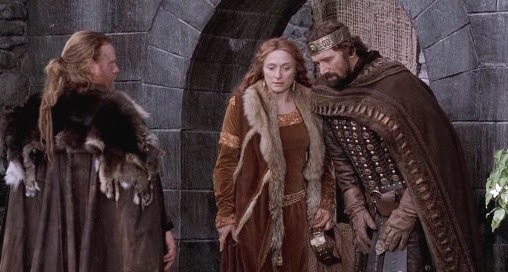
Cast from the movie, "The Mists of Avalon" 
Years ago, I read the book The Mists of Avalon, which forever changed my life!  The story is told from Morgan Le Fey's point of view, and it deliciously weaves (historical and fantasy) layers and decades of deception, love triangles, war, all with the underlying battle between Druid and Christian.  


There are few places on earth that can stir my imagination and my fairy-tale, romantic notions more than Tintagel Castle.   Set on the rugged coast of North Cornwall, England, Tintagel is steeped in mystery and legend; with a history dating back to the Roman occupation of England.  


The castle is reported to be the site of the conception of King Arthur; and below the castle lies the great magician's cave of Merlin, which can be accessible at low tide.


TINTAGEL CASTLE HISTORY

"Even before Richard, Earl of Cornwall, built his castle, Tintagel had come to be associated with the conception of King Arthur. 


During the summer months, a story-teller is often on hand to bring the legends of King Arthur, Guinevere and Lancelot to life. In the bleak mid-winter, Tintagel is a place that inspires the imagination of writers and poets. It's a place of dreams, romance and legend.


In June 1998, excavations were undertaken under the direction of Professor Chris Morris of the University of Glasgow, on a relatively sheltered and small site on the eastern side of the island, first excavated in the 1930s. 


Pottery from the 5th and 6th centuries was found, as well as some fine glass fragments believed to be from 6th- or 7th-century Málaga. 


Even more remarkable was a 1,500-year-old piece of slate on which remain two Latin inscriptions. The second inscription reads: ‘Artognou, father of a descendant of Coll, has had [this] made.’ Who exactly Artognou was continues to be a subject for lively speculation." 


Tintagel Castle is set on a dramatic and picturesque headland that is virtually an island, connected to the mainland by a slim finger of land. Over the centuries much of Tintagel castle has fallen into the sea and very little remains today."

TINTAGEL

"Tintagel Castle is famous for its association with the legend of King Arthur, who was said to be born on Tintagel Island where the remains of the 13th century Castle stand today.


With its spectacular location on one of England's most dramatic coastlines, It is an awe-inspiring place to visit and soak up the atmosphere generated by the dramatic views and wonderful legends.

Below the castle on the Castle Beach is Merlin’s cave which is accessible at low tide.

Merlin's Cave
The coastline around Tintagel is significant because it is composed of old Devonian slate; about a mile southwards from Tintagel towards Treknow the coastline was quarried extensively for this hard-wearing roofing surface.

The turquoise green water around this coast is caused by the slate/sand around Tintagel which contains elements of copper: strong sunlight turns the water a light turquoise green color in warm weather.

The Castle was built by Reginald, Earl of Cornwall on Tintagel Head, where according to Cornish legends the ancient Kings of Cornwall held their court. Tintagel castle was built for propaganda purposes and had no real strategic value.

Stained glass window in St Mary's Church, Wales,
containing the image of Geoffrey of Monmouth.
It was claimed by Geoffrey of Monmouth in the 12th century that the castle at Tintagel Head was where King Uther Pendragon seduced Queen Igraine of Cornwall, while her husband, Gorlois, was under siege elsewhere. King Arthur was thus conceived and later writers made the castle his birthplace."

King Uther, Lady Igraine and Corlois

TINTAGEL CASTLE - CORNWALL

"Tintagel Castle stands on windswept cliffs in North Cornwall on one of England’s most dramatic coastlines. The Castle is believed to be the birthplace of King Arthur who, as legend has it, was protected from the evil magician Merlin by his magical sword, Excalibur. 


Tintagel Castle is an awe-inspiring place to visit and soak up the atmosphere generated by the dramatic views and wonderful legends. Today, the remains of Tintagel castle stand on rugged cliffs high above the sea.


Many claim that Tintagel is one of the most romantic places in the UK, with beautiful walks along the Cornish Coast."  Source: http://www.tintagelcastle.co.uk/

Friday, September 27, 2013

TOWN SPOTLIGHT: GLASTENBURY ~ Ghost Town

The "ghost town" of Glastenbury and Glastenbury Mountain lies in the center of what is known as the "Bennington Triangle"  in Southern Vermont, which is surrounded by Bennington, Shaftsbury, Somerset and Woodford.  What exactly makes up the mysterious Bennington Triangle is not all together clear, but the area obtained it's name because many people have disappeared over the years; most, never to be heard from again!

Glastonbury, chartered in 1761 and founded by New Hampshire Governor, Benning Wentworth.  Though several families attempted to live in this region, they did not stay for long.  Nearly a century later, by 1872, the town's lumber resource was discovered and a railroad was constructed into Glastenbury Mountain.  Many transient workers settled in the surrounding region to tap this natural resource for logging.   Apparently, dozens of kilns were built as the town began to produce charcoal (converting it's lumber into charcoal, which "fed" the iron industry in nearby towns).

"By the late 1880s, however, the mountain had been cleared of nearly all of its mature trees, and the town’s economy dipped dramatically. In 1889 the railroad operation ceased. It was revived briefly in 1894 as an electric passenger trolley run by the Bennington & Woodford Railroad and a brief and initially promising effort was made to convert South Glastenbury to a tourist attraction. A small fortune was spent to convert the area into a mountain resort area which opened in the summer of 1898. Unfortunately, a "freshet" wiped out the railroad tracks that winter, marking the beginning of the end of Glastenbury as a functioning town. Population dwindled in the early twentieth century, down to only seven in 1937, when the legislature unincorporated the town." - Wikipedia


..."Stories of strange happenings had been told about Glastenbury and the surrounding area for many years prior to the disappearances in the 1940s, the best-known of which is probably that of Paula Jean Welden.

Between 1945 and 1950 five people disappeared in the Bennington area. The first occurred on November 12, 1945 when 74-year-old Middie Rivers disappeared while out hunting. Rivers was guiding a group of four hunters up the mountains. On the way back Rivers got ahead of the rest of the group and was never seen again. An extensive search was conducted and the only evidence found was a single rifle shell that was found in a stream. The speculation was that Rivers had leaned over and the shell had dropped out of his pocket into the water. The disappearance had occurred in the Long Trail Road area and U.S. Route 9. Rivers was an experienced hunter and fisherman and was familiar with the local area.


Paula Welden, 18, disappeared about a year later on December 1, 1946. Welden was an a sophomore at Bennington College. She had set out for a hike on the Long Trail. Many saw her go, including Ernest Whitman, a Bennington Banner employee who gave her directions. She was alleged to have been seen on the trail itself by an elderly couple who were about a 100 yards (91 m) behind her. According to them, she turned a corner in the trail, and when they reached the same corner, she had disappeared.  When Welden never returned to her college an extensive search was conducted which included the posting of a $5,000 reward and help from the FBI, however, no evidence of her was ever found. Unconfirmed rumors speculated that she had moved to Canada with a boyfriend or that she become a recluse living in the mountains.


The third occurrence took place when a veteran James E. Tedford (also spelled as Teford or Tetford) disappeared on December 1, 1949, exactly three years after Paula Welden had disappeared. Tedford was a resident of the Bennington Soldiers' Home. He had been in St. Albans visiting relatives. He was returning home on the local bus when he vanished. According to witnesses, Tedford got on the bus and was still on the bus at the last stop before arriving in Bennington. Somewhere between the last stop and Bennington, Tedford vanished. His belongings were still in the luggage rack and an open bus timetable was on his vacant seat.


The fourth person to vanish was eight-year-old Paul Jepson. On October 12, 1950, Jepson had accompanied his mother in a truck. She left her son unattended while she fed some pigs. His mother was gone for about an hour. When she returned her son was nowhere in sight. Search parties were formed to look for the child. Nothing was ever found, though Jepson was wearing a bright red jacket that should have made him more visible.  According to one story, bloodhounds tracked the boy to a local highway, where, according to local legend, four years earlier Paula Welden had disappeared.


The fifth and last disappearance occurred sixteen days after Jepson had vanished. On October 28, 1950, Freida Langer, 53, and her cousin Herbert Elsner left their family campsite near the Somerset Reservoir to go on a hike. During the hike Langer slipped and fell into stream. She told Elsner if he would wait, she would go back to the campsite, change clothes and catch up to him. When she did not return, Elsner made his way back to the campsite and found Langer had not returned and that nobody had seen her since they had left. Over the next two weeks a total of five searches were conducted involving aircraft, helicopters and up to 300 searchers. No trace of the woman was found then. On May 12, 1951, her body was found near Somerset Reservoir, in an area that had been extensively searched seven months previously. Because of the long time the body had been exposed to the elements, no cause of death could be determined.

Langer was last person to disappear and the only one whose body was found. No direct connections have been identified that tie these cases together – other than general geographic area and time period." - Wikipedia