{ font: $(body.font); color: $(body.text.color); background: $(body.background); padding: opx; $(body.background.override) } expr:class='"loading" + data:blog.mobileClass'>
Showing posts with label Eras. Show all posts

Sunday, March 13, 2016

Hello, Beautiful Doll

A boudoir is a woman's private sitting room, sometimes referred to as a  salon.   The word is derived from the French verb bouder to sulk, and the room was originally designated as a place to which a woman could sulk or withdraw.  It can also refer to a woman's private dressing room or bedroom.  The word boudoir is somewhat archaic, and can have a negative connotation, as its inference today is frequently associated with photography of scantily clad women in suggestive poses intended to be romantic and most definitely to capture the most flattering aspect of an individual.  


vintage dressing table be vintage style flowers, pinks creams white , vanity table:


Historically, the boudoir was a room designated from a private suite of rooms of a "Lady" or one who held an upper social class.  It was used for bathing and dressing and was located next to the bedchamber.  


Capital ‘V’ Vintage, A Bias LBD & A 2yr Blogoversary! | SewVeraVenus:
Dinner at Eight:
Jean Harlow in her dressing room
During the Victorian era and early in the 20th century, more elaborate homes designated the boudoir as an evening sitting room for activities such as sewing or embroidery, or accepting gentleman callers.  

The more elaborate homes with social prestige would include a boudoir as a separate room, as she would also have a morning room, and a dressing room. 

Actress Alice White in lingerie, 1920s.:


The Boudoir Doll Craze

During the mid 1920's, commonly called the "Jazz Age", the U.S and European and American women were preoccupied with dolls, and this time of collecting, has been referred to as the "Doll Craze".   Boudoir dolls, also known as "Poupee" dolls were a "must have" for every fashionable woman.  These dolls were a decorative accessory to their dressing room and not to be used as a toy.


According to "The Jazz Age Club", The Poupee dolls ranged in size, any where from 14" to 32".   The website "Jazz Age Club" writes, "Generically the dolls were called by various names that to some extent still endure today : art, portrait, boudoir, art deco, flapper, vamp, bed, smoker, salon or parlor dolls. These new dolls were different to what had been produced before as they were characterized by ornate, long limbs. long thin bodies, little hands and less ‘doll’ like, or ‘child’ like features or expressions; they had a stylized rather than a realistic appearance."


"The dolls varied in size from 24″ – 32″ with smaller dolls averaging 14″ – 18″ and were made out of a variety of media. The heads were usually of composition (sawdust mixed with a staying agent such as sugar water or starch placed in a mould) or of cloth or felt and some hands, feet and bodies were of composition too. Most of the bodies were soft of cloth or felt and stuffed with cotton. The composition heads were beautifully painted with blush and eye shadow, ‘bee stung’ red lips and even beauty marks. Hair was human, camel, mohair or silk strands."  - Source: thejazzageclub.com


"There were hundreds of different styles and treatments that followed exotic, historical, theatrical, foreign, fantasy or mythological themes. More popular inspiration came from the Eighteenth century of the French court and Marie Antoinette, the Elizabethan or early Georgian period, the romantic styles of the 1840s, Napoleon’s first empire, Pier rot, Harlequin, and Commedia figures from the Italian theatre, contemporary flappers with cigarettes, harem girls and flamenco or Apache dancers." Source: thejazzageclub.com


Half dolls in front of a framed antique fan:


"The trend of adopting these dolls appears to have started with the theatrical profession when dolls were created imitating great actresses and some actresses gave these portrait dolls to their co-workers. Later, they spread to society at large. As one contemporary commentator observed ‘we must have our little fads, otherwise life would jog along in too monotonous a fashion.’ Seemingly, most people ordered dolls for their own amusement. They were regarded as funny and their owners like to laugh at them and show them of to their friends. But equally they symbolized the rise of the new woman and epitomized a feminine dream of an adventurous, glamorous and more exciting new life." - Source: thejazzageclub.com


Amazing half doll lamp:


Lady's dresser, boudoir doll.:

Antique Boudoir Doll:

Lovely Anita Boudoir Doll with Ribbonwork Outfit. . Found on pinterest isn't she sooo lovely...:

ANTIQUE FRENCH BOUDOIR DOLL.PARIS.EDWARDIAN WEDDING.SILK. LACE.C 1920:

well I don't like dolls,but she is kind of nice.....Rare Antique Sterling Co. Boudoir Doll- All Original:

antique french boudoir doll by stylerevisited on Etsy, €375.00:

Gorgeous Tagged Lenci Salon/Boudoir Lady - Lillian Gish face from ribbonsantiques on Ruby Lane:

ANCIENNE POUPEE DE SALON,FRENCH BOUDOIR DOLL CLOTH DOLL SUPERBE COSTUME ART DECO:


***All images were found on Pinterest.com 
under the key words search "boudoir dolls".***

Saturday, December 6, 2014

Talking 'bout my generation

How do you define yourself?  While doing the research for this post, I see a little of me in all of these generations, having been influenced by my Grandmother to my young niece.  Though, being born in a certain era, or our age may plant us in a certain "generation", I like to think that part of me lives in each.  It is rather exciting to have an understanding and/or a deep appreciation for all of the following!

Greatest Generation

1901 - 1924 , sub-generation name was the "G.I. Generation" - these are the folks who experienced WWII in adulthood


World War I was a GLOBAL war.  It was war wrapped in barbed wire, fought in trenches, using heavy artillery and machine guns that must have been deafening. Food shortages, starvation and malnutrition, as well as freezing to death were all possible and real factors during this war. Diseases such as influenza, typhus, malaria, and other sicknesses and infections were rampant during and after the war.

"On 22 April 1915, at the Second Battle of Ypres, the Germans (violating the Hague Convention) used chlorine gas for the first time on the Western Front. Several types of gas soon became widely used by both sides, and though it never proved a decisive, battle-winning weapon, poison gas became one of the most-feared and best-remembered horrors of the war."


Gas! GAS! Quick, boys! – 
An ecstasy of fumbling,
Fitting the clumsy helmets just in time;
But someone still was yelling out and stumbling,
And flound'ring like a man in fire or lime ...
Dim, through the misty panes and thick green light,
As under a green sea, I saw him drowning.


—Wilfred Owen, Dulce et Decorum est, 1917


The Greatest Generation is a term coined by Tom Brokaw from a 1998 book he wrote to describe this generation, in his book by the same name.  The Greatest Generation are those Americans who grew up during the deprivation of the Great Depression, many of which fought in World War II.  Those left at home contributed to the war effort through labor and industry.

Tom Brokaw believed, "that these men and women fought not for fame and recognition, but because it was the "right thing to do."

Amen.


1925 - 1945, this sub-generation was also called the Silent Generation who experienced WWII in childhood, as well as the Civil Rights Movement.


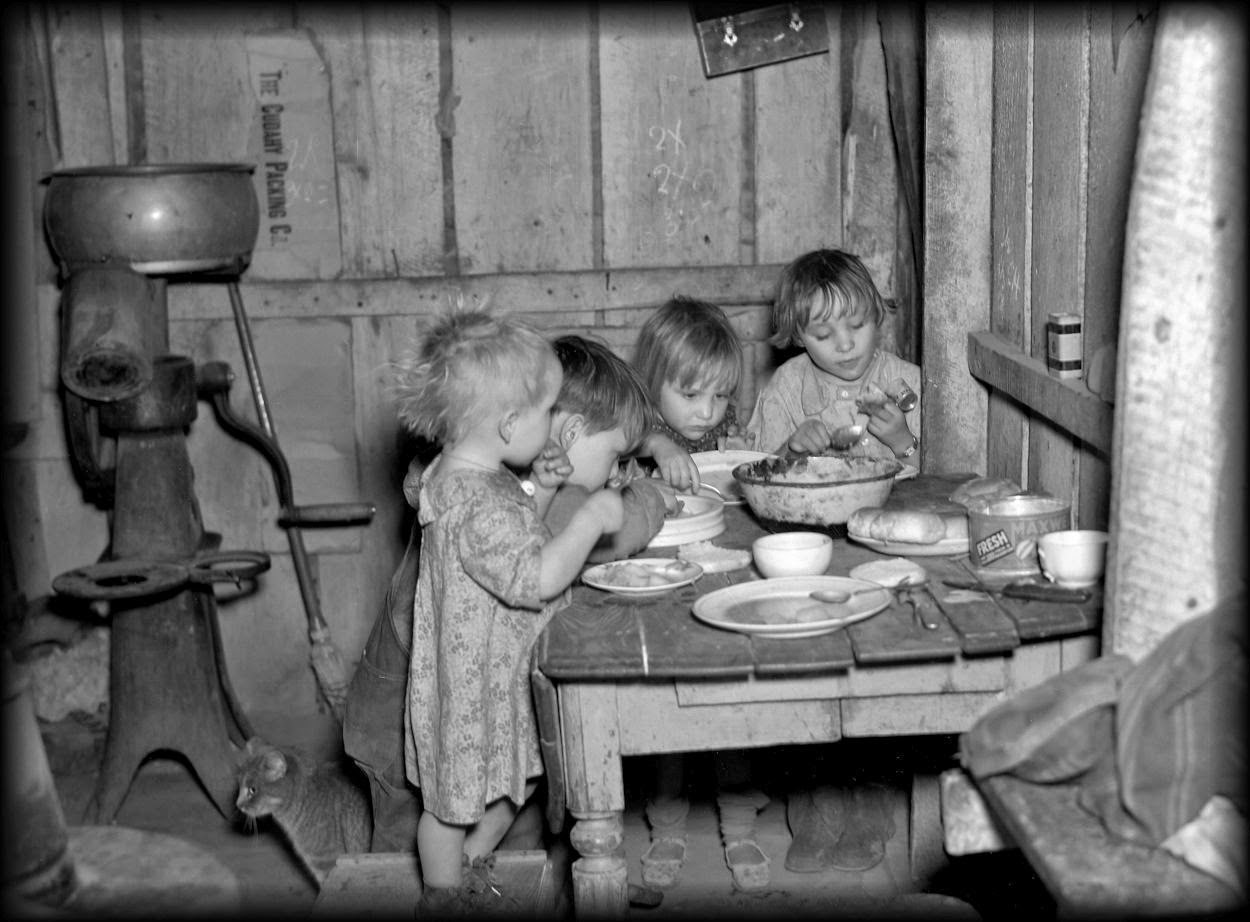
Silent Movies did NOT define this generation. The reality of this time was the Great Depression, commonly believed that this was the result of the 1929 crash of the stock market, coupled with one of the worst droughts this country has ever experienced - people all over the United States were faced with the lack of employment, and quite frankly - the possibility of starving.  People lived in wood or cardboard structures all across America.


"The Silent Generation was the generation born between the two World Wars, who were too young to join the service when World War II started. Many had fathers who served in World War I. It was coined in the November 5, 1951 cover story of Time to refer to the generation within the United States coming of age at the time. The article, (which defined the generation at the time as born from 1923 to 1933), found its characteristics as grave and fatalistic, conventional, possessing confused morals, expecting disappointment but desiring faith, and for women, desiring both a career and a family."


"At the beginning of the 1930s, more than 15 million Americans–fully one-quarter of all wage-earning workers–were unemployed. President Herbert Hoover did not do much to alleviate the crisis: Patience and self-reliance, he argued, were all Americans needed to get them through this “passing incident in our national lives.” But in 1932, Americans elected a new president, Franklin Delano Roosevelt, who pledged to use the power of the federal government to make Americans’ lives better. Over the next nine years, Roosevelt’s New Deal created a new role for government in American life. Though the New Deal alone did not end the Depression, it did provide an unprecedented safety net to millions of suffering Americans." - history.com

Slowly, the economy began to recover until the 1941 bombing of Pearl Harbor by the Japanese, thus beginning America's involvement in the next World War.

Baby Boomers 

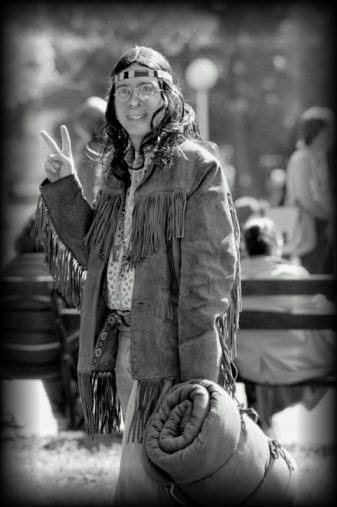
Boom Generation / a.k.a Hippie
1946 - 1964 Space Exploration, First Modern "counterculture"


Baby Busters 1965 -1980 Experienced Vietnam War/Cold War


"The Baby Boomers were the generation born just after World War II, a time that included a 14-year increase in birthrate worldwide. Following World War II, several English-speaking countries -- the United States, Canada, Australia, and New Zealand -- experienced an unusual spike in birth rates, a phenomenon commonly referred to as the baby boom. 


Baby Boomers in their teen and college years were characteristically part of the 1960s counter-culture, but later became more conservative, eventually gave birth to Generations X and Y. Most academic and demographic literature uses 1946 and 1964 as the cutoff years of the Baby Boom generation.


The Hippie subculture was originally a youth movement that began in the United States during the early 1960s and spread around the world. These people created their own communities, listened to psychedelic rock, embraced the sexual revolution, and used drugs such as cannabis and LSD to explore alternative states of consciousness."


Generation X 

MTV Generation / Boomerang Generation
1975 - 1985 Rise of Mass Media/end of the Cold War


Generation X is the generation born between approximately 1964 to 1980, and connected to the pop culture of the 1980s and 1990s they grew up in. The term has been used in demography, the social sciences, and marketing, though it is most often used in popular culture. Other names used interchangeably with Generation X are 13th Generation and Baby Busters. Most of this generation are children of The Baby Boomers and The Silent Generation. Those born before 1973 spent most of their teen years in the 1980s.

Introducing the Mullet... God help us.

"Baby Busters" is a term which is used interchangeably with "Generation X" and "13th Generation" to describe those people born between approximately 1965 and 1979.

Others define it as the "post-peak Boomers", the long steady decline of Baby Boomer birth rates starting in 1958 and ending in 1968.
Awareness of this generation began in the early 1990s, with cultural touchstones like the Lollapalooza Festival and grunge band Nirvana's song Smells Like Teen Spirit, and Time Magazine's 1990 cover story titled "Twentysomething", signaling the advent of a new generation coming of age. 


The MTV Generation is a term sometimes used to refer to people born from the mid 1970s to the mid 1980s. As a group, they constituted the youth culture of at the turn of the Millennium, ranging from age 15 to 25 in 2000.

Culturally the term MTV Generation has been widely used to define the generation of young adults in the Western World who are influenced by fashion trends, music, and slang terms shown in music videos on the newly created cable channel MTV. MTV Generation has often been associated as a neologism for Generation X. 


Boomerang Generation is one of several terms applied to the current generation of young adults in Western culture, born approximately between 1975 and 1986. They are so named for the frequency with which they choose to cohabitate with their parents after a brief period of living alone - thus boomeranging back to their place of origin. This cohabitation can take many forms, ranging from situations that mirror the high dependency of pre-adulthood to highly independent, separate -household arrangements.


The term can also be used to indicate only those members of this age-set that actually do return home, not the whole generation. 

Generation Y Echo Boom
1978 - 1990

Rise of the Information Age/Internet/War on Terror/Iraq War/Rising Gas and Food Prices

And thus begins what I like to call, the "Pull  up your freakin' pants" generation.

Generation Y, sometimes referred to as "Millennials, "Echo Boomers", or jokingly as "Generation Why?", refers to the cohort of individuals born, roughly, between 1982 and 1994.


These are usually the children of Baby Boomers and people in early Gen X. Generation Y grew up with many world-changing events including the rise of mass communication and the Internet. The Y Generation is known as a Culture War "battleground" with growing disagreements between conservative and progressive perspectives. 


1976-2001 is the widest possible definition commonly cited, but generally speaking this generation starts with the 1980s and ends in the middle of the 1990s.


21st century

Generation Z 
The "New Silent Generation"

1995 - 2007 Rise of the Information Age; The Internet; dot com bubble; Digital Globalization


"They are your sons and daughters. They populate your neighborhoods, their thumbs spastically banging out two-way conversations composed entirely of over-punctuated and under-constructed sentences. They may even work for you. Eventually, you will work for them.  This is Generation Z, and they have never known a world without the Internet, cell phones or iPods."


Generation Z is the generation of people living in Western or First World cultures that follows Generation Y. Experts differ on when the earliest members of Generation Z were born, ranging from 1990 to 2001, though a majority opinion claims about 1996. Several other names have been used to refer to this population group, including "Generation V" (for virtual), "Generation C" (for community or content), "Generation Cox", "The New Silent Generation", the "Internet Generation", the "Homeland Generation", or even the "Google Generation". 

What is in store, next?


Sources: wiki, incosta, howstuffworks,Google images

People try to put us d-down (Talkin' 'bout my generation)
Just because we get around (Talkin' 'bout my generation)
Things they do look awful c-c-cold (Talkin' 'bout my generation)
I hope I die before I get old (Talkin' 'bout my generation)

This is my generation
This is my generation, baby

Why don't you all f-fade away (Talkin' 'bout my generation)
Don't try to dig what we all s-s-s-say (Talkin' 'bout my generation)
I'm not trying to 'cause a big s-s-sensation (Talkin' 'bout my generation)
I'm just talkin' 'bout my g-g-g-generation (Talkin' 'bout my generation)

My generation
This is my generation, baby

Why don't you all f-fade away (Talkin' 'bout my generation)
And don't try to d-dig what we all s-s-say (Talkin' 'bout my generation)
I'm not trying to 'cause a b-big s-s-sensation (Talkin' 'bout my generation)
I'm just talkin' 'bout my g-g-generation (Talkin' 'bout my generation)

This is my generation
This is my generation, baby
My my my generation

People try to put us d-down (Talkin' 'bout my generation)
Just because we g-g-get around (Talkin' 'bout my generation)
Things they do look awful c-c-cold (Talkin' 'bout my generation)
Yeah, I hope I die before I get old (Talkin' 'bout my generation)

This is my generation (Talkin' 'bout my generation) 
My generation (Talkin' 'bout my generation)
This is my generation, baby (Talkin' 'bout my generation) 
This is my generation (Talkin' 'bout my generation) 
This is my generation (Talkin' 'bout my generation)