{ font: $(body.font); color: $(body.text.color); background: $(body.background); padding: opx; $(body.background.override) } expr:class='"loading" + data:blog.mobileClass'>
Showing posts with label History. Show all posts

Wednesday, October 26, 2016

The Werewolf of Bedburg

In the massive online game, One Tamriel [The Elder Scrolls Online], my little wood-elf character can transform into a werewolf, after a certain amount of time has lapsed, with the touch of 2 buttons on my PS4 controller.  (So, now you know my guilty video game addiction pleasure).   She becomes afflicted with "Lycanthropy" or in simpler terms, turned into a werewolf.  Lycanthropy is the  is the imaginary ability of a human being to transform into an animal like state, most commonly, as a werewolf.   The metamorphosis or transformation is called shape-shifting.
  
I can't help but wonder.... how many of us, after watching the series Charmed or movies such as Van Helsing or X-Men, have secretly wished they could shape-shift to vanquish or escape their enemies?  I'll admit that I have....


The belief of werewolves' existence was at it's height during the late 16th century, in France, which resulted in frequent trials, and mass hysteria like the famous European witch trials.   


Image source: yovisto
The most notorious historical account is not of a werewolf, but a man named Peter Stumpp who was also French.  He was a Rhenish farmer who was a serial killer and a cannibal, who became known as the "Werewolf of Bedburg".  Stumpf (or Stumpp) is known as other aliases, which include these names: Ubel Griswold, Abal Griswold, and Abil Griswold.  

There is reference to his last name as Stumpp or Stumpf that it may have been given because his left hand had been cut off, hence, leaving only a stump.  It was later alleged that the "werewolf" (accused) had its left forepaw cut off, then the same injury proved the guilt of the man.


Image source: viralnova
The source of Peter Stumpf's reign of terror only survive in 2 pamphlets, published in London in 1590, which, today, can be located at the British Museum, and the other one in the Lamberth Library.  They were apparently translated from a German pamphlet, and no known copies of the original pamphlet are known to have survived.  In 1920, these pamphlets were discovered by an occultist by the name of Montague Summers.  Apparently, the contents of the pamphlet(s) fully describe Peter Stumpf's horrific rampage of serial killing, (as told by through many statements from the locals who witnessed his crimes. 

Summers must  have been quite fascinated with the information, as he went on to create a reproduction of the information which contained woodcuts, in his own version of the stories, entitled, The Werewolf.


Stumpf was a lucrative farmer, during  the 1580's who was believed to be a widower, left with a daughter, Beele (a.k.a. Sybil) and a son, whose name is unknown. 

Before his trial, it is reported that he had an "intimate relationship with a distant relative named Katharina Trump, or "Trumpen" or "Trompen" - her name is not entirely known, nor accurately recorded.


gif image: tumblr
"During 1589, Stumpf had one of the most lurid and famous werewolf trials of history. After being stretched on a rack, and before further torture commenced, he confessed to having practiced black magic since he was twelve years old. He claimed that the Devil had given him a magical belt or girdle, which enabled him to metamorphose into "the likeness of a greedy, devouring wolf, strong and mighty, with eyes great and large, which in the night sparkled like fire, a mouth great and wide, with most sharp and cruel teeth, a huge body, and mighty paws." Removing the belt, he said, made him transform back to his human form.


google images - hamsteadhealth
For twenty-five years, Stumpf had allegedly been an "insatiable bloodsucker" who gorged on the flesh of goats, lambs, and sheep, as well as men, women, and children. Being threatened with torture he confessed to killing and eating fourteen children, two pregnant women, whose fetuses he ripped from their wombs and "ate their hearts panting hot and raw," which he later described as "dainty morsels."  One of the fourteen children was his own son, whose brain he was reported to have devoured.


gif image - pinterest
Image source: tumblr
Not only was Stumpf accused of being a serial murderer and cannibal, but also of having an incestuous relationship with his daughter, who was sentenced to die with him, and that he had coupled with a distant relative, which was also considered to be incestuous according to the law. In addition to this he confessed to having had intercourse with a succubus sent to him by the Devil.


Image credit: wickedhorrorblog

The execution of Stumpf, on October 31, 1589, and of his daughter and mistress is one of the most brutal on record: he was put to a wheel, where "flesh was torn from his body", in ten places, with red-hot pincers, followed by his arms and legs. Then his limbs were broken with the blunt side of an ax-head to prevent him from returning from the grave, before he was beheaded and his body burned on a pyre. His daughter and mistress had already been flayed and strangled and were burned along with Stumpf's body. As a warning against similar behavior, local authorities erected a pole with the torture wheel and the figure of a wolf on it, and at the very top they placed Peter Stumpf's severed head." 
- Source: wikipedia


Sunday, July 3, 2016

The Shadow Caster

Have you ever watched an old movie that is set in the time of the Wild West era, and observed how a woman steps from a stage coach, after she has presumably  traveled through mountains, prairie and dirt roads for either weeks or months at a time?  Her dress is pristine - even without a wrinkle!


Lillian Russell - Pinterest
Our character will then, walk into a hotel, lifting off her tall feathered hat to reveal perfectly coiffed hair, and proceeds to remove her gloves.  The bustle on which she has sat for days is still unrealistically in perfect shape.  Hollywood is known for romanticizing the actual reality of history, but traveling was arduous, formidable and down-right dangerous.

America was still in its infancy and the cauldron of ethnicity brewed with diversity.  The Gold Rush and dreams of new settlements brought cultures from all over the world.   It brought the outlaws, the gamblers, the Madams with their brothels, former slaves, the cattle drivers, the religious, doctors, lawyers, actors, the artists and writers, medicine men, entertainers, railroad and mine workers and so on.  Curiosity, explorers and those seeking adventure made their way West. 


Main Street, Breckenridge, Colorado. 1895:
Main Street, Breckenridge, Colorado: 1895 (raremaps/Pinterest)
Crystal Palace Saloon Tombstone AZ 1885:
Historic photo of the Crystal Palace Saloon - Tombstone, Arizona: 1885 (Pinterest)
Deadwood, South Dakota in 1876:
Deadwood, South Dakota: 1876 (Historum/Pinterest)
As you well know, the U.S. Government used treaties to displace our American Indian (Native Americans) from their own tribal lands, and often violated treaties and other laws as a means to facilitate the movement of western and southern settlements, so that European Americans could take over the land.

By 1900, innumerable wars had been fought on American soil, resulting in expulsion and banishment of countless tribes.  
Edward Sheriff Curtis
Fortunately, one man, by the name of Edward Sheriff Curtis, frequently referred to as the "Shadow Caster" endeavored to capture the existing tribes and I will add that his photography is absolutely breath-taking.  Not only did he take pictures of Native Americans, he was able to make time stand still and deliver almost tearfully beautifully images of every day moments that we may not otherwise be so lucky to possess today.   Much of his photography was set in sepia tones, which, in my opinion, only add to the quality of the images.  

The Apache | The North American Indian Photography of Edward Curtis - Edward S. Curtis, a professional photographer in Seattle, devoted his life to documenting what was perceived to be a vanishing race. His monumental publication The North American Indian presented to the public an extensive ethnographical study of numerous tribes, and his photographs remain memorable icons of the American Indian.:
"The Apache"
Edward S. Curtis spent more than 20 years documenting over 80 tribes across North America.:

Edward Sheriff Curtis (Photography)  (1868-1952) - At the Old Well of Acoma, 1904:
"At the Old Well of Acoma"
Here we present a stunning image of an Indian Sentinel. It was taken in 1927 by Edward S. Curtis.    The image shows a San Ildefonso man peering from behind large rock formation.:
Indian Sentinel - a San Ildefonso man peering from behind large rock formation.
Here for your perusal is a one-of-a-kind photograph of Crow Indians on Horseback. It was created in 1908 by Edward S. Curtis.    The photograph illustrates Four Crow men on horseback holding Spears with Feathers.    We have compiled this collection of photographs mainly to serve as a valuable educational resource. Contact curator@old-picture.com.:
Crow Indians on horseback
c. 1910 - Members of the Qagyuhl tribe dance to restore an eclipsed moon. IMAGE: EDWARD S. CURTIS/SMITHSONIAN INSTITUTION:

Photographs:Orotone, Edward Sheriff Curtis (American, 1868-1952). Signal Fire to theMountain Gods, 1909. Orotone. 4 x 3 inches (10.2 x 7.6 c...:
Signal Fire to the Mountain Gods
Edward Sheriff Curtis, or the “Shadow Catcher” as he was referred to by some of the tribes he photographed, Curtis captured over 40,000 images and also recorded now rare ethnographic information from over 80 Native American (Indian) tribal groups.  pbs.org states that "This monumental accomplishment is comprised of more than 2,200 sepia toned photogravures bound in twenty volumes of written information and small images and twenty portfolios of larger artistic representations."
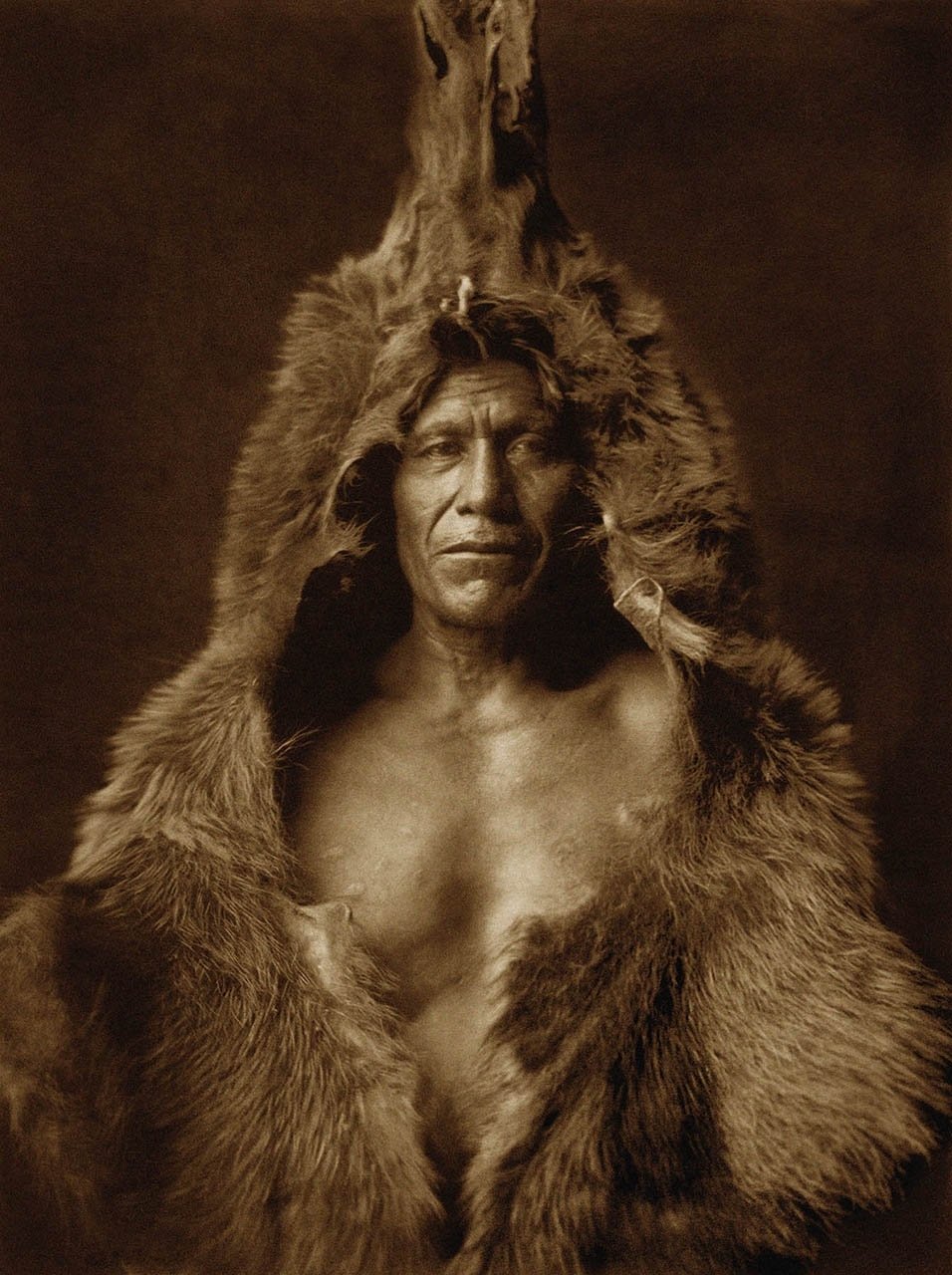

"Bear's Belly"
"arikara girl", edward sheriff curtis:
"Arikara girl"
Edward S. Curtis. Navajo Medicine Ceremony. 1904. A Navajo (Diné) man in ceremonial dress representing the Yebichai god Zahadolzha. Photograph by Edward S. Curtis, 1904. This nine day ceremony, the Nightway chant (Tłʼééʼjí), is done to restore Hózhǫ́ especially after head ailments or mental illnesses. (It is not forbidden to photograph this part of the ceremony.):
Navaho medicine ceremony
Edward S. Curtis was born near Whitewater, Wisconsin in 1868. His father was a Civil War veteran and a minister who moved the family to Minnesota.  It was here that Edward found an interest in photography.  When he was 17 years old, he apprenticed as a photographer in St. Paul.   Later, his family moved near Seattle, Washington, "where Edward purchased a second camera and bought a half interest in a photographic studio. He married and the couple had four children." - pbs.org


PHOTO BY EDWARD SHERIFF CURTIS......SOURCE MAGICKKITCHEN.TUMBLR.COM.................:


Edward S. Curtis:

"In 1898 while photographing on Mt. Rainier, Curtis encountered a group of prominent scientists who were lost, among them George Bird Grinnell, a noted Indian expert, who became interested in Curtis’ work and invited him to photograph the Blackfeet Indian people in Montana two years later. It was there that Curtis practiced and developed his photographic skills and project methodology that would guide his lifetime of work among the other Indian tribes." - pbs.org


A young Yakima warrior c. 1910 Edward S. Curtis.:
Yakima
Edward S. Curtis,Hesquiat woman wrapped in a shawl, ca. 1916.:
Hesquiat
A Sarsi woman in 1926 -  North American Indian Portraits by Edward S. Curtis:
Sarsi
A Pomo Girl - No Name - Photo by Edward S. Curtis - 1924 - (Original):
Pomo
A Clayoquot woman in cedar-bark hat.  Seattle : E.S. Curtis, 1915:
Clayoquot
Bear Bull – Blackfoot. Edward Sheriff Curtis Photography.:
"Bull Bear" - Blackfoot
Library of Congress: Edward S Curtis Collection Havasupai matron:
Havasupai
Arapaho water girl,1910. Edward Sheriff Curtis Photography.:
Arapaho
The Mohave,1907. Edward Sheriff Curtis Photography.:
Mohave
A Kotzebue man. Edward Sheriff Curtis Photography.:
Kotzebue
Mosquito Hawk - Assiniboin, 1908. Photogravure. Curtis Caption: "A biographical sketch of this subject is found in Volume 111, page 187.":
"Mosquito Hawk" - Assiniboin
A young Sioux woman in a dress made entirely of deerskin, embroidered with beads and porcupine-quills.:
Sioux in beaded deerskin
A Ponca dancer,1927. Edward Sheriff Curtis Photography.:
Ponca dancer
Kiowa Girl, by Edward Curtis:
Kiowa
c 1909 Cayuse child on a horse  photo: Edward S. Curtis (Native American, Indian, Oregon, beaded, beadwork):
Cayuse child
Two Whistles, a Crow Man, by Edward S. Curtis, 1908:
"Two Whistles" - Crow
Brule Indian Woman ~Two Charger Woman. It was made in 1907 by Edward S. Curtis.:
Brule
His accomplishment was an enormous undertaking as he not only struggled with finances, but he also was at odds with technology - current means of transportation, the weather and had to secure meetings with the academic community and the technicians with whom he worked, not to mention the tribes which he was interested in photographing.  He traveled by horseback or horse drawn wagon over treacherous terrain and isolated, primitive paths to arrive at his various destinations.  pbs.org explains, "Once on site Curtis and his assistants would start work by interviewed the people and then photographing them either outside, in a structure, or inside his studio tent with an adjustable skylight. Employing these and other techniques over his lifetime he captured some of the most beautiful images of the Indian people ever recorded."


"Atsina Camp"  1908, photographed by #Edward_Curtis:
Atsina Camp
You are looking at a beautiful picture of a Blackfoot Tepee. It was taken in 1927 by Edward S. Curtis.    The picture presents a Blackfoot Indian, Bear Bull, holding a horse outside his tipi.    We have created this collection of pictures primarily to serve as an easy to access educational tool. Contact curator@old-picture.com.:
Blackfoot Teepee
Canon de Chelly (National Monument) Arizona. Seven Navajo riders on horseback and dog trek against background of canyon cliffs. E. S. Curtis (1904) [3620  2721]:
Canyon de Chelly, Arizona - Navajo Riders
+~+~ Antique Photograph ~+~+  Skokomish Indian Chief's Daughter with baskets by Edward Sheriff Curtis.:
Skokomish's (Chief) Daughter
Edward S. Curtis:  A Smoky Day at the Sugar Bowl—Hupa, ca. June 30, 1923:
"A Smokey Day at the Sugar Bowl", Hupa
Invocation - Sioux,1907. Edward Sheriff Curtis Photography.:
Invocation - Sioux
Edward S. Curtis, Kwakwaka'wakw canoeing on Clayoquot Sound, British Columbia, c. 1910.:
Kwakwaka'wakw canoeing on Clayoquot Sound
"Crying to the Spirits" [Hidatsa] (The North American Indian, v. IV. Cambridge, MA: The University Press, 1909) by Edward Sheriff Curtis from USC Libraries:
"Crying to the Spirits"
Portrait Photography Artist Study with thanks to Photographer Edward Curtis, ,Resources for Art Students, CAPI ::: Create Art Portfolio Ideas at milliande.com , Inspiration for Art School Portfolio Work, Portrait, Painting, Figure, Faces, Mixed Media, Sepia, North American Indian:


This is another Edward Curtis photograph from the early 1900's. It shows a Native American placing a feather into a stream.:


Title: Nunipayo decorating pottery. Date Created/Published: c1900. Summary: Woman seated on mat painting designs on pottery. Photograph by Edward S. Curtis, Curtis (Edward S.) Collection, Library of Congress Prints and Photographs Division Washington, D.C. #:

"One of Curtis’ major goals was to record as much of the people’s way of traditional life as possible. Not content to deal only with the present population, and their arts and industries, he recognized that the present is a result of the past, and the past dimension must be included, as well. Guided by this concept, Curtis made 10,000 wax cylinder recordings of Indian language and music. In addition he took over 40,000 images from over 80 tribes, recorded tribal mythologies and history, and described tribal population, traditional foods, dwellings, clothing, games, ceremonies, burial customs, biographical sketches and other primary source information: all from a living as well as past tradition. Extending the same principle to the photographs, he presented his subjects in a traditional way whenever possible and even supplied a bit of the proper clothing when his subjects had none." -pbs.org


Medicine Crow - Apsaroke,1908. Edward Sheriff Curtis Photography.:
"Medicine Crow" - Apsaroke
A Chief in the Desert - Navaho  Artist: Edward Sheriff Curtis  Artist Bio: American, 1868 - 1952  Creation Date: 1904  Process: orotone on glass:
Navajo
photo by edward s curtis:


Portrait Photography Artist Study with thanks to Photographer Edward Curtis, ,Resources for Art Students, CAPI ::: Create Art Portfolio Ideas at milliande.com , Inspiration for Art School Portfolio Work, Portrait, Painting, Figure, Faces, Mixed Media, Sepia:


Native American photographs Edward S. Curtis/Library of Congress Two Piegan girls gather the goldenrod plant, in 1910.:


Native American photographs:


You are viewing a rare image of a Whale Ceremonial - Clayoquot. It was taken in 1910 by Edward S. Curtis.    The image shows Nootka indian taking ceremonial bath, before whale hunt.    We have created this collection of images primarily to serve as an easy to access educational tool. Contact mailto:curator@ol....:


A Piegan Lodge

"Reenactments of battles, moving camp, ceremonies and other past activities were also photographed. These efforts provided extended pleasure to the elders and preserve a rare view of the earlier ways of the people." - pbs.org


Image source: swanngalleries.com
"With the publication of volume twenty in 1930, the years of struggle finally took their toll with Curtis suffering a physical and nervous break down. The declining interest in the American Indian, the Great depression, and other negative forces slowed, then halted the successful financial completion of the project. Less than 300 sets of “The North American Indian” were sold. Curtis spent the remaining years of his life with his daughter Beth and her husband in Los Angeles. On October 21, 1952 at the age of 84, E. S. Curtis died of a heart attack in Los Angeles, virtually unknown. But what a legacy he recorded for us." 


"As one admires the beauty of the Curtis photographs they must be placed in a proper perspective. In spite of the dedication and hardships the photographer had to endure, the ultimate beauty of “The North American Indian” lies not only with the genius of Curtis, but also and most importantly, within his subjects. The native beauty, strength, pride, honor, dignity and other admirable characteristics may have been recorded by photographic techniques, but they were first an integral part of the people. While Curtis was a master technician, the Indian people possessed the beauty and their descendants carry on these same traits."


The Yuma, 1907, photograph by Edward S. Curtis.:
Yuma
You are looking at an intriguing picture of Slow Bull, a Dakota Sioux Medicine Man. It was taken in 1907 by Edward S. Curtis.    The picture presents the Medicine Man standing outside his tipi gazing upward, apparently in Prayer.    We have created this collection of pictures primarily to serve as an easy to access educational tool. Contact curator@old-picture.com.    Image ID# 7D59DF2A:
"Slow Bull" - Sioux Medicine Man

This is a picture of a Native Alaskan. The picture was taken in the early 1900's by Edward Curtis.  Absolutely enchanting : ):
Native Alaskan

Native American Indian , Edward S Curtis:


Little Hawk, a Brule Warrior It was taken in 1907 by Edward S. Curtis.:
"Little Hawk", Brule

Pow Wow Photos – PowWows.com » » Cheyenne Indian Chief on Horseback:
Cheyenne

Mohave Child 1907. Photograph by Edward S. Curtis's The North American Indian.:
Mohave

You are viewing an original photograph of a Tipi in the Snow.  The photo was taken by Curtis in 1908. The picture shows two men on horseback in front of a Tipi.:


Indian Smoking a Peace Pipe. This Cheyenne indian appears to be meditating on a rock known as Medicine Rock. It was taken in 1907 by Edward S. Curtis.:
Cheyenne

You are looking at an intriguing picture of a Maricopa Indian Child. It was taken in 1907 by Edward S. Curtis.  The picture presents the Maricopa child seated in large basket.:
Maricopa

It was difficult today, to stop posting images, as there are so many wonderful photographs to be found, and enjoyed.  Head on over to Pinterest and type "Edward Curtis photographs" into the subject line to find more stunning examples of his legacy.

Text source:  http://www.pbs.org/wnet/americanmasters/edward-curtis-shadow-catcher/568/
Image source: Pinterest, Google Images, Wikipedia,