The origin of Sinterklaas (Santa Claus) and his helpers has sometimes been associated with the "Wild Hunt" of the Norse wind God, Odin. [Teutonic god, Woden]. The Wild Hunt is also known from post-medieval folklore, and evokes images of the frenzy of battle, and the terror inspired by death.
The Wild Hunt by Franz von Stuck
The Wild Hunt is a folk tale originating from Europe, and involves a group of huntsman who are presumed ghosts, who pass through the wild in pursuit of humans as game.
These hunters may be assumed as fairies, elves or even the dead. The leader of the Hunt is Odin, and all of whom are lost spirits, both male and female. Odin passes through persistent darkening skies, amidst great mid-winter storms of angry wind, clapping thunder and violent lightening.
Odin appears on his gallant white horse, called Sleipnir, who carries him swiftly through the air, leading his army of lost souls. Sleipnir also possessed 8 legs, which must have aided him in his ability to carry Odin very swiftly, with his feet never touching the earth.
Odin's ever-present companions are two black ravens, Huginn and Muninn, who were the carriers of news - the good or bad behavior of the mortals, below - and report back to Odin, after listening to people through their rooftops. Huginn and Muninn's role as Odin's messengers have long been associated with shamanic practices, the Norse raven banner, general raven symbolism among the Germanic peoples, and the Norse concepts of the fylgja (is a spirit who accompanies a person in connection to their fate or fortune) and the hamingja (either the personification of the good fortune or luck of an individual or family, or the altered appearance of shape-shifters).
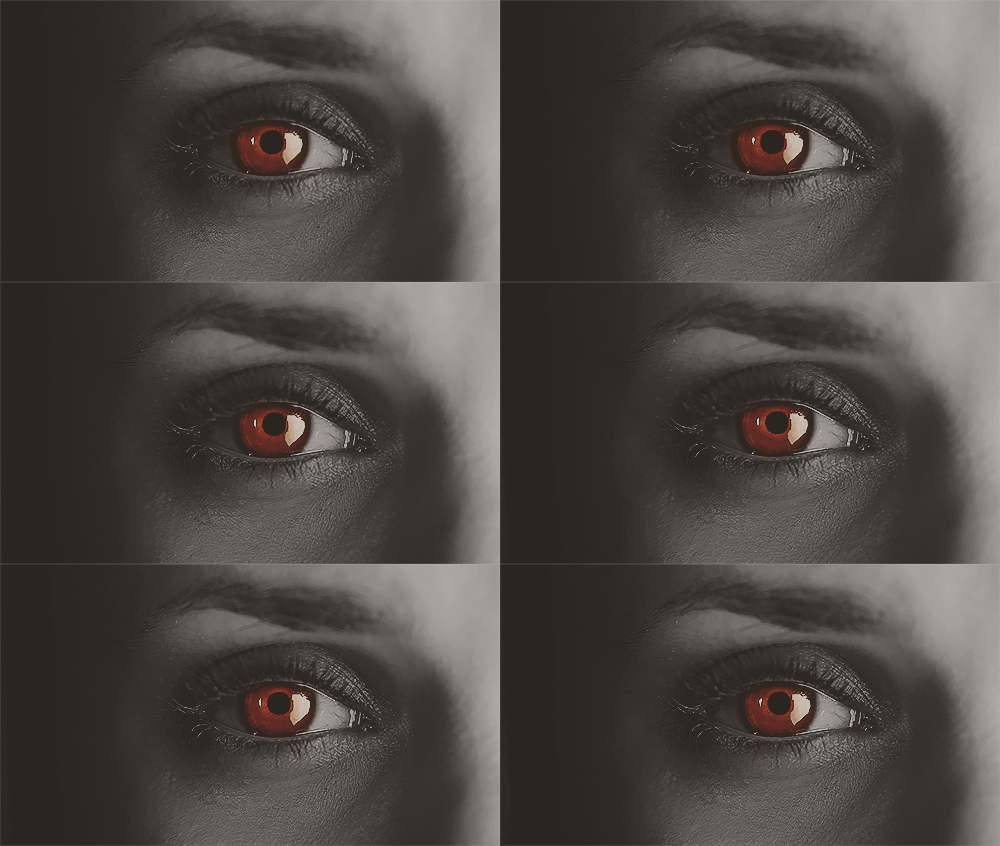
In his nocturnal procession, are huge, vicious, black hounds that bay ceaselessly through the icy winds, and have been described as having red eyes the size of saucers.
"The Bearer of Death is a term used in describing the Hellhound. Hellhounds have been said to be as black as coal and smell of burning brimstone. They tend to leave behind a burned area wherever they go. Their eyes are a deep, bright, and almost glowing red. They have razor sharp teeth, super strength and speed, and are commonly associated with graveyards and the underworld. Hellhounds are called The Bearers of Death because they were supposedly created by ancient demons to serve as heralds of death. According to legend, seeing one leads to a person's death. Sometimes it is said to be once; other times it requires three sightings for the curse to take effect and kill the victim. These factors make the Hellhound a feared symbol and worthy of the name “Bearer of Death”. The Hellhound has been seen several times throughout history, and it is not specific to any one place. The most recent sightings occurred in Connecticut, Kentucky, Louisiana, Ohio, and Vilseck, Germany, in or near cemeteries."-wiki
Artwork by Howard Johnson, source: pinterest
Finally, as part of his war-band, and at this side, Odin is also accompanied by his warrior wife, Frigga [Frig or Frigg]. Frigg is known as the goddess of motherhood and marriage, and the keeper of domestic arts. She possesses the power of prophecy, but does not disclose this information. Frigg is the wife of Odin, queen of the Æsir, and goddess of the sky. To underline the importance of Frigg as part of the Wild Hunt, one must consider that she is the only one who is permitted to sit on Odin's high seat "Hlidskjalf" and look out over the universe.
If you were unfortunate enough to witness the Wild Hunt, you may be the hapless augur of such events like war, pestilence or the plague and surely, death will follow.
Some mortals who did not meet their demise as witnesses, would mysteriously vanish, and may have been carried into the Underworld or a Fairy Kingdom, as the soul was pulled from the body to join the army of the soul-less. Melissa Snark, wrote: "As people continued to settle in the region, Odin’s path for the Wild Hunt remained unchanged. Once he traveled a road, he would continue to travel it for eternity, so people who tried to build their houses on the old roads he once used would find their home’s burnt down as a result of his hunt. In fact, it was best to leave his routes completely untouched, as anything within his path would be set ablaze in his wake. To protect themselves during the Wild Hunt, people learned to throw themselves at the ground when the host stampeded through the area to avoid getting hit. They also took to carrying a piece of steel and a piece of bread with them as they made their way to church for Yule. They believed that throwing the bread for the dogs if they encountered them first would offer some protection. If, on the other hand, they first encountered a rider wearing a broad-rimmed hat, they would throw the piece of steel in front of them. Still others believed they could avoid being swept up altogether by the hunt if they asked the riders for parsley."
There is a bright side, however. If one joined the Wild Hunt, in earnest and sincerity, one may be rewarded with silver or gold.
Google Images, Artists not cited
“When the winter winds blow and the Yule fires are lit, it is best to stay indoors, safely shut away from the dark paths and the wild heaths. Those who wander out by themselves during the Yule-nights may hear a sudden rustling through the tops of the trees – a rustling that might be the wind, though the rest of the wood is still.“But then the barking of dogs fills the air, and the host of wild souls sweeps down, fire flashing from the eyes of the black hounds and the hooves of the black horses.”-Kveldulf Hagen Gundarsson
Peter Nicolai Arbo (1831–1892) - Title "Norsk bokmål: Asgårdsreien, 1872
“Sleep, those little slices of death — how I loathe them.” ― Edgar Allan Poe
Everyone craves a good night's sleep, and we practice many ways to achieve this. Listening to music, playing a game on your cell phone, reading, watching television and so on. When we fall asleep, we hope for dreamless or peaceful sleep; yet, many are awakened by nightmares. It is estimated that 5 to 10% of adults suffer from nightmares, and 50% of toddlers or children (ages 3 to 6) suffer from regular bad dreams or nightmares. Some people choose to utilize medications and even therapy, but personally, I prefer white noise and use a fan 365 nights per year. About a decade ago, I used a sea-scape CD, and used repeat, to help lull me to sleep.
Enter The Sandman.
Commonly regarded as a cheerful presence, (always a male) who creates a restful night for children by creating sweet dreams, through some sort of wizardry. He is called the Sandman because he is known to blow or sprinkle magical dust, or sand, from his hands onto the eyes of children. In this folklore, when one wakes in the morning with grit in their eyes, it was often told to children that the Sandman had visited them.
Jennifer Anniston as Rachel, in this short video from the popular television show Friends really dislikes anything near her eyes.
This Sandman, is frequently depicted in vintage illustrations, as a childish or small elf-like creature, who appears quite cheerful while administering his night time duty. This Sandman is benevolent and a creator of dreams, and even has the ability to create premonitions, so that one may be able to foretell their own future.
In 1841, Hans Christian Anderson, gave the Sandman proverbial wings in his story called, "Ole Lukøje".
The origin of The Sandman story is believed to be Norse or Northern Europe, and most likely an oral tradition passed on to help children fall asleep, and may have been were Anderson adopted the idea. Anderson describes The Sandman's visits with a pleasant approach: "In the evening, while the children are seated at the table or in their little chairs, he comes up the stairs very softly, for he walks in his socks, then he opens the doors without the slightest noise, and throws a small quantity of very fine dust in their eyes, just enough to prevent them from keeping them open, and so they do not see him. Then he creeps behind them, and blows softly upon their necks, till their heads begin to droop.... Under each arm he carries an umbrella; one of them, with pictures on the inside, he spreads over the good children, and then they dream the most beautiful stories the whole night. But the other umbrella has no pictures, and this he holds over the naughty children so that they sleep heavily, and wake in the morning without having dreams at all."
There is another Sandman, whose nocturnal visits are not surrounded by sugar plums and winged fairies dancing in one's head. He is a wicked, fanged creature with long fingers and nails, who collects the skin of his dead victims, and wears them as a putrid and decaying cloak. He lurks in the shadows of bedrooms, whispering "tick-tock, tick-tock" which induces sleep in his victim. Once the individual has dozed off, the Sandman may devour the innocent dreamer, suffocate you with sand, or steal your eyes and eat them!
"Mr. Sandman, bring me a dream...." – The Chordettes
This very disturbing story, "The Sandman", was translated from German as Der Sandmann, written in 1816 as a short story by Ernest Theodor Amadeus Hoffmann. It was first introduced in 1817, in his book of stories entitled, "The Night Pieces". Hoffman delivers a inverted, satirical critique of society at that time, and feeds fear into the minds of the reader. The story is a narrative, and, according to the protagonist's nurse in one excerpt, describes the Sandman with horror-based detail: "He is a wicked man, who comes to children when they won't go to bed, and throws a handful of sand into their eyes, so that they start out bleeding from their heads. He puts their eyes in a bag and carries them to the crescent moon to feed his own children, who sit in the nest up there. They have crooked beaks like owls so that they can pick up the eyes of naughty human children. A most frightful picture of the cruel Sandman became impressed upon my mind; so that when in the evening I heard the noise on the stairs I trembled with agony and alarm, and my mother could get nothing out of me but the cry, 'The Sandman, the Sandman!' stuttered forth through my tears. I then ran into the bedroom, where the frightful apparition of the Sandman terrified me during the whole night."
In the modern-day supernatural thriller based on The Legend Of Sleepy Hollow, our friend, The Sandman comes to life in Episode 3: 'For the Triumph of Evil'. Apparently, sand emanates from his own eyes, which he gathers into his hand to cast into the eyes of his victim. Let's face it: He is really a disturbing creature!
^Metalica^ - Enter Sandman [Official music video]
Perhaps one of the most frightening variations of The Sandman is the character of Freddy Kruger, appearing in the 1984 movie "A Nightmare on Elm Street". Wes Craven was Freddy's creator, who invented this seemingly invincible man to enter into the real world, via dreams. Though this is a slasher movie, I still feel that a strong association can be drawn from The Sandman. Freddy, and the film are a superb representation of a realized nightmare, the suffering children and the power of subconsciousness. This flick scared me to my core, and I still have several fears resulting from watching this particular movie.
"Wes Craven said his inspiration for the basis of Freddy Krueger's power stemmed from several stories in the Los Angeles Times about a series of mysterious deaths: All the victims had reported recurring nightmares and died in their sleep. Additionally, Craven's original script characterized Freddy as a child molester, which Craven said was the "worst thing" he could think of. The decision was made to instead make him a child murderer in order to avoid being accused of exploiting the spate of highly publicized child molestation cases in California around the time A Nightmare on Elm Street went into production.
Craven's inspirations for the character included a bully from his school during his youth, a disfigured homeless man who had frightened him when he was 11, and the 1970's pop song "Dream Weaver" by Gary Wright. In an interview, he said, "When I looked down there was a man very much like Freddy walking along the sidewalk. He must have sensed that someone was looking at him and stopped and looked right into my face. He scared the living daylights out of me, so I jumped back into the shadows. I waited and waited to hear him walk away. Finally I thought he must have gone, so I stepped back to the window. The guy was not only still looking at me but he thrust his head forward as if to say, 'Yes, I'm still looking at you.' The man walked towards the apartment building's entrance. I ran through the apartment to our front door as he was walking into our building on the lower floor. I heard him starting up the stairs. My brother, who is ten years older than me, got a baseball bat and went out to the corridor but he was gone." - Source: wiki
Below, "The Sandman" - an (oral narrative) horror story, created by Tam Lin. This short film is a bit different, as it appears to be an art project, of sorts. Still and gifs pictures are combined with the spoken word create this modern and unique tale of The Sandman.
Image Credits:
Umbrella Illustration by Caroline Emilie Mundt - Pinterest
Sleepy Hollow Sandman - tumblr
The Sandman - Illustration by Brian Bolland
Midsummer Night's Dream, 1935 gif image
Other: tumblr, Pinterest, Google Images under search words Sandman, sleep, sleep gif
“Evil is a point of view. We are immortal. And what we have before us are the rich feasts that conscience cannot appreciate and mortal men cannot know without regret. God kills, and so shall we; indiscriminately He takes the richest and the poorest, and so shall we; for no creatures under God are as we are, none so like Him as ourselves, dark angels not confined to the stinking limits of hell but wandering His earth and all its kingdoms.”― Anne Rice, Interview with the Vampire
The vampire is a loathsome creature, who appears in human form, and is sustained by drinking the blood (also known as "feeding") from living beings, like you and I. Naturally, we want to defend ourselves from an immortal existence and there are many ways in which we can employ self-protection.
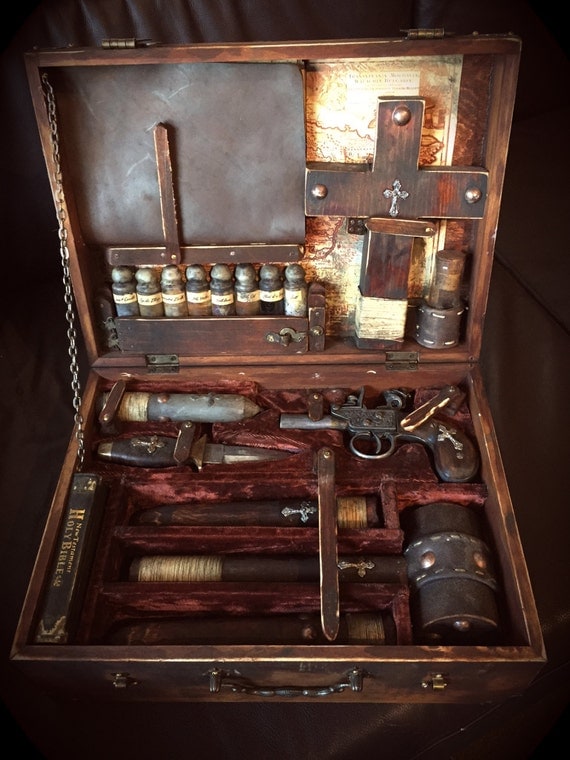
Today, one can easily find, online at auction or generally for sale, "Vampire Hunter Kits" - also known as - "Vampire Defense Kits". Some kits may be vintage, but are not actually an authentic tool used during the height of this superstition. These kits are most likely made in the 1930's or perhaps even later and were made to look older than they actually are. These kits can even be "made to order", today. Speculation is that they were produced after the publication of Bram Stoker's "Dracula" in 1897, and were more likely intended as souvenirs or novelties. Buyer, Beware!
If the contents were indeed real, here are the many ways in which you may use to defend yourself against the un-dead. There are also many superstitions that may grant you some form of protection against these evil beings. "Apotropaics" or apotropaic magic are a means in which one may defend against evil or harm, and may deflect misfortune. If you have a lucky charm, or sprinkle salt over your shoulder, or hang a horseshoe over your door, you are practicing this type of magic! Common items, such as garlic or holy water that are supposedly used to ward off those who returned from the dead and are common in vampire folklore.
Branch of a wild rose - may harm or ward off a vampire
Candles Used for ceremonies like exorcisms, prayers, and seeing in the dark.
Crossbow and Bolts Crossbows were useful when employed for range. The tip of the bolt may be dipped in silver, however, silver is not effective means to ward off the vampire.
Crucifix A symbol of Christ, it was commonly held facing toward the vampire, who balked in its presence. Sometimes, it was attached to a chain from which the slayer could rapidly pull it out. The crucifix was often made of silver. This tool is one of the most important manners in which one can repel a vampire, and if it touches the skin of the undead, it will burn them similar to an acid. Decapitation / Dismemberment One of the easiest methods to kill a vampire is to simply lob off its head, and then to burn it along with the remaining body (which should also be dismembered). See "Fire". Decapitation was also the means in which one could expedite the departure of one's soul.
Entry It is common knowledge that a vampire will not enter your home, unless you invite him/her. Once the invitation is extended, however, they may enter or leave at will.
Eucharist Holy wafers are used to place over the lips of the dead, as a form of protection against vampirism; or, may be placed around the grave as a circle of protection so that the undead may not enter.
Fire The method of burning a vampire is used in conjunction with the decapitation and dismemberment method. After the body is in pieces, the remaining parts must be thoroughly burned.
Garlic Garlic has been used in defense against vampirism, as they notoriously despise this herb and repel against it. Consequently, garlic was placed into a deceased person's mouth to prevent a vampire from feeding upon the victim.
Graveyard A vampire will not be able to use his power on consecrated grounds such as a church yard or a cemetery. You will be safe to retreat to these places.
Hammer Some hammers were fashioned with a crucifix styled into the head. Its size was approximately six to seven inches long, and was what is used to drive a stake into the body of the vampire.
Holy Water This was used to sprinkle on the vampire for both protection of the hunter, the surrounding area in which they occupied, or used directly on the vampire to harm it.
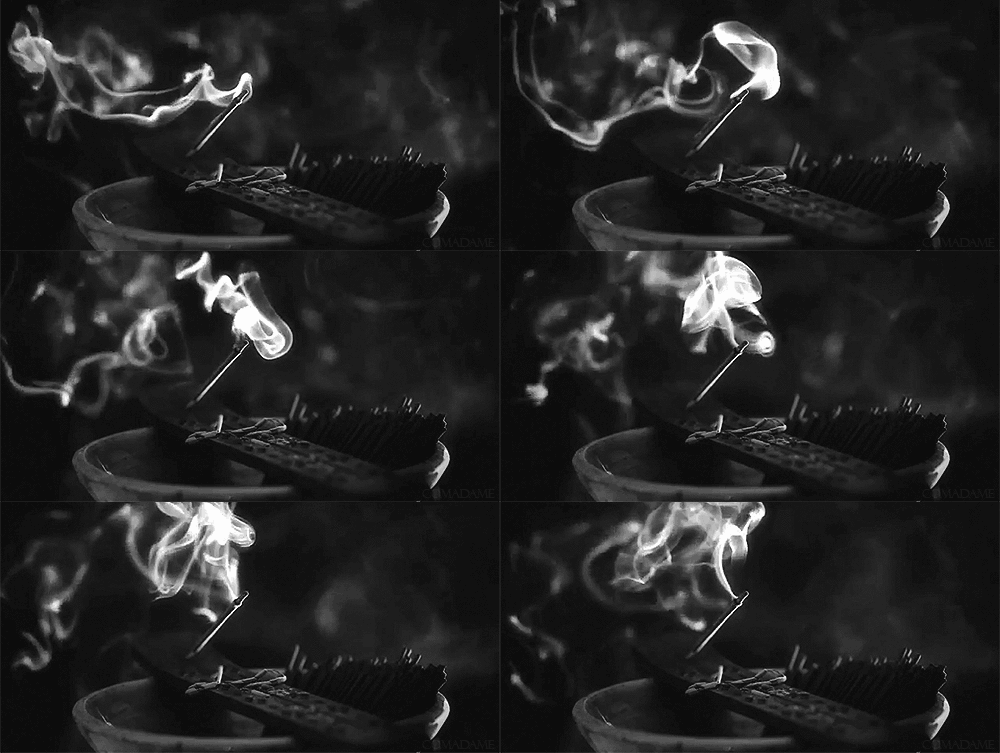
Incense The pungent odor arising from this may have been used ceremoniously, whether it be used for protection or to ward off the evil spirit which lay in the vampire’s body.
Knives and Daggers Some were used for throwing while others were specifically used for close combat.
Lemon In Saxon regions of Germany, a lemon was placed in the mouth of suspected vampires.
Metal Teeth Pliers Nothing more than a common tool, these were used to remove the long teeth or fangs of vampires.
Mirrors Mirrors are used to ward off vampires when placed facing outwards, on a door. You can also verify if the individual is indeed a vampire, as they do not have a reflection, or they may not cast a shadow which helps to substantiate their lack of having a soul.
Mustard Seed Sprinkled over the roof of one's home will protect you against these intruders.
Oils and Ointments Commonly used as repellents, any consecrated oil or ointment can be used to place directly on oneself or an object
Prayer Book or Bible Holy verses, quotes or readings may be used for performing exorcisms.
Pistols Everyone knows that bullets do NOT kill vampires. Bullets - exclusively silver bullets - are used to kill werewolves, never vampires.
Running Water Such as a brook or stream - vampires will not cross either. I would caution you, however, to not rely on this as a means of defense, as a vampire can not only change forms, such as transforming into a bat or wolf, I would suggest that there is no reason why he would not leap over running water, if his thirst was great; or perhaps, his anger, high.
Stakes Stakes were driven into the hearts of the vampires by use of the hammer. A suspected vampire's grave could be unearthed and a stake would be driven through the corpse, to pin it to the ground. Holy water, Eucharists, and/or oils or ointments could be administered directly onto its body to prevent it from reanimating and could be either driven through the mouth, the heart or the stomach depending upon from what region the superstition came. Popular choices of wood to make stakes were Ash, Hawthorne or Oak.
Sunlight One of the most vulnerable aspects of a vampire is to expose them to sunlight, which may disintegrate them, instantly. This is why they are only active at night.
Here is my shadow... from the streets of Chicago...
...and, here I am, also in Chicago, - and my reflection is real. Whew! Glad we got that nasty piece of business out of the way!