{ font: $(body.font); color: $(body.text.color); background: $(body.background); padding: opx; $(body.background.override) } expr:class='"loading" + data:blog.mobileClass'>
Showing posts with label Druid. Show all posts

Sunday, December 21, 2014

Winter Solstice


Posting a bit late in the day (Eastern Standard Time). It has been a very busy week and weekend, which has largely not related to Christmas, Yule or other seasonal normality.  And, I cannot get my formatting to behave today, so forgive the messy post!


"Yule. In ancient Scandinavia, this festival lasted 12 days (and nights). The first night of Yule (the night before the Solstice) was called the "mother's night". That night the Nordic Pagans used to sit and wait for the birth of the Sun God, Balder, born of the goddess Frigg and fathered by Odin. With the winter solstice, the goddess turned wheel of the year to give you a new point of departure." ~Toodles/Pinterest


THE STORY OF BALDER

“Once upon a time Balder dreamed heavy dreams which  seemed to forebode his death. Thereupon the gods held a council and resolved to make Balder secure against every danger. So the goddess Frigg took an oath from fire and water, iron and all metals, stones and earth, from trees, sicknesses and poisons, and from all four-footed beasts, birds and creeping things, that they would not hurt Balder. When this was done Balder was deemed invulnerable; so the gods amused themselves by setting him in their midst, while some shot at him, others hewed at him, and others threw stones at him. But whatever they did, nothing could hurt him; and at this they were all glad.”


Frigg with infant Balder
“Only Loki, the mischief maker, was displeased, and he went in the guise of an old women to Frigg, who told him that the weapons of the gods could not hurt Balder, since she had made them all swear not to hurt him. 


Then Loki asked, ‘have all things sworn to spare Balder?’ She answered, ‘East of Valhalla grows a plant called mistletoe; it seemed to me too young to swear’. 


So Loki went and pulled the mistletoe and took it to the assembly of the gods. There he found the blind god Hother standing at the outside of the circle. Loki asked him, ‘Why do you not shoot at Balder?’ Hother answered, ‘Because I do not see where he stands; besides I have no weapon.’ Then said Loki, ‘Do like the rest and show Balder honour, as they all do.I will show you where he stands, and do you shoot at him with this twig.’ 


Hother took the mistletoe and threw it at Balder, as Loki directed him. The mistletoe struck Balder and pierced him through and through, and he fell down dead. For a while the gods stood speechless, then they lifted up their voices and wept bitterly.”
-From Frazer's The Golden Bough


VARIATION of the LEGEND of BALDER

"For its supposedly mystical power mistletoe has long been at the center of many folklore. One is associated with the Goddess Frigga. The story goes that Mistletoe was the sacred plant of Frigga, goddess of love and the mother of Balder, the god of the summer sun. Balder had a dream of death which greatly alarmed his mother, for should he die, all life on earth would end. In an attempt to keep this from happening, Frigga went at once to air, fire, water, earth, and every animal and plant seeking a promise that no harm would come to her son. Balder now could not be hurt by anything on earth or under the earth. But Balder had one enemy, Loki, god of evil and he knew of one plant that Frigga had overlooked in her quest to keep her son safe. 

Balder or Baldur
It grew neither on the earth nor under the earth, but on apple and oak trees. It was lowly mistletoe. So Loki made an arrow tip of the mistletoe, gave to the blind god of winter, Hoder, who shot it , striking Balder dead. The sky paled and all things in earth and heaven wept for the sun god. For three days each element tried to bring Balder back to life. He was finally restored by Frigga, the goddess and his mother. It is said the tears she shed for her son turned into the pearly white berries on the mistletoe plant and in her joy Frigga kissed everyone who passed beneath the tree on which it grew. The story ends with a decree that who should ever stand under the humble mistletoe, no harm should befall them, only a kiss, a token of love."    Source: theholidayspot


Friday, October 24, 2014

The Veil Thins


Fall has arrived and is now waning.  I had anxiously awaited to embrace the height of the season, when all of the leaves had piqued in their full splendor.  I wanted to drive the back roads to absorb all of the glory of the season, where every road seems to have turned into a tunnel of fire, ablaze with orange, red, and yellow.   I wanted to walk in the woods and hear the leaves, and dried pine needles crackle underfoot; and, to breathe the cool crisp air, so welcome after the long, humid summer.  Unfortunately, the rain has arrived, and I did not afford the opportunity this year, and it has left me a disappointed.  

I can't help but think, however, that this is exactly what makes our beloved little state so special.  Each season is defined, but none more glorious than autumn. It has always been my favorite time of year.    

Something inside me changes, too.  There is a feeling, that occurs within me that I've never put into words until now, and for some reason, it occurred to me that it is definitely seasonal, and it is definitely there as we grow closer to Halloween, a.k.a. Samhain.  

I will try to explain it.  And, I am curious if others experience this, too? 

There is something innately within me that begins to shift after the Autumnal Equinox [Mabon].  Perhaps it could be described as a "creepy feeling".  It is as if something is following me, and I find myself looking out of the corner of my eye, or observing a dark corner as if I am waiting for something - or some one - to appear from it's depths.   I feel as if someone is behind me, lurking - only to turn around and find there is nothing there, but a presence seems to linger.  I have thought of someone from long ago, only to have them appear.  


Recently, I began to consider the "Thinning of the Veil" which is mainly of Celtic phenomena or legend, that occurs at Halloween.  

The belief is that the Veil begins to thin after the Autumn Equinox.  It is a time of dark mysteries and magical traditions where the "veil" between our world and the Underworld (also known as the "Otherworld") is lifted (and is the thinnest) between October 31st and November 1st, allowing the dead to convene with the living. 

In ancient times, during Halloween (which was known as "The Feast of the Dead";  or "Old Hallowmas"; or "Shadowfest" ; or "All Hallow's Eve"), the Celts would open all of their doors and windows open to both allow spirits to enter - and more importantly, -  to leave their households. 

Food was left on doorsteps for the wandering dead, apples were buried along roadsides and paths for spirits who had no descendants to provide for them or who were lost; and, candles were lit and left in windows to help guide the dead home.  All of this, and more, was an attempt to communicate with those departed and a way to guide them into Summerland.


Recently I have discovered that many, like me, also feel this "Thinning of the Veil".  Senses are heightened, we are very much in tune with nature, and our extrasensory perception is in over-drive. 

I found the following online, and it best explains what is happening to us, as the Veil "thins".  I loved how this person described the natural shift that occurs within many of us:


"The ability to feel Spirit is called clairsentience.  This ability, naturally inherent in all of us, is the ability to clearly sense the energy of those around you - both those living and those deceased. If you have the ability to sense emotions, thoughts and intentions of others or have the ability to connect and bond closely with animals by anticipating their needs, it’s likely you have high natural clear-sensing skills.

By detecting the emotions, thoughts and then using this sensory information to connect with others in empathy and compassion, you are connecting with the Spirit of another living being. And if you can connect with the Spirit of someone currently with a physical body, you can communicate and connect with the Spirit of someone currently without a physical world house - someone on the Other Side of the veil. This is because you are connecting with the Spirit of a person - not the body of a person - in almost all forms of true connection.

A veil,  a sheer and thin layer, is all that that separates the physical and the Spiritual worlds. Two very similar worlds, but based within different in levels of energy (one higher, one lower) are separated by only the types of individuals that can reside there. In the Spiritual realm, there are non-physical beings like Spirit Guides, Angels and Deceased Loved Ones and in the Physical realm, there physical beings, like humans, plants and animals. 

The human realm and the Spirit realm are essentially 'ecosystems' that live side by side, on top of each other.  An ecosystem, is a certain community of beings that are linked together through certain processes - and differences physical, energetic and environmental conditions of an area.

When two ecosystems come together, there is an invisible, yet distinct line that separates the two different habitats. In nature, this line is seen in shorelines, edges of forests, cliffs, tree layers of a rain forest, etc. These are all examples of locations where a thin wall of separation exists - where a veil is located. These are all places where a distinct line in two world meet can meet.

And these are all places where you can identify where that line is located. In the world of Spirit, the thin, yet distinct separating line, is also identifiable, except it's not always visible. Most of the time though, you can feel it. 

When you stand on the edge of this forest, right at tree line, you can start to sense what the forest might be like, even before you step into it - even when you still standing just on the edge of the meadow. You can feel the cool breeze coming out from under the shady canopy, your eyes start adjusting to the lower light in the understory of the forest. You can even begin to feel a temperature change on your skin. When you stand on the line between the two worlds, you can begin to sense properties of both.


On the edge of the veil, between the Spirit World and the Human world, you might start to sense properties of what the veil might be like, and as you walk through it, you may begin to feel physical sensations -  changes within or on your body - indicating that your body is adjusting to an ‘environmental’ change. On the edge of a veil and as you begin to walk past it, it's possible to begin to sense and interact with those on the other Side - Spirit." 


Thy soul shall find itself alone
'Mid dark thoughts of the grey tomb-stone;
Not one, of all the crowd, to pry
Into thine hour of secrecy.

Be silent in that solitude,

Which is not loneliness- for then
The spirits of the dead, who stood
In life before thee, are again
In death around thee, and their will
Shall overshadow thee; be still.

The night, though clear, shall frown,

And the stars shall not look down
From their high thrones in the Heaven
With light like hope to mortals given,
But their red orbs, without beam,
To thy weariness shall seem
As a burning and a fever
Which would cling to thee for ever.

Now are thoughts thou shalt not banish,

Now are visions ne'er to vanish;
From thy spirit shall they pass
No more, like dew-drop from the grass.

The breeze, the breath of God, is still,

And the mist upon the hill
Shadowy, shadowy, yet unbroken,
Is a symbol and a token.
How it hangs upon the trees,
A mystery of mysteries! 

~Edgar Allan Poe


Thursday, May 15, 2014

Vermont Fairy Houses

It has been a while since I have made a post....my job and wedding plans have consumed me for the past couple of months.  I am happy to report that I have everything wrapped up.  I have had a lot of fun making all of my own wedding decorations, ordering various things on line and of course, shopping.  It is hard to believe that we will be married in just 15 days and a wake up!

Today I discovered a whimsical and artistic event that is now an annual happening in Grafton, Vermont. Grafton is a small town in Windham County with a population of just about 650 people.  It is east of Manchester and Chester is to the North.

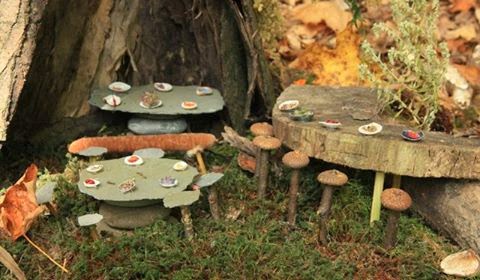
The Nature House Museum hosts a "Fairy House Tour", which will be held this year on Saturday and Sunday, September 27th and 28th, 2014.  I don't know about you, but I was intrigued and hope to make the trip this year!  Below are some photos from last year's event.  I am inspired to make a few fairy houses around my own property.....Their website reads:

"A hand-carved door. A meticulously shingled roof. Tables set with acorn cups. A toadstool merry-go-round. And woods and gardens echoing with the sounds of delighted tour-goers of all ages.

A​lways held on the last weekend in September, the Fairy House Tour has become a cherished autumn tradition in southern Vermont. In 2013, over 600 people attended our Fifth Annual Fairy House Tour. The fairy houses were incredible, the weather was glorious--and the record attendance means more support for our school and community nature programs throughout the year. We are a non-profit organization, and the fees for our programs do not begin to cover the costs of producing them. The Fairy House Tour is a key part of our year-round fundraising.

Tour goers wore fairy wings, built their own fairy houses in our gardens, made fairy wands, and marveled over the three dozen fairy houses in the Village Park woods behind the Museum."


GUIDELINES FOR BUILDING FAIRY HOUSES

"Use natural materials – feathers, dry grasses, leaves, sticks, pebbles, shells, bark from a fallen tree, milkweed, moss, nuts, pods, acorns, berries, gourds, miniature pumpkins, pine cones.
All fairy houses must appear to be made entirely of natural components. Hot glue, acrylic spray, natural twine and other man-made items can be used but must be completely concealed by natural elements.
Platforms or man-made support materials can be used for easier delivery and transport, but must be concealed with natural materials when installed on-site.
Houses may be any size and the theme of the house may be anything you wish.
Please do not use any items of value in the houses.
Free parking. No pets please."

The Nature Museum
186 Townshend Rd
Grafton, VT 05146
(802) 843-2111
http://www.nature-museum.org


Monday, January 27, 2014

Black Agnes

THE LEGEND OF BLACK AGNES


MONTPELIER,  VERMONT:  
GREEN MOUNTAIN CEMETERY

This statue is one of Vermont's most desirable haunts, particularly at night.

The story of the curse of the statue that was told to me was: "If you lay in her arms at midnight, during a full moon, you will die within 7 days, and 7 of your friends will die, too."  


Another version is if you sit on her lap, you will have 3 strokes of bad luck.   


"One story claims that three teenagers sat on Black

 Agnes during   the full moon, trying to show how

 brave they were. They all drove home safely that

 night and thought they had escaped the curse. But

 within a week one was in a serious car accident,

 one fell and broke  his leg, and the third drowned

 when his canoe capsized in the  Winooski River.

 Just coincidence or the malevolent power of 

 Black Agnes? " -newenglandfolklore.com

John Hubbard bronze statue (shown wrapped in a shroud) was commissioned by Austrian sculpture Karl Bitter in 1899

For anyone believing that this beautiful statue is a statue of "Black Agnes" may want to read the actual memorial of the person that is actually buried here.  And if you are silly enough to believe that you are laying in the arms of a woman....you may want to actually look at the statue itself.  Your first hint might be that this individual is not a she (has no visible breasts), your second hint is that he is not black.


"Black Agnes" - to which this statue is commonly referred, is actually John Hubbard.   John Hubbard lived a relatively short life (1847 - 1899), leaving this world at the young age of just 52.  During his life, however, one of his Aunts died, leaving him a rather large sum of money that was intended to be used for the public good - one of which was the Kellogg-Hubbard Public Library.  Here is the skinny on that story, from kellogghubbard.org:

"The saga of the Kellogg-Hubbard Library began in 1889, when Martin M. Kellogg, a New York City real estate magnate born in Barre, died of a heart attack, followed three months later by his widow, the former Fanny M. Hubbard, a Montpelier native. The couple had agreed their $300,000 estate should be given to the city of Montpelier to construct ornate entrance gates for the Green Mount Cemetery and to build a public library.


But Fanny's nephew, John E. Hubbard, contested her will. After signatories to Fanny's will testified at a probate court hearing that they hadn't realized they were signing a will, the judge ruled in Hubbard's favor and declared the will void. Town fathers filed a counter suit, and after three years of dispute — with local residents taking sides — John Hubbard agreed to build a library."


But what of "Black Agnes" a.ka. "Black Aggie" a.k.a. 'Black Annis"?  From where did this curse and urban legend come?  


Well, you might as well jump on the band-wagon, because there are many trumpeters here to join you.  Researching this has been very informative and interesting.  It always amazes me how stories are started, and how they evolve into urban legend.


In Maryland:

Original statue before it was removed and replaced with a bronze statue
"Black Aggie is the folkloric name given to a statue formerly placed on the grave of General Felix Agnus in Druid Ridge Cemetery in Pikesville, Maryland. It is an unauthorized replica, rendered by Edward L. A. Pausch, of Augustus St. Gaudens' allegorical figure, popularly called Grief, at the Adams Memorial in Rock Creek Cemetery in Washington, D.C. The statue shown above is of a seated figure in a cowl or shroud. 

Beginning with its installation in 1926, the statue was surrounded by many urban legends, principally that someone spending a night in its lap would be haunted by the ghosts of those buried there; that the spirits of individuals buried at Druid Ridge would annually convene at the statue; that no grass would grow on the ground where the statue's shadow would lay during the daytime; or that the statue would animate itself during the night, whether by physically moving or by showing glowing red eyes.


These urban legends led to much unwelcome attention toward the statue; many people were caught breaking into the cemetery at night to visit it, and the pedestal was frequently vandalized. The Agnus family, disturbed by the attention the statue received, donated it to the Smithsonian in 1967. It sat for many years in storage at the National Museum of American Art (later named the Smithsonian American Art Museum) where an authorized recasting of the original Adams Memorial statue now sits.

"Black Aggie", today in bronze
 Black Aggie was moved from her previous home at the museum to a courtyard behind the Dolley Madison House on Lafayette Square[disambiguation needed] in Washington, D.C. where she currently stands. The bare, blank pedestal remains at the statue's former home at Druid Ridge Cemetery." -wiki

In West Virginia:

"Black Agnes is a statue located in a cemetery in West Virginia, she is a very famous statue of a seated lady, with her hands outstretched. Is believed to be in the memory of Felix Agnus (1839-1925), a General from the Civil War.

Another version of the legend behind this statue (and most popular) says that in this grave, lies a woman who died from a broken heart, but let me tell you why is this statue famous: One of the legends says that at midnight, if you dare to look at her eyes, they will burn bright red and then they will turn you blind, or even kill you with her gaze, but there is another legend.

A teenager girl it's in a slumber party with her girlfriends playing truth or dare, when one of her friends dare her to go to the cemetery and sit on Black Agnes' lap. The young girl accepts the challenge and makes her way to the cemetery.  After some hours, she never made it back to the party, all of the girls thought she got afraid and just went to her home, and all of them decided to call it a night and went to sleep.

The next morning all of the girls had to walk in front of the graveyard to go to school and noticed that one of the shoes of their friend outside and decided to see what happened. When they got to the statue, they screamed in horror when they saw their friend dead, laying on the arms of the statue.

There are various versions of this legend as I said before, sometimes is a girl that has to sit on the statue's lap as a sorority initiation dare, other version says that the girl is a descendant from the woman's fiance, and she finally had her revenge.


Also in some versions of the legend says that on the body of the dead girl, were found marks that looks if she was held by a superhuman clutch. But the legend of the killer statue its not only based on Black Agnes. There are various statues around the world that share the same legend, all of them having as an end, that the girl is found dead on the arms of the statue." -read-legends-and-myths.com

In England: 


"Black Annis, also known as Black Agnes, is a bogeyman figure in English folklore. She is imagined as a blue-faced crone or witch with iron claws and a taste for humans (especially children).  She is said to haunt the countryside of Leicestershire, living in a cave in the Dane Hills, with an oak tree at its entrance.

She supposedly goes out onto the glens at night looking for unsuspecting children and lambs to eat, then tanning their skins by hanging them on a tree, before wearing them around her waist.  


She would reach inside houses to snatch people. Legend has it that she used her iron claws to dig into the side of a sandstone cliff, making herself a home there which is known as Black Annis's Bower. The legend led to parents warning their children that Black Annis would catch them if they did not behave." 


The earliest written account of ‘The Old Hag’ which comes from a poem written in 1797 by John Heyrick, a lieutenant in the 15th Regiment of Light Dragoons (which later became 15th/19th King’s Royal Hussors). In the History of Leicester, Heyrick recalled this poem, and insisting it to be a true story.  It is understood that his honorable character meant that he could be quite trusted.  These six lines of Heyrick’s poem were the foundation to every tale and every description of Black Annis written since:

"Tis said the soul of mortal man recoil’d,

To view Black Annis’ eye, so fierce and wild;

Vast talons, foul with human flesh, there grew

 In place of hands, and features livid blue

 Glar’d in her visage; while the obscene waist

 Warm skins of human victims close embraced.

 Where down the plain the winding pathway falls,

From Glenfield Vill to Lester’s ancient walls,

Nature or Art with imitative power,

Far in the glenn has placed *Black Annis’ Bower.

An oak, the pride of all the mossy dell,

Spread its broad arms above the stony cell;

And many a bush, with hostile thorns arrayed,

Forbids the secret cavern to invade;

Whilst delving vales each way meander round,

And violet banks with redolence abound."


*Black Annis, also known as Black Agnes, is an evil witch-crone figure from English folklore.  Supposedly, she possesses a blue-face of a crone or witch and has iron claws with an appetite for humans - and especially likes children.   She is said to haunt the countryside of Leicestershire, England and lives in a cave in the Dane Hills.  Legend states that there is an oak tree at the entrance of the cave. 

In England, and earlier still....

There was a woman by the name of Agnes Scott, who in the "The Description of Leicestershire” is described as ‘Black Agnes.’ Agnes was a real person, in fact, she was a Dominican Nun, "is surmised to have lived in a cave near the Dane Hills and from there ran a leper colony."  She died in 1455 and was buried at Swithland church. An engraved brass plate memorializes her at the church, engraved in Latin translates:


The Swithland Church
"Enclosed in this tomb lies Agnes Scott, called the devout mother of Lady Ferrers. Whoever thou shall pass by pour out prayers, I beg. I am what thou shalt be. I used to be what thou art. Pray for me, I pray."


Scotland:  1337

"Agnes, Countess of Dunbar, was the daughter of Thomas Randolph, Earl of Moray, a close ally of Robert the Bruce. In 1337, while her husband was fighting in the north, ‘Black Agnes’ defended her home, Dunbar Castle, against an English siege.


Dunbar Castle
Black Agnes was named for her olive skin and black hair. She was outraged when the Earl of Salisbury besieged her home and she refused to surrender.


For months Agnes and a few servants and men held out against the English forces. The English earl brought mighty siege engines to batter the castle walls. Agnes and her ladies walked the battlements and dusted the walls where they had been hit with their white handkerchiefs.

Agnes stood on the walls of the castle and berated the English forces.

When the Earl of Salisbury brought a battering ram called ‘a sow’ to the castle, Agnes had a massive boulder - that the attackers had fired at the walls - dropped on the war machine, destroying it.

The English held Agnes’ brother John Randolph, Earl of Moray, captive. They put a rope about his neck and threatened to hang him. Agnes called their bluff telling them to go ahead as she would fall heir to the Earldom of Moray. The English relented and Randolph survived.


Eventually the English earl gave up and abandoned the siege. Black Agnes became a folk hero. A ballad, put words into the mouth of the Earl of Salisbury:"


"She kept a stir in tower and trench, 

That brawling, boisterous Scottish wench, 

Came I early, came I late, 

I found Agnes at the gate."