
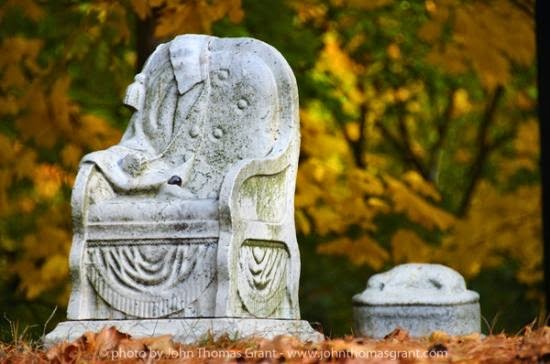
What happens when you sit in a stone carved chair, intended for someone's final resting place? Pull up a seat, and find out.

.jpg)




theunexplainable.net writes:
"When visiting older graveyards and other locations where the dead are buried, you may come across a mysterious stone chair or bench along the way in the midst of the ancient tombstones. What are these chairs? And is there a reason that so many communities throughout the world have dubbed them "Devil's Chairs?"
The chairs themselves are often ornate, carved from solid granite or other expensive stone and held in the ground affixed by either iron bolts or its sheer weight to a firm stone cube within the ground. The monuments may themselves be confused with gravestones, though they are often simply unmarked monuments with a practical purpose - the comfort of 19th century visitors to the grave sites in times when the graves themselves were often remote and had to be traveled to on foot and to avoid visitors from disrespecting the graves of the interred by sitting on them. Gravestones, which are surprisingly fragile over time, were instead left alone while the chairs were used.
Alternatively, as the chairs became more popular occasionally ornate ones were placed in the ground with the intention simply of being observed for their craftsmanship and beauty. But as people began to forget the culture of these chairs, originally known as "mourning chairs," the legends began to fill the void.
The Devil's Chair has been spotted in several cemeteries throughout the eastern United States and the midwest. The chairs are said to have been placed in a given location as a tempting offer to the visitors to sit in, and part of a ritual component designed to summon powerful demons or even in some cases the devil himself to the location. Legends often follow a formula intended to frighten or dare visitors to sit in the chair if they are brave enough.
The chairs are said to be connected by unknown means to the world of the dead, often depicted as a version of Hell. And on Halloween if you sit in one - generally described alone without mention of the others that have been built - you will be visited by a demon which will either claim your soul or give you a great fortune. One of the chairs in Highland Park, Missouri (just west of the home home to the legendary Hell Gates) is said to have a phantom hand lurking beneath the chair which will drag the offending party beneath the Earth to another realm.
Visitors are often said to visit these locations with the intention of spotting the paranormal, and accounts from the visitors suggests that sometimes these visits don't go precisely as planned. Is it possible the legend itself could have built up something in the minds of the visitors to bring them into existence? Is it possible the mind itself, and the legends it comes to believe in could become the ultimate catalyst in bringing something from the realm of imagination not necessarily into the real world fully, but somewhere in between? In this way, the legend of the Devil's Chair could have started as mere legend, but become something more in time."


The Devil's Chair
"The term devil’s chair (or "haunted chair") in folklore is frequently attached to a class of funerary or memorial sculpture common in the United States during the nineteenth century and often associated with legend tripping. Nineteenth century graveyards sometimes included carved chairs for the comfort of visitors. In this function, the object was known as a "mourning chair," and cemeteries have since provided benches for similar purposes, most often movable units of the type used in parks, but also specimens in the tradition of the carved chairs.
Some carved chairs were probably not intended for use as anything but monuments, while the "monubench" is still commercially available. Once the original purpose of these chairs fell out of fashion, superstitions developed in association with the act of sitting in them. In a typical example, local young people dare one another to visit the site, most often after dark, at midnight, or on some specified night such as Halloween or New Year’s Eve. Variously, the stories suggest the person brave enough to sit in the chair at such a time may be punished for impudence or rewarded for courage." -wiki
theunexplainable.net writes:
"When visiting older graveyards and other locations where the dead are buried, you may come across a mysterious stone chair or bench along the way in the midst of the ancient tombstones. What are these chairs? And is there a reason that so many communities throughout the world have dubbed them "Devil's Chairs?"
The chairs themselves are often ornate, carved from solid granite or other expensive stone and held in the ground affixed by either iron bolts or its sheer weight to a firm stone cube within the ground. The monuments may themselves be confused with gravestones, though they are often simply unmarked monuments with a practical purpose - the comfort of 19th century visitors to the grave sites in times when the graves themselves were often remote and had to be traveled to on foot and to avoid visitors from disrespecting the graves of the interred by sitting on them. Gravestones, which are surprisingly fragile over time, were instead left alone while the chairs were used.
Alternatively, as the chairs became more popular occasionally ornate ones were placed in the ground with the intention simply of being observed for their craftsmanship and beauty. But as people began to forget the culture of these chairs, originally known as "mourning chairs," the legends began to fill the void.
The Devil's Chair has been spotted in several cemeteries throughout the eastern United States and the midwest. The chairs are said to have been placed in a given location as a tempting offer to the visitors to sit in, and part of a ritual component designed to summon powerful demons or even in some cases the devil himself to the location. Legends often follow a formula intended to frighten or dare visitors to sit in the chair if they are brave enough.
The chairs are said to be connected by unknown means to the world of the dead, often depicted as a version of Hell. And on Halloween if you sit in one - generally described alone without mention of the others that have been built - you will be visited by a demon which will either claim your soul or give you a great fortune. One of the chairs in Highland Park, Missouri (just west of the home home to the legendary Hell Gates) is said to have a phantom hand lurking beneath the chair which will drag the offending party beneath the Earth to another realm.
Visitors are often said to visit these locations with the intention of spotting the paranormal, and accounts from the visitors suggests that sometimes these visits don't go precisely as planned. Is it possible the legend itself could have built up something in the minds of the visitors to bring them into existence? Is it possible the mind itself, and the legends it comes to believe in could become the ultimate catalyst in bringing something from the realm of imagination not necessarily into the real world fully, but somewhere in between? In this way, the legend of the Devil's Chair could have started as mere legend, but become something more in time."
The Devil's Chair
"The term devil’s chair (or "haunted chair") in folklore is frequently attached to a class of funerary or memorial sculpture common in the United States during the nineteenth century and often associated with legend tripping. Nineteenth century graveyards sometimes included carved chairs for the comfort of visitors. In this function, the object was known as a "mourning chair," and cemeteries have since provided benches for similar purposes, most often movable units of the type used in parks, but also specimens in the tradition of the carved chairs.
Some carved chairs were probably not intended for use as anything but monuments, while the "monubench" is still commercially available. Once the original purpose of these chairs fell out of fashion, superstitions developed in association with the act of sitting in them. In a typical example, local young people dare one another to visit the site, most often after dark, at midnight, or on some specified night such as Halloween or New Year’s Eve. Variously, the stories suggest the person brave enough to sit in the chair at such a time may be punished for impudence or rewarded for courage." -wiki


.jpg)


