{ font: $(body.font); color: $(body.text.color); background: $(body.background); padding: opx; $(body.background.override) } expr:class='"loading" + data:blog.mobileClass'>
Showing posts with label Victorian. Show all posts

Thursday, December 15, 2016

The Many Faces of Santa


Last year at this time, I blogged about strange vintage Christmas cards, which featured (among other strange things) pigs, bugs and mushrooms.   


You really have to wonder if the Victorian artists or those illustrators from the early part of the 20th Century possessed an evil streak or did they simply embrace the season with that era's form of humor?  It is difficult to tell from where they found inspiration, as some illustrations were funny, but others were nonsensical, and dark in nature, and some appear to even embrace violence.   

For instance, dead frogs - how in the world does this suggest a Merry Christmas?  I continue to shake my head, in wonder!


And then, there is this:  A rat apparently hitching a ride on the back of a lobster.  This totally reeks of Christmas!  Not.


Translation:  "Peace, Joy, Health and Happiness."  


With the invention of the camera, Christmas became a favorite subject.  In the 6 photos, featured below, Santa is not always the jolly, sweet man with a white, pristine mustache and beard, whose twinkling blue eyes and merry laugh spread joy.  No, Santa appears to either have tied one on, or suffering the ill effects from the night before.  Let's face it - he's just plain creepy.  


Fortunately, the typical Santa is a more welcoming presence, and his happy demeanor remains his enduring charm and appeal to children and adults around the world.   


Image source:  bindblottyandcajole
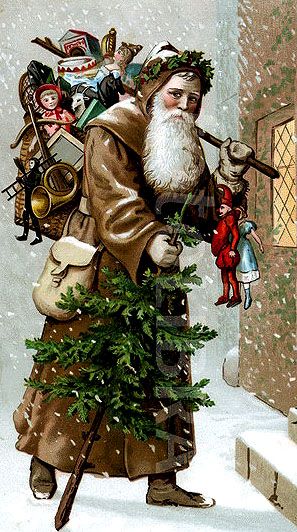
The interesting thing about Old St. Nick, is how many ways he has been portrayed, throughout centuries. Santa Claus is known by many names, for example, in Poland, he is Swiety Mikolaj (St. Nicholas); in Russia, Ded Moroz (“Grandfather Frost”); in Sweden, Jultomten (“Christmas brownie”) and in the United Kingdom, he is Father Christmas.  He is also portrayed as a religious figure as either a Bishop or a Saint.  


If you have read my blog, you probably know by now that I enjoy reading and writing about the Victorian era, and love all things vintage.  These delightful illustrations, featured below, are from (mostly) vintage greeting cards.   They are extraordinary examples of the variations of this beloved figure.  

The reason I love the Victorian artists is because Santa is frequently featured in rich clothing that isn't always the typical white-fur lined red velvet suit.  Instead, he is often portrayed with an air of wealth and social status.  It is interesting to note the detail of illustration to show-case the embroidery and trimmings of his clothing, which are often indicative of this era. 


As you can see, Santa Claus can be thin or fat.  He can be merry or serious.  He can be seen wearing red, or blue or green or beige and apparently has a large assortment of hats.  He may carry a staff, parcels or a sack of toys.  The common denominator is that he always appears in the snow, donning his marvelous long, white beard, mustache and hair.  
However you spot Santa this year, his appearance is guaranteed to bring a feeling of joy to your heart, as we anticipate the sentiments of the season.   May the wonder of it all, be yours. 


Seasons Greetings, 
(with love)

~Denise


Thursday, February 25, 2016

Headcase

You've heard the phrase that fact is stranger than fiction, and when it comes to the Victorian era, I think you will agree that this statement is accurate, particularly when it came to their choices in photographing people. 


Photography was actually invented around the year 1800.  Portrait photography came into vogue until around 1830, and with this new found procedure for capturing images, came an obsession to photograph just about everything.  Dead or alive, they took pictures of it....and, what ever they clicked, the creep factor always tipped the scales.

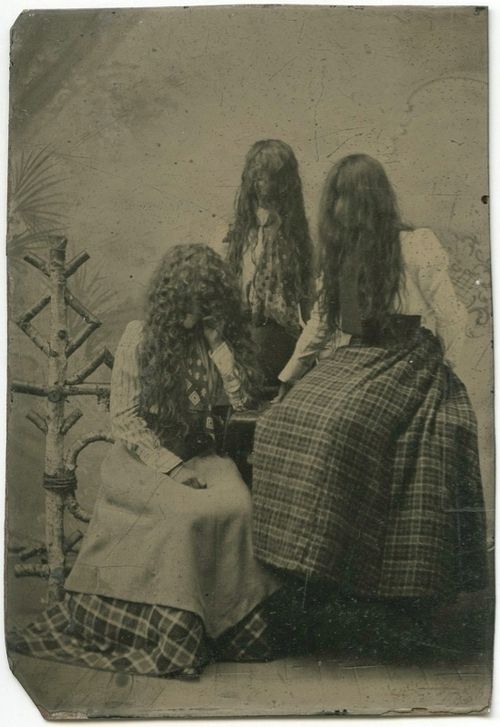
Long hair was rather matter-of-fact, as cutting the hair had not come into popularity. Though these images of loosed hair may be simply recorded examples of how long the hair grew, it was mostly worn braided (note the rippled effect in these images) or piled neatly on top of the head.

Original hippies?


Having your hair cut during that time, may have resulted in disasters, like these:


Experimentation with photo manipulation became popular, so naturally, one would want a photograph of holding one's own head, or the head of another - or appearing without a head all together! One thing is for sure, they had a sense of humor.  And as you can see, some photographers were more clever, than others....


Photography also became a way to share information such as the creation of wanted posters that were distributed to the public, and displayed the alleged criminals or fugitive's "mug". They were formally drawn, so to have an actual image of the individual was in any law-man's favor.  These became popular in the latter part of that era.  Here are a few examples of some of the more notorious wanted criminals:


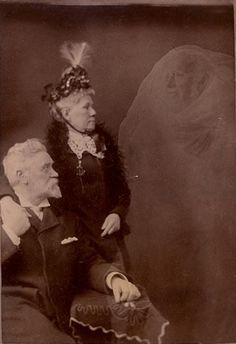
Photo manipulation took on a whole new genre during the height of the Spiritualism Movement.  Again, some photographers were better than others in executing these interesting results.  And, I must say that some of these images are rather convincing! 


And finally, what blog post would be complete without people's bodies in animal heads?  ps... If you have seen Mad Dogs on Netflix, a couple of these images just might make your hair curl.


If you enjoyed these oddities in time, check out Hidden Mothers, on Vermont DeadLine, it is a must see!  

Image credits:  All images were found on Google Images and Pinterest.