{ font: $(body.font); color: $(body.text.color); background: $(body.background); padding: opx; $(body.background.override) } expr:class='"loading" + data:blog.mobileClass'>
Showing posts with label Voodoo. Show all posts

Wednesday, February 4, 2015

Haunted Myrtles Plantation, Louisiana


Northwest of New Orleans, and just east of the Mississippi River lies a sleepy plantation that is a grand example of antebellum style architecture found in the deep South, known simply as the Myrtles Plantation.  


As you approach the facade of the clapboard mansion in St. Francisville, you cannot help but be impressed to see an intricate grill-work design of grape vine made of cast iron, that has been painted in a soothing pale green color, and outlines this long (120 foot) veranda.  Lovely pink myrtle trees fill the southern air with their sweet scent.  

However impressive this southern beauty may be, it has been long suggested that this mansion was originally built atop of an ancient Tunican Indian burial ground.  The Tunica were Native Americans who lived in the Mississippi Valley.  While researching this article, I learned that the Tunicans used a language now referred to as "isolate" which simply means that the tongue in which they spoke had no relationship to other languages known. Their language was their own: unique and isolated.

Bradford
This southern beauty plantation was originally dubbed "Laurel Grove" and it was built by General David Bradford (somewhere between 1794 to 1796).  Bradford lived by himself there for a few years until he was pardoned by President John Adams because of his activity during the Pennsylvania Whiskey Rebellion.

After things died down a bit, he brought his wife and 5 children from Pennsylvania.  Bradford did not remain long on this earth after this, and died in 1808.  

Woodruff
Almost a decade later, his daughter Sara Mathilda married a law student by the name of Clark Woodruff.  This couple eventually inherited the plantation and produced 3 children by the names of Cornelia Gale, James, and Mary Octavia. 
During the unfortunate era in time, Clark obtained a lovely slave named Chloe.  

Now, Chloe was naturally interested in her surroundings and took to listening to the family's conversations, and reportedly spying through a keyhole.  She was discovered by Clark, who promptly cut off her ear to teach her a lesson about eavesdropping and spying.  It has been documented that after this terrifying incident, Chloe donned a green turban to cover her disfigurement.  

[Other versions of the story declare that Clark forced Chloe into being his mistress against her will, and that he repeatedly forced himself upon her.]

To put it mildly, Chloe was not impressed by this infraction  and devised a twisted plan to earn back the trust of Clark and the family.  Luck was on her side, as the oldest daughter's birthday was just around the corner, and Chloe was responsible for making the birthday cake.  


And so, Chloe set about mixing the cake with the basic ingredients: flour, sugar, eggs, vanilla bean and just a touch of boiled orleander leaves.  The orleander would add just the right amount of poison to make the family sick and then she would aid in their rescue by returning them all to perfect health.  This would certainly earn back the lost trust of her master!

When the occasion came, the family sat around the table to celebrate the day and to devour the scrumptious cake.  After a few bites, the festivities waned ,as forks were dropped and coughing and choking ensued.  Chloe rushed to their aid by bringing each to their respective beds, but alas! it was too late.  Every one who ate the cake died, including Sara Mathilda who was carrying a baby.  (Mary Octavia survived and lived well into adulthood; and, Cornelia, who did not eat the cake, later died of yellow fever.)

Chloe was very frightened and returned to the homes of her kin and friends, where she confessed that she had poisoned the cake in an effort to make amends.  She was mortified and literally feared for her life.  She returned to the mansion and fell into a deep sleep.  

Her confession did not bode well with the other slaves, for now their own lives may be endangered.  They wanted to keep their homes and their lives so they devised their own plan to show their loyalty to their master. 

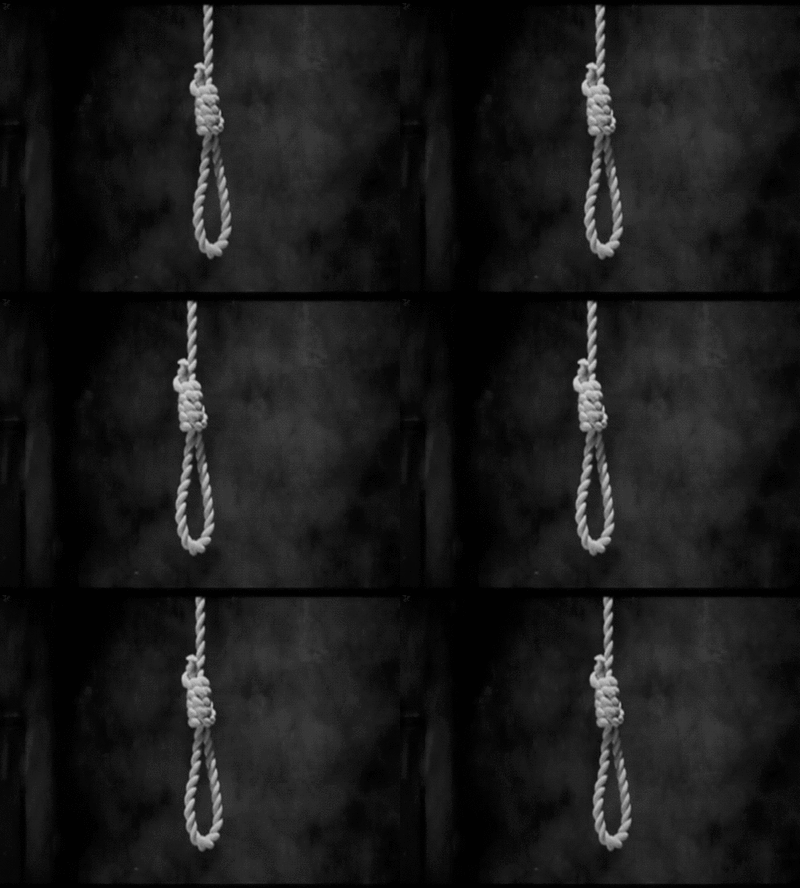
In the darkest hour of the night, some of them crept into the room where she slept and silently stole her.  Once they had her outside, she was hung by the neck in a nearby tree, and then her body was brought to the Mississippi River, weighed by rocks, and tossed in.  Her body was never to be seen again.


Today, and is known as one of "America's Most Haunted Homes".

The mansion changed hands, on several occasions through the years and along the way, many strange reports have been told.  

Subsequent owners and their family members suffered hardship and many met their fate by tragedy or disease.

Whether or not the site is build over an old burial ground, has not been fully substantiated, but one must ask - haven't you seen the movie, Poltergeist?  Apparently this is not a smart move!

During the Civil War, the Myrtle Plantation was looted and many personal belongings were annihilated. 

Some say that during this loot, three Union soldiers were killed after they gained entry and were shot to death in the gentlemen's parlor.  Today it is told that bloodstains are left on the floor of that spot, and cannot be washed away: 

"...William Drew Winter was lured out of the house by a rider, who shot him to death on the side porch. It is here where the stories take a turn for the worse. In the legend, Winter was shot and then mortally wounded, staggered back into the house, passed through the gentlemen's parlor and the ladies parlor and onto the staircase that rises from the central hallway. He then managed to climb just high enough to die in his beloved's arms on exactly the 17th step. It has since been claimed that ghostly footsteps have been heard coming into the house, walking to the stairs and then climbing to the 17th step where they, of course, come to an end."  
- prairieghosts.com

Today, some claim steps can be heard on the stairs, during the middle of the night.  People have counted the steps, as they occur and state that the footstep sounds stop on the 17th step.


At the end of the Civil War, one owner went bankrupt (but the family was able to regain their fortune).  This same owner,  William Winter - who was actually a caretaker, not an owner - was shot on the front porch and died.

His wife, Sara, died at the young age of 44.

A child died of typhoid.

Another owner's son went to round up cattle during a storm and drowned upon falling into the Mississippi River.

In one of the upstairs bedrooms, a young lass died of yellow fever. Distraught, her parents called upon a Priestess of VooDoo to work her magic because conventional medicine did not work.  But alas! the little girl died.  The enraged parents hung the witch doctor from the bedroom chandelier.  

An elder son of another owner was stabbed to death in the mansion over a gambling debt.

A tale is told that a caretaker was murdered during a robbery that allegedly occurred in 1927.  One with a sharp eye may witness him at the plantation gate, advising people to leave.


A soldier from the Civil War died at the interior entry (near the front door) after suffering from battle wounds. 

He was known to be a heavy cigar smoker, and he had stayed at the house before before he died. 

Today, the Myrtles Inn is non-smoking but those who have stayed in his room can sometimes smell the smoke of his cigar.

The ghostly mirror of Myrtle's Plantation
One of the most enduring tales is that of a mirror which has actually been in the house since it's construction.  Some say that the mirror has ensnared the souls of some of the former occupants, that died there. 

When ghostly images of hand prints began to appear, the mirror was exhaustively cleaned...but they hand prints returned.  Perhaps it is the glass in the mirror, they thought, and the glass was replaced.  With the original frame intact, a new glass was installed but eerily, the hand prints continued to return.  This was repeated once again (replacing the glass) but the hand prints continue to appear.

"Those who have seen the mirror up close describe it as “unsettling.” A faint residue of “drips” running from top to bottom mar the glass."  -eldoradofurniture.blogspot


Friday, July 18, 2014

VooDoo


"Voodoo is a religion that originated from Africa in the Kongo and Fon regions approximately 6,000 years ago. "Voodoo" means "sacred" or "spirit" in Fon. They believe in a supreme god in Voodoo such as the god Bondye in Haiti. This deity is extremely powerful and intangible of humans. Only with the help of thousands of believers and spirits, can they reach Bondye, known as Ioa or Iwa in Haiti. Voodoo is a spoken tradition, so there is no one book to which a believer can refer.


"The practitioners of Voodoo, often called Voodooists, believe the real world is intertwined with the spirit world. When we die, we pass over to that unseen realm where we can still observe and even help or harm the living. The spirit world also contains the Lwa, which embody certain characteristics, such as bravery or kindness. There are numerous spirits each possessing different degrees of each characteristic. The Voodooist seeks their counsel and advice through ceremonies and offerings. Voodoo spirits can also take over the bodies of believers, commanding those bodies to do their bidding. There are no unifying sacred writings or scripture in Voodoo."


"Beliefs in these Voodoo spirits came to the Americas with Africans who were captured as slaves more than 400 years ago. People from different villages lived and worked together in the New World and combined their traditions. Voodoo continues today in Haiti, Cuba, Brazil and New Orleans, but this Voodoo is somewhat different from the traditional African version. In the Americas, slaves often mixed their African religion with their captors' Catholicism and with Native American religious beliefs. They melded Roman Catholic saints with their familiar Voodoo spirits. Voodoo priests, like Catholic priests, are respected members of the community whose intercessions with the spirits are necessary. Priests perform healing rituals as well as provide counseling and practical help. Spirits don't just assist people with their troubles, however. Just like Christianity, Islam and several other large religions, Voodoo features malevolent spiritual figures who can act out to do harm to the living. Part of the tradition of Voodoo is this spiritual struggle between the forces of good and evil." -curiosity.com


" Voodoo is based on the belief in the presence of powerful yet invisible forces (les invisibles) that directly affect our lives and behavior. In times of crisis, a believer may invoke the aid of these spirits, also referred to as loa, for support and assistance. (Christians can invoke the so-called Holy Spirit for similar support.) This conception of metaphysical forces that can be both harmful and helpful is found in all religions. The ancient Greeks called them daimones. Other religions refer to them as angels and demons. (Actually, the word demon derives from daimon, but carries only the negative aspect of the daimonic.) In shamanism, they are known as spiritus familiares, "winged ones," supernatural beings not unlike angels but different: If the shaman accepts and cooperates with these spirits, they become helpful. But if he or she rejects or resists them, they turn demonic and destructive." -Psychology today


A simplified explanation of VooDoo:  From WiseGeek.com:

"The widely held image of Voodoo in the Western world is one of wax dolls with pins sticking out of them and black magic. It is, however, one of the world’s most ancient religions. Voodoo arrived in the West during the slave trading days, and the basis of the religion came from Africa. The practice as it is most widely known was structured in Haiti, where a variety of different ethnic groups amalgamated their traditions into this form of the religion.

Voodoo is a West African word meaning "spirit," and comes from term vodun. The basic ethos of the religion is that everything in the universe is connected. Nothing happens by chance in this world, and there are no accidents. Everything that one person does to another, he is doing to himself, because he is that person.

Religious ceremonies contain prayers, dancing, and rituals, as well as animal sacrifices. The figure of the snake plays a major part in the rituals, and the high priest or priestess will embody the serpent’s power. Spirits of wealth, nature, and happiness possess the bodies of believers at the ceremony. Dancing and music are also major elements. In the West, the dancing has often been portrayed as sexual, but that is not its main purpose: it's a way to connect with spirits and the spirit world.

Voodoo is an important part of family life in any community that practices it. The high priest has a great deal of influence and gives spiritual advice when it is asked for. He or she is also seen as a healer and practices with herbs and medicines. The knowledge that the high priestess has gained will have been passed along through prior generations.

Practitioners also use spells, most of which are performed to evoke good, not harm. There are healing spells, love spells, and spells to celebrate joy. The image of black magic and harmful spells was mainly founded by Europeans who had a distrust of anything African.

Voodoo is practiced as a religion in a number of countries around the world. In Brazil, it is called Candomble, and in the Caribbean, it is called Obeah. In 2003, the government of Haiti sanctioned it as an official religion, so believers can be baptized and married within the practice. It has taken centuries for this official action to happen, however, and believers say it will take more than an official show of faith to make up for the persecution that followers have had to contend with. There are millions of people in Haiti alone who share this faith."

SYMBOLS (Called Veve or Vévé ):


In Vodoun (Voodoo) practice, Veves are intricate symbols of the Loas (gods), and are used in rituals. They are similar to the sigils used in ritual magic.  Each Loa has his or her own complex veve, which is traced on the ground with powdered eggshell or a similar substance prior to a ritual. The ability to draw a Veve correctly is considered to be a particular skill of the initiate. A veve is believed to be more powerful if it is drawn with the correct details.


OTHER SOURCES:

http://www.omplace.com/articles/Voodoo_History.html

http://en.wikipedia.org/wiki/West_African_Vodun

http://www2.webster.edu/~corbetre/haiti/voodoo/biglist.htm

Looking for an online voodoo spell? Try this link:
 http://www.ancientvoodoo.com/spell.php


Monday, October 14, 2013

It's All Fluff ~ Feather Superstition


I admit it.  I have a feather phobia... Ever since I was a child, my mother would warn me not to pick up feathers, because birds are dirty and have germs.  Maybe she had a premonition about Bird Flu... who knows!  My Grandmother said to never bring peacock feathers into the home, as it is considered bad luck.  I never thought to ask her from where she originally heard that superstition.  So, I have never liked feathers indoors; heck, I have never even owned a boa!  Gram ma's peacock feather phobia piqued my curiosity today, so I researched a bit, and found the following information.
  

"White feathers signify either a guardian angel or a loving message from a loved one who is not alive. If you are gifted with a white feather you should save it and keep it close for good fortune.  When you find a feather it means that someone who has died, is thinking of you.


Peacock feathers are considered to be bad luck, especially in the house. Actors and circus performers do not allow them in the tents or on stage. Some believe that the "eyes" on a peacock feather are synonymous with the evil eye and can even be a sign of impending death. In the Mediterranean the feathers are associated with Lilith the she-demon said to be responsible for killing children.


In Greek mythology Argus was a monster whose body was covered with 100 eyes. Hera changed him into a peacock and his feathers were covered with eyes. The feathers symbolize the vault of heaven and all-seeing knowledge. Roman mythology sees peacocks as Juno's birds. The coins they appear on are to denote the female lineage of princesses.


The peacock is associated with Lakshmi for Hindus. The feathers represent fortune, compassion, kindness, and patience. Kwan-yin in Asian culture is a similar figure and the feathers have similar meaning. Buddhists associate peacock feathers with openness because of the display the peacock makes when spreading its tail. Because peacocks eat poisonous plants their feathers are considered to sustain the ability to thrive in times of suffering.


Resurrection, immortality, and renewal are what Christians see in peacock feathers. They also symbolize an all-seeing church. In Persia and Babylonia peacocks are thought to be guardians of royalty and feathers adorn thrones. Muslim legend uses feathers as a symbol in temples, the royal garden, and at the gates of paradise. Mongol warriors wore peacock feathers which caused Eastern Europe to view them as bad luck. 


Sleeping on a bed that has peacock feathers will bring death to the person sleeping. Some women get tattoos of peacock feathers to show that they are protective of their children. Another myth says that peacocks slay serpents and transform the venom into solar iridescence that is seen in the feathers. Feathers of the peacock are used as adornment on clothing and hats. Those who wear them are considered to be vain. One last thing about peacock feathers... they are said to be bad luck if they are in the room at a wedding.


Just before 1880 a house was demolished in England. Found in the attic were a chair, four brooms, and a string of feathers. It was announced to be the house of a witch. The chair was for resting, the brooms for flying, and the string was called a witches ladder.


The witches ladder was speculated to have several uses. It was one and a half meters long and made of cock's feathers. It may have been used to help the witch to cross the roof. It may have been used to cause deaths. It was most certainly used to take milk away from neighboring cows.


Some thought that it was not a witches ladder, but a sewel. A sewel would be held in the hand to turn back deer while hunting. A second string of feathers was found with much newer feathers. And finally another form of witches ladder was found. It had feathers fastened loosely in a line of black wool.


Each feather was said to represent an ill feeling or bad wish. It was to be thrown into a pool where the feathers would eventually loosen and pull away from the wool, releasing the bad wishes and ill feelings. They would appear as bubbles in the water. Modern witches are said to use witches ladders for good wishes instead of bad.


A pillow with feather stuffing is believed to hold a dying person in this world. Replacing the feathers with another type of pillow will allow a peaceful passing.


The Voodoo religion makes wide use of feathers. Pillow magic is the practice of placing objects into the pillow of a person to cause wasting sickness and even death. Feather pillows are the best type to use because of feathers' magical properties. By using secret spells the "Voodoo" can cause bird or animal monsters to take shape out of the pillow feathers. It will grow slowly and only at night. When it is completely formed the person who has been sleeping on the pillow will die.


In another form of Voodoo pillow magic, a living bird is torn apart and portions of the wings are put into the pillow. Or charms or fetishes made of concoctions containing feathers, bones, hair, rags, and string are used.  Some believe that placing kernels of corn in a child's pillow will keep it from growing. Many Voodoo charms are made using feathers.


Many people associate feathers with Native Americans but they mean different things to different tribes. Even then it depends on the kind of bird the feather came from. Many Indians use feathers only as decoration. Plains Indian warriors were awarded a feather when they took coup or were particularly brave in battle. The females probably did not wear them at all.


The Crown of Feathers is another object having to do with pillows. They are made of down feathers of the same size, all swirled into a circle, and all joined at the center of the circle. When a person dies on a feather pillow and goes to heaven, the angels leave a crown of feathers in the pillow. The older the person - the larger the crown.


In England cock fights used to be great sport. Certain cocks with white tail feathers would show their white feathers and turn from the fight. They were said to be cowards. 


During World War I any male of appropriate age who was not in the military was also considered to be a coward. The White Feather Society was made up of women who would approach any such male and present him with a white feather to show that she thought him to be less than manly. The practice is thought to have begun during the Boer War.


If you find a white and black feather after a prayer, it is believed that the feather is a sign your prayer will be answered.

Feathers from a wren are used by sailors to prevent shipwreck. The wren must be chased, caught, and killed on Christmas Eve. Then it was carried on top of a pole with its wings outstretched. For a coin one feather was bought. At the end of the day so many sailors would have purchased a feather that the wren was practically featherless. It would then be buried on the seashore. The sailor would keep the feather on his person in order to make it home safely.


In East Anglia, it was a custom that anyone carrying a split goose feather must be given help and protection by the Fenmen. During the English Civil War King Charles I and his soldiers escaped by showing their split goose feathers to local Roundhead soldiers. Oliver Cromwell took no action against his soldiers for honoring the custom. However when King Charles was again captured, he sent a message to Cromwell along with his split feather asking for clemency. Cromwell ignored the plea and the King was executed. Cromwell suffered from guilt for the rest of his life.


Carrying the feathers of the kingfisher is good luck. It will protect you from negative energies and bring good health.

Pigeon feathers in a feather bed or pillow prolong the pain and agony of dying.

A swan's feather sewn into the husband's pillow will ensure that he will be faithful.

Wren feathers protect you from drowning.

The magical qualities of a feather can depend on its color. Here is a list of some of the magical properties by color.


WHITE: Purification, spirituality, hope, protection, peace,
blessings of the Moon.

GREEN: Money, fertility, growth.

BROWN: Health, stability, grounding, the home.

ORANGE: Attraction, energy, success.

YELLOW: Intelligence, blessings of the Sun.

RED: Courage, good fortune, life.

PINK: Love

GRAY: Peace, neutrality.

BLUE: Psychic awareness, peace, health.

BLACK FEATHERS: Not recommended.

RED AND BROWN: Healing animals.

BROWN AND WHITE: Happiness.

GRAY AND WHITE: Hope, balance.

BLACK AND WHITE: Union, protection.

GREEN AND RED: Finances.

BLUE, WHITE, AND BLACK: Change.

BLACK AND PURPLE: Deep spirituality.


The last thing to remember is that many birds and all of their parts can be subject to laws. In some cases it is illegal to possess a feather even if you find it on the ground. Make sure you know which feathers are okay for you to have before you decide to make a collection."
Source:  The Nature Center Magazine online