{ font: $(body.font); color: $(body.text.color); background: $(body.background); padding: opx; $(body.background.override) } expr:class='"loading" + data:blog.mobileClass'>
Showing posts with label 1800's. Show all posts

Friday, December 30, 2016

Flower-Power Flour Sacks

Photo credit:  Cimarron County, Oklahoma - A father with his 2 sons in a dust storm, 1936. Photographer: Arthur Rothstein.
There is an old adage that comes to mind, which is appropriate for today's post:  "Necessity is the mother of invention", and this was certainly apparent during the Great Depression.   This economic downturn was the result of the stock market crash in October of 1929 and lasted approximately a decade.  In one day, 16 million shares were traded and 30 billion dollars vanished, and millions of investors were depleted of their finances.  A very dreary picture was painted, as it was known as the "deepest and longest lasting" economic decline in the history of the Western world.    Banks failed.  People's savings were gone, thus spending decreased.  Industries were forced to lay off it's workers.  Unemployment and poverty skyrocketed.

Black Sunday Storm - approaching Ulysses, Kansas on April 14, 1935.  Photo credit: Historic Adobe Museum and pbs.org
Then, after suffering so much loss, our nation had to endure a severe drought which only exacerbated the hardships already felt.  Dust storms became frequent events, which resulted in this time period being known as "the dirty thirties".

Millions of people headed west to find work, however, these migrant workers overburdened the system as they competed for jobs.   Children did not attend school, and were forced to travel with their family in search of work.  Many schools had closed or only offered reduced hours.   People foraged for scraps of tin and wood, from which they made temporary homes.  They sought shelter in old train cars, or abandoned shacks and warehouses.

Photo credit - people and places
Photo credit: inkbluesky.wordpress


Often times, people, like the migrant workers, only had the clothes on their back.  Yet, those who were lucky enough to stay put, made due with what they had on-hand.  They learned to prevent waste and re-use as much as possible.   Frugality was simply a way of life and women began to utilize the cotton sacks in which flour, grain or feed was sold, to  transform them into dresses, curtains, quilts, towels and even underwear for their families!

By the time the Great Depression rolled around, many women had already sewing machines in their homes.   Commercial sewing patterns had been around since the mid 1800's, and I would assume that the art of sewing was not something that was "discovered", but rather the utilization of "found" material was a logical solution to growing children.

It should be noted that the trend for using sacks to transform into clothing, actually began around the mid-19th century, as manufacturers sought cheaper ways to sell their products.  Prior to the manufacturing of "sacks" (for items sold in bulk such as grain, sugar, salt or flour) were sold in wooden barrels or tins, which was much more expensive.  Canvas was then used, and eventually manufacturers began to utilize textile mills to produce strong-weight, yet inexpensive cotton, replacing the more expensive options.

As you can see, Life Magazine captured this photo in which a
factory worker is sealing the top of a flour sack which has
been printed with an actual cut out pattern for a stuffed animal!

Another Life Magazine photo showing this gentleman amidst a
variety of flour sacks, all bearing colorful prints and designs.
 
To explain how textile mills created feed sacks for specific products, it is important to note that if the manufacturer was selling flour, sugar or salt, a tighter weave of cotton was used to ensure that there was no leakage or spillage of the actual product; and in contrast, grain for animals were sold in sacks with a low thread count.


When the manufacturers of these sacks began to realize that women were using not only the intended products, but its shell, they rallied and began to print textiles with both cut-out patterns, as well as a large variety of floral, kitchen and multi-colored patterns.


During this same time, many publications were developed to assist families with ideas of how to utilize the fabric, and some manufacturers of fabric used certain inks that would fade with washing, to print instructions directly on the sacks!  "Sack Dresses" earned popularity not just for poor families but grew into popular fashion.


When you consider the time, it was a very kind - an almost heroic act - on behalf of the sack manufacturers, who had contributed far more than just providing a product.  They brought color into otherwise dark times. At the onset of World War II, economics again forced these same manufacturers to begin to utilize paper instead of cotton and this is where the story ends.

Here are a few examples of the prints found on the colored flour sacks that were manufactured during that era:


Special thanks to Melissa B., who posted this meme on Facebook, and was the inspiration for today's post.  Thanks, Missy! :)


*All images without specific credit were found on Pinterest.com

Saturday, December 24, 2016

1816 - Eighteen Hundred and Froze to Death

Two hundred years ago, in 1816 is known as the 'Year Without a Summer", due to extreme fluctuating temperatures which made growing crops virtually impossible.  Other names assigned to this dark year were, "Eighteen Hundred and Froze to Death", "The Poverty Year", "The Summer that Never Was" and, the "Year There Was No Summer".  

Paricutin volcano erupting in Mexico - Image credit:  mexicoimportarts.com.au
In New England, the "Dark Veil" anomaly prevailed, as 6 inches of snow fell on June 6th, and there was a impenetrable frost during every other normal summer month.  During July and August, temperatures fell to as low as 40 degrees, which caused the inability to raise crops and resulted in farmers charging exorbitant prices or, people hoarded what they had. 


Some went hungry and some farmers even left New England to try their luck in the west.  Snow fell the following day, in Boston, which was the latest time ever recorded.  On June 8th, in Cabot, Vermont 18 inches of snow blanketed the ground.  

The New England Historical Society states, "On June 11, a temperature of 30.5 degrees was recorded in Williamstown, Massachusetts. Frozen birds dropped dead in the streets of Montreal. Lambs died from exposure in Vermont."  Then, just 11 days later, temperatures soared to 101 degrees in Salem, Massachusetts, and then plummeted between 30 to 40 degrees around the region, during the beginning of July. 

An unrelenting "dry fog" persisted which gave the skies a reddish hue and sunlight was weak and subdued.  People were able to observe sunspots by the naked eye.  Winds blew, and rain fell but it didn't lift the fog.  Temperatures dramatically soared, and then fell to freezing within hours.  


Here in the east, people were fearful of famine and rightfully so, as the railroad from the west had not been operating so they were unable to share the stocks from their granaries, so the east did what they could in their own communities to simply eat.  But, the effects were felt across the world.  


Remarkably, it gave rise to the growing and production of opium in China.  After their crops failed, they found new prosperity in this trade. 

The origin of this strange year was the result of a volcanic eruption, that occured in April, 1815 (designated as the most powerful eruption in recorded history) at Mount Tabor, in Indonesia.  


Image source: eh-resources.org
The Tambora volcano registered a 7 on the Volcanic Explosivity Index whose measurements are from 0 to 8, with 8 considered a "mega-colossal" event.  To compare this to other historical eruptions, Mount St. Helen's and Mount Vesuvius (Pompeii) registered as a 5.   It was reported that the mountain summit site was viewed up to 370 miles away, as nothing but pitch blackness for about 2 days.


Billions of tons of gas, ash and debris were expelled from the violent explosion, and lingered in the atmosphere which caused the severe oscillation of temperatures, lingering fog and the ability to see sun spots.  It is assumed that at the time of the eruption, possibly hundreds of thousands of people died from the pyroclastic lava lows which extended up to 12 miles surrounding the site.  Tsunami waves crashed onto shore at heights up to 13 feet.  Sulfurous gas and falling ash likely choked people to death. 


This natural disaster likely slowed the Indian monsoon, which is the world's largest weather system, encouraging drought due to the devastation of crops, and inevitably brought disease.  A breakout of a deadly strain of cholera, developed in the Bay of Bengal as the volcano actually altered the microbial ecology in the surrounding seas and mutated into a new strain. It began to affect the local population and then spread into Asia.  The disease continued it's path around the globe and, before all was "said and done", an estimated death toll was in the tens of millions.  

Fortunately, the global climate change lasted about 2 years.  The ash and debris settled back onto the earth's surface, and the sun's radiation slowly returned to normal.   Tomorrow is Christmas, 2016, and I can't help but wonder if the phrase "Christmas in July" was the result of this phenomenon?


mentalfloss.com gives 3 additional facts about this horrible year:

"CROP FAILURES FURTHER HARMED A FOUNDING FATHER.  We don’t normally think of leaders of the United States as individuals without money—especially in current times, it’s common for candidates to require vast personal wealth in order to seek the highest office in the land. In the early days of the United States, however, this wasn’t always the case. Thomas Jefferson lived most of his life deeply in debt, and the summer of 1816 didn’t help. That year’s extreme weather caused Jefferson’s crops to fail for several years afterward, heavily contributing to the Founding Father’s already-considerable debt. Jefferson never recovered financially, and he lived the waning years of his life in debt that would equal millions of dollars in 2016."


"THE YEAR WITHOUT SUMMER HELPED GIVE US THE BICYCLE.  When crops failed as a result of the extreme weather in 1816, it wasn’t only humans that suffered without food. The failed harvests sent the price of oats soaring, making it harder and more expensive for individuals to afford to keep horses for transportation. Looking for a new way to get around, Karl Drais invented a device called a “Laufmaschine,” or a “running machine.” The contraption is very similar to the bicycle we know and love today—instead of using pedals, however, you operated it with your feet Fred Flintstone-style."


"THE COOL DOWN LED TO ARCTIC EXPLORATION.  Weather exists as nature’s way of trying to balance out the atmosphere. When one part of the world experiences extreme weather, somewhere nearby is often experiencing the opposite weather to balance it out. When much of the world experienced a cool-down in the wake of Mount Tambora’s eruption, the Arctic warmed up, and it warmed up enough that it cleared the sea ice and allowed British explorers to map out the area and hunt for the Northwest Passage."

Thursday, December 15, 2016

The Many Faces of Santa


Last year at this time, I blogged about strange vintage Christmas cards, which featured (among other strange things) pigs, bugs and mushrooms.   


You really have to wonder if the Victorian artists or those illustrators from the early part of the 20th Century possessed an evil streak or did they simply embrace the season with that era's form of humor?  It is difficult to tell from where they found inspiration, as some illustrations were funny, but others were nonsensical, and dark in nature, and some appear to even embrace violence.   
For instance, dead frogs - how in the world does this suggest a Merry Christmas?  I continue to shake my head, in wonder!


And then, there is this:  A rat apparently hitching a ride on the back of a lobster.  This totally reeks of Christmas!  Not.


Translation:  "Peace, Joy, Health and Happiness."  


With the invention of the camera, Christmas became a favorite subject.  In the 6 photos, featured below, Santa is not always the jolly, sweet man with a white, pristine mustache and beard, whose twinkling blue eyes and merry laugh spread joy.  No, Santa appears to either have tied one on, or suffering the ill effects from the night before.  Let's face it - he's just plain creepy.  


Fortunately, the typical Santa is a more welcoming presence, and his happy demeanor remains his enduring charm and appeal to children and adults around the world.   


Image source:  bindblottyandcajole
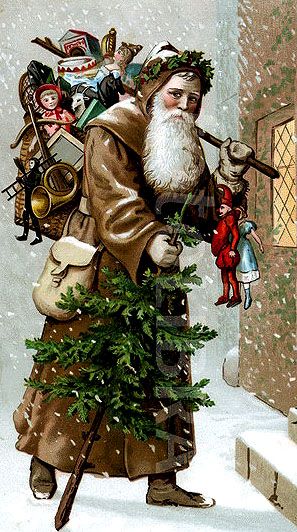
The interesting thing about Old St. Nick, is how many ways he has been portrayed, throughout centuries. Santa Claus is known by many names, for example, in Poland, he is Swiety Mikolaj (St. Nicholas); in Russia, Ded Moroz (“Grandfather Frost”); in Sweden, Jultomten (“Christmas brownie”) and in the United Kingdom, he is Father Christmas.  He is also portrayed as a religious figure as either a Bishop or a Saint.  


If you have read my blog, you probably know by now that I enjoy reading and writing about the Victorian era, and love all things vintage.  These delightful illustrations, featured below, are from (mostly) vintage greeting cards.   They are extraordinary examples of the variations of this beloved figure.  

The reason I love the Victorian artists is because Santa is frequently featured in rich clothing that isn't always the typical white-fur lined red velvet suit.  Instead, he is often portrayed with an air of wealth and social status.  It is interesting to note the detail of illustration to show-case the embroidery and trimmings of his clothing, which are often indicative of this era. 


As you can see, Santa Claus can be thin or fat.  He can be merry or serious.  He can be seen wearing red, or blue or green or beige and apparently has a large assortment of hats.  He may carry a staff, parcels or a sack of toys.  The common denominator is that he always appears in the snow, donning his marvelous long, white beard, mustache and hair.  
However you spot Santa this year, his appearance is guaranteed to bring a feeling of joy to your heart, as we anticipate the sentiments of the season.   May the wonder of it all, be yours. 


Seasons Greetings, 
(with love)

~Denise