{ font: $(body.font); color: $(body.text.color); background: $(body.background); padding: opx; $(body.background.override) } expr:class='"loading" + data:blog.mobileClass'>
Showing posts with label Wicca. Show all posts

Friday, August 1, 2014

Today is Lammas

Lammas:  

(Updated/corrected since this morning)

This is the festival of the First Fruits of the Harvest and is the first festival of the Waning Year.   Summer has piqued and though it was traditionally celebrated on July 31st, Lammas is the first day of Autumn.  You can easily research Lammas, and it's meaning and history, so I will leave that up to the reader, respectfully.


Here in central hills of the Green Mountains, we have been waking to cooler temperatures during the past week, a welcome reprieve from the constant humidity.  Yet, if you sniff the cool morning air, you can sense it is very subtly changing.  With the seasonal changes, one may experience an emotional change.  To me, this day signifies the fading summer.  Grass will begin to appear more yellow than green and leaves on the trees, may begin to change in the same way.  You may feel an urgency to indulge and to make merry before the summer season ends for the year.  

If this is how you feel, that is perfect!  "Lammas takes its name from the Old English "Hlaf," meaning "loaf" and "Maesse," meaning feast."  


"This was one of the four great pagan festivals of Britain, the others being on the 1st November, 1st February, and 1st May. The festival of the Gule of August, as it was called, probably recognized the realization of the first-fruits of the earth, and more particularly that of the grain-harvest. When Christianity was introduced, the day continued to be observed as a festival on these grounds, and, from a loaf being the usual offering at church, the service, and consequently the day, came to be called "Hlaf-mass", subsequently shortened into Lammas, just as half-dig (bread-dispenser), applicable to the mistress of the house, came to be softened into the familiar and extensively used term, lady. This we would call the rational definition of Lammas. There is another, but in our opinion utterly inadmissible derivation, pointing to the custom of bringing a lamb on this day, as an offering to the cathedral church of York. Without doubt, this custom, which was purely local, would take its rise with reference to the term Lammas, after the true original signification of that word had been forgotten."   ~ from the Chambers Book of Days (1864).


Preparing the Lammas Altar

Every altar is different - - (very personal) - - and yours should be too!  

Here, green and white candles have been lit for the Goddess and God, respectfully.  A pink candle burns positive vibrations for emotional love, nurturing relationships and romance. A pink candle will also promote spiritual depth, healing of the spirit, femininity, friendships, honor and morality. Pink is used in rituals to draw affections and brings friendly, lively conversation to the dinner table.


This Lammas altar was prepared with apples, seashells and pine cones.  A poppet (made of sculpey clay) with a cow statue on the right (God/Male) represents the ancient bull - specifically devoted to His Goddess-Mother.  "The Bull owes this association in part to the shape of its horns, in part to its connection with the Sacred Cow-Goddess, and in part to its power and virility. A single bull will produce a herd of calves, which creates prosperity for the people."


A green candle is lit, and surrounded by both seashells, symbolizing eternity, water and the Goddess.  Pine cones were also used (symbolic of the Tree of Life), and as a reflection of the fall season to come.


The East:  (Air):  Incense, Salt


The North: (Earth):  Pictured here, the offering of seasonal fruit.


The West:  (Water):  A picture of blessed water poured into a medieval goblet, a crystal ball and a bell.


Write a wish on a leaf of Bay, burned it over a candle, and then let it finish smoldering in a fire safe bowl (as you visualized the wish coming true). 


The South:  (Fire):  A brass bowl holds the burnt remains of a bay leaf. 


Salt is used to purify water, and symbolizes the element of Air / East (or Earth / North).


Blessed water to the West (water).


A stone of Hematite wards off evil and its energy is known to be calm and cooling. 


Incense to the East, representing Air.


On the left, is the female fairy.  The word Fairy is "derived from the ancient "faunoe o fatuoe" which, in the pagan mythology, indicated the faun's (deer) companions, creatures endowed with power of foretelling the future and ruling the human events. The word Fairy also comes from "fatigue", which in Middle Ages was synonymous with "wild woman", that is woman of woods, waters and, in general, of the natural world. Fairies are supernatural creatures endowed with magic power, thanks to which they can change their appearance and make it change to the others."  And since we are celebrating change, this seemed appropriate.   

"Lammas is often celebrated as the Wake for the Sacred King. As you know, a Wake is a Celebration of Life, not a time to grieve. And Lammas is a joyous time of celebration. Feast to your heart's content, sing, dance and make merry. Light your Need-Fires and make your Kern-babies. You'll "ne'er forget that happy night" you celebrated in The Old Ways!" 


Thursday, May 15, 2014

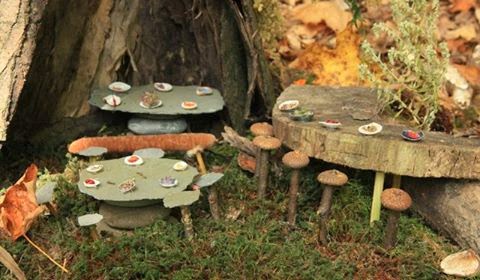
Vermont Fairy Houses

It has been a while since I have made a post....my job and wedding plans have consumed me for the past couple of months.  I am happy to report that I have everything wrapped up.  I have had a lot of fun making all of my own wedding decorations, ordering various things on line and of course, shopping.  It is hard to believe that we will be married in just 15 days and a wake up!

Today I discovered a whimsical and artistic event that is now an annual happening in Grafton, Vermont. Grafton is a small town in Windham County with a population of just about 650 people.  It is east of Manchester and Chester is to the North.

The Nature House Museum hosts a "Fairy House Tour", which will be held this year on Saturday and Sunday, September 27th and 28th, 2014.  I don't know about you, but I was intrigued and hope to make the trip this year!  Below are some photos from last year's event.  I am inspired to make a few fairy houses around my own property.....Their website reads:

"A hand-carved door. A meticulously shingled roof. Tables set with acorn cups. A toadstool merry-go-round. And woods and gardens echoing with the sounds of delighted tour-goers of all ages.

A​lways held on the last weekend in September, the Fairy House Tour has become a cherished autumn tradition in southern Vermont. In 2013, over 600 people attended our Fifth Annual Fairy House Tour. The fairy houses were incredible, the weather was glorious--and the record attendance means more support for our school and community nature programs throughout the year. We are a non-profit organization, and the fees for our programs do not begin to cover the costs of producing them. The Fairy House Tour is a key part of our year-round fundraising.

Tour goers wore fairy wings, built their own fairy houses in our gardens, made fairy wands, and marveled over the three dozen fairy houses in the Village Park woods behind the Museum."


GUIDELINES FOR BUILDING FAIRY HOUSES

"Use natural materials – feathers, dry grasses, leaves, sticks, pebbles, shells, bark from a fallen tree, milkweed, moss, nuts, pods, acorns, berries, gourds, miniature pumpkins, pine cones.
All fairy houses must appear to be made entirely of natural components. Hot glue, acrylic spray, natural twine and other man-made items can be used but must be completely concealed by natural elements.
Platforms or man-made support materials can be used for easier delivery and transport, but must be concealed with natural materials when installed on-site.
Houses may be any size and the theme of the house may be anything you wish.
Please do not use any items of value in the houses.
Free parking. No pets please."

The Nature Museum
186 Townshend Rd
Grafton, VT 05146
(802) 843-2111
http://www.nature-museum.org


Monday, October 21, 2013

Vermont: The Least Religious State


As you may know, Vermonters are excruciatingly slow at change, distrustful of strangers, full of dry wit and fiercely protective of their families and land.  The more remote their location, the more this will ring true.  And, this is certainly true when it comes to their religious beliefs.  While researching material for this entry, I found some interesting statistics:

Did you know....

...that Vermont is the least religious state in the US with only 19% claiming to be "very religious". 

.....that Vermont is second only to Wyoming, for having the slowest growth rate in the country at only 0.02%, ranking it 49th.

.....In 1990 11.4% of state residents described themselves as "nonreligious" and 1.2% said they were agnostic. 

Siddhartha 
.......Often referred to as one of the "whitest states in the nation," Vermont has "not attracted large scale immigration. Hence, major world religions such as Islam, Hinduism, and Buddhism' hardly even exist in this state.

Let's start from the beginning and move forward: 

Jacque Cartier
Jacques Cartier (Roman Catholic) is thought to be the first to have explored our state as early as 1535.  It was during that time that  the Abenaki Indians battled the Iroquois for this land.  

Samuel de Champlain
In 1609,  Samuel de Champlain (Roman Catholic) coined our state's name "Verts Monts" [Green Mountains, Fr].  Several decades later, France claimed Vermont as part of New France, and erected Fort Sainte Anne on Isle La Motte in 1666 as part of their fortification of Lake Champlain. This was the first European settlement in Vermont and the site of the first Roman Catholic mass (church service).


It is said that during the Colonial Times (roughly 1607 - 1793), Vermont's largest religious affiliation was Congregationalism. In 1776, 63% of affiliated church members in Vermont were Congregationalists.  It is believed that approximately 9% of people belonged to a specific church, and this was due largely in part of the populations remote settlements.


"Today Congregationalists (as the United Church of Christ) are third largest religious body in the state. Over 4% of the population are claimed by the UCC as members, and the same percentage name Congregationalism or the UCC as their religious preference. Even today, the Congregationalists have more churches than any other denomination (religious body) in the state. 


The largest single religious body in Vermont today is the Catholic Church. In 1990 the Catholic Church reported that 25% of Vermont residents were members, but the Kosmin self-identification survey indicated that over 35% consider themselves Catholic. The 10% difference indicates a significant number of state residents who are nominal Catholics not affiliated with a parish. 

The United Methodist Church is the second largest church, with about 5% of the population.

The fourth largest church is the Episcopal Church, followed by the American Baptist Churches in the U.S.A. ("Northern Baptists") and the Church of Jesus Christ of Latter-day Saints. 

Taken as a whole, Christianity is clearly the largest religion in the state, claimed as the preferred religion by 83% of state residents. -wiki

Slowly emerging from the depths is the Wicca or Neopagan (Druidism) movement.  I think it would be safe to say that the older generation is especially skeptical and wary of these religions because of there association with terms such as "Witch-craft", or "Dark/Black Magic [Magick]".

Wiccan "Wheel of the Year"

Perhaps, even with introducing the definition of what Wicca is, it would still be considered a dark art, and this is truly unfortunate. Neopaganism and Wicca are what is known as "Earth Based" religion, and absolutely do not worship Satan or the Devil.  This negative stereotype is mostly due to television shows and movies, for to understand any earth-based religion, one must consider that it is the worship of all aspects of nature, often to include both gods and goddesses, and to consider nature as whole source of the universal consciousness.  

Ignorance and fear surrounding these religions feed the frenzy of negativity.   I would suggest that anyone who is fearful of Wicca, to do their homework, and educate themselves properly about every day practice, the wheel of the year, what a pentacle means, and the Sabbats, and so on.  You may also learn that, for many, Christianity is an integral part of earth-based worship!  In Vermont, and certainly New England, you will begin to discover just how many people practice solitary Wicca often right in your back yard!


"Earth religions are formulated to allow one to utilize the knowledge of preserving the Earth."  


Here are a few Vermont resources, if you'd like to discover more:

Merchants online:

http://www.vtwiccan.org/

Shops around the state:  (Please feel free to add to list in the comments ~ this was all I could find online)

Bellows Falls:  The Upward Spiral 

Brattleboro:  Black Bear Trading Post

Burlington:  Blue Heron Imports

                   October Tea Room

                   Spirit Dancer

Milton:  Moonlight Gift Shoppe

Randolph:  Mugwort and Malachite 

St Albans:  Moonshadows Gifts for the Spirit

Wilmington:  Heaven and Earth


"An it harm none, do what ye will."

"There is no divine judgement.

It is up to each individual to decide what is ethical.

Each individual is responsible for his or her actions.

Nature and all life should be honored.

There is no one correct path or religion, only that which fits best for each individual.

Moral doings are done for their own sake and not for a reward."