{ font: $(body.font); color: $(body.text.color); background: $(body.background); padding: opx; $(body.background.override) } expr:class='"loading" + data:blog.mobileClass'>
Showing posts with label Grave Medallion. Show all posts

Monday, April 6, 2015

St. Raphael


Easter has passed by one day, and yesterday during a phone call with my 86 year old Mother, we took a little trip down memory lane, recalling an Easter from the very early 1970's.  


Mom and Dad had bought my sister and I white fur hats and matching muffs, for Easter Sunday service at St. Raphael's Church in Poultney.  We were also given new white patent leather shoes. 

There were Easter baskets filled with jelly beans, chocolate and other candy waiting for each of us that morning, I recall they sat on the wooden bench that was in the hall way near the front door.  It is the only Easter that I remember as a child.  


Above:  This is the only picture I can find of the interior of St. Raphael's online.  I am very disappointed to find only a black and white photo.  The Church itself is quite stunning.  The Stations of the Cross are very impressive, not to mention it's altar. 

St. Raphael's Church
As a small child, I did not understand why we went to church, and why Dad got to stay home, even after it was explained to me that Dad was Lutheran, and we went to Catholic Church.  To this day, knowing my father, I think going to church with him would have been fun, because he made everything fun, or at the very least, he always made us laugh. 


So who was Raphael? 

"St. Raphael is one of seven Archangels who stand before the throne of the Lord. He was sent by God to help Tobit, Tobiah and Sarah. At the time, Tobit was blind and Tobiah's betrothed, Sarah, had had seven bridegrooms perish on the night of their weddings. Raphael accompanied Tobiah into Media disguised as a man named Azariah.


Raphael helped him through his difficulties and taught him how to safely enter marriage with Sarah. Tobiah said that Raphael caused him to have his wife and that he gave joy to Sarah's parents for driving out the evil spirit in her. He also gave Raphael credit for his father's seeing the light of heaven and for receiving all good things through his intercession. Besides Raphael, Michael and Gabriel are the only Archangels mentioned by name in the bible. 


Raphael's name means "God heals." This identity came about because of the biblical story which claims that he "healed" the earth when it was defiled by the sins of the fallen angels in the apocryphal book of Enoch. Raphael is also identified as the angel who moved the waters of the healing sheep pool. He is also the patron of the blind, of happy meetings, of nurses, of physicians and of travelers. His feast day is celebrated on September 29th.


Raphael (Standard Hebrew רָפָאֵל, Rāfāʾēl, "It is God who heals", "God Heals", "God, Please Heal") is an archangel of Judaism, Islam and Christianity, who in the Christian tradition performs all manners of healing. In Islam, Raphael is the fourth major angel; in Muslim tradition, he is known as Israfil. Raphael is mentioned in the Book of Tobit, which is accepted as canonical by Catholics, Orthodox, and some Anglo-Catholics, and as useful for public teaching by Lutherans and Anglicans. Raphael is generally associated with the angel mentioned in the Gospel of John as stirring the water at the healing pool of Bethesda. Raphael is also an angel in Mormonism, as he is briefly mentioned in the Doctrine and Covenants.

In Catholicism:  Tobias and the Angel

The name of the angel Raphael appears only in the Biblical Book of Tobit. The Book of Tobit is considered canonical by Catholics, Orthodox, and some Anglicans. Raphael first appears disguised in human form as the travelling companion of Tobit's son, Tobiah (Greek: Τωβίας/Tobias), calling himself "Azarias the son of the great Ananias". During the course of the journey the archangel's protective influence is shown in many ways including the binding of a demon in the desert of upper Egypt. After returning and healing the blind Tobit, Azarias makes himself known as "the angel Raphael, one of the seven, who stand before the Lord" Tobit 12:15.He is venerated as Saint Raphael the Archangel.


Regarding the healing powers attributed to Raphael, there is his declaration to Tobit (Tobit, 12) that he was sent by the Lord to heal him of his blindness and to deliver Sarah, his future daughter-in-law, from the demon Asmodeus, who kills every man she marries on their wedding night before the marriage can be consummated.

In the New Testament, only the archangels Gabriel and Michael are mentioned by name (Luke 1:9–26; Jude 1:9). Later manuscripts of John 5:1–4 refer to the pool at Bethesda, where the multitude of the infirm lay awaiting the moving of the water, for "an angel of the Lord descended at certain times into the pond; and the water was moved. And he that went down first into the pond after the motion of the water was made whole of whatsoever infirmity he lay under". Because of the healing role assigned to Raphael, this particular angel is generally associated with the archangel.


Veneration and Patronage

Due to his actions in the Book of Tobit and the Gospel of John, St. Raphael is accounted patron of travelers, the blind, happy meetings, nurses, physicians, medical workers, matchmakers, Christian marriage, and Catholic studies. As a particular enemy of the devil, he was revered in Catholic Europe as a special protector of Catholic sailors: on a corner of Venice's famous Doge's Palace, there is a relief depicting Raphael holding a scroll on which is written: Efficia fretum quietum (“Keep the Gulf quiet”). On July 8, 1497, when Vasco Da Gama set forth from Lisbon with his four ship fleet to sail to India, the flagship was named—at the King of Portugal's insistence—the St. Raphael. When the flotilla reached the Cape of Good Hope on October 22, the sailors disembarked and erected a column in the archangel's honor. The little statue of St. Raphael that accompanied Da Gama on the voyage is now in the Naval Museum in Lisbon.

Iconography

Raphael is said to guard pilgrims on their journeys, and is often depicted holding a staff. He is also often depicted holding or standing on a fish, which alludes to his healing of Tobit with the fish's gall.
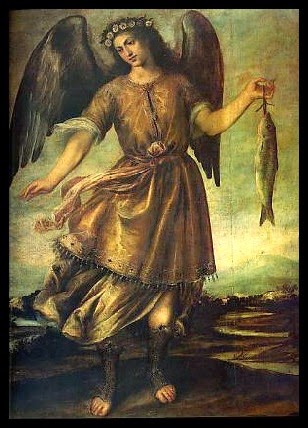

Feast day

The feast day of Raphael was included for the first time in the General Roman Calendar in 1921, for celebration on October 24. With the 1969 revision of the General Roman Calendar, the feast was transferred to September 29 for celebration together with archangels Saints Michael and Gabriel.[7] Due to Pope Benedict XVI's Summorum Pontificum, the Catholic Church permits, within certain limits for public use, the General Roman Calendar of 1960, which has October 24 as Raphael's feast day.

Apparitions

The Archangel Raphael is said to have appeared in Cordova, Spain, during the 16th century; in response to the city's appeal, Pope Innocent X allowed the local celebration of a feast in the Archangel's honor on May 7, the date of the principal apparition. St. John of God, founder of the Hospital order that bears his name, is also said to have received visitations from St. Raphael, who encouraged and instructed him. In tribute to this, many of the Brothers Hospitallers of St. John of God's facilities are called “Raphael Centers” to this day. The 18th century Neapolitan nun, St. Maria Francesca of the Five Wounds is also said to have seen apparitions of Raphael.


Legacy

The following places have been named in honor of Raphael:

Saint Raphaël, France; Saint Raphaël, Quebec, Canada; and San Rafaels in Argentina, Bolivia, Colombia, Costa Rica, Chile, Mexico, Trinidad and Tobago, Peru, and the Philippines; also San Rafael de El Moján and San Rafael de Orituco in Venezuela.

In the United States, San Rafaels inherited from Mexico survive in California (where besides the city there are the San Rafael Mountains)

New Mexico, and Utah, where the San Rafael River flows seasonally in the San Rafael Desert.

St. Raphael's Cathedral, the seat of the Diocese of Madison, Wisconsin

St. Raphael's Cathedral, the seat of the Archdiocese of Dubuque
Mission San Rafael Arcángel in San Rafael, California.

St. Raphael's Church, Huccaby, Hexworthy, Dartmoor National Park, Devon, England

San Rafael Obrajuelo municipality in La Paz, El Salvador.
Popular culture


Paradise Lost

The angel Raphael, along with many other prominent angels, appears in John Milton's Paradise Lost, in which he is assigned by God to re-warn Adam concerning the sin of eating of the Tree of the knowledge of good and evil. He also expounds to Adam the War in Heaven in which Lucifer and the demons fell, and the creation of the Earth.

Raphael features as one of the four archangels in the TV series Supernatural, the other three being Michael, Lucifer and Gabriel.


He is inspired as one of Kaori Yuki's manga characters from Angel Sanctuary."


St. Raphael Blog post taken directly from: http://www.catholic.org/saints/

Friday, October 25, 2013

Odd Fellows and Knights


While traveling through Hyde Park, Vermont a couple of weeks ago, I stopped at the Village Cemetery to take some pictures, and I was struck by all of the strange Veteran grave medallions and flags that were in this grave yard. Some of them are identifiable, others - not so much.  One thing was certain, this town was bursting with pride for those who gave the "ultimate sacrifice".  I also learned about the "I.O.O.F.", and the "Knights of Pythias" grave medallions and flags, which was an interesting twist to this adventure!

I.O.O..F.  Grave Marker (see below)

1883

An example of an Independent Order of Odd Fellows flag (See definition, below)


"Several theories aim to explain the meaning of the name "Odd Fellows". One is that they were called "odd" because in the beginning of Odd Fellowship in the 18th century, at the time of industrialization, it was rather odd to find people who followed noble values such as benevolence, charity and fraternalism.


A variation on that theory states: "The Odd Fellows, at least according to one story, got its curious name from the fact that it was a lodge that opened its doors to the working class who at that time did not ordinarily belong to fraternal orders—and were thus 'odd'. This may or may not be true as the Odd Fellows have been around for a long time and a good many things get lost in the fog of history." Another theory states that Odd Fellows were people who engaged in miscellaneous or "odd" trades. In the 18th century, major trades were organized in guilds or other forms of syndicate, but smaller trades did not have any social or financial security. For that reason, people who exercised unusual trades joined together to form a larger group of "odd" fellows. Finally, a slightly different version of this second theory states: "By the 13th century, the tradesmen's Guilds had become established and prosperous. During the 14th Century, with the growth of trade, the guild 'Masters' moved to protect their power (and wealth) by restricting access to the Guilds. In response, the less experienced (and less wealthy) 'Fellows' set up their own rival Guilds. In smaller towns and villages, there weren't enough Fellows from the same trade to set up a local Guild, so Fellows from a number of trades banded together to form a local Guild of Fellows from an odd assortment of trades. Hence, Guilds of Odd Fellows.


"The Independent Order of Odd Fellows (IOOF) is a global altruistic and benevolent fraternal organization derived from the British Oddfellows service organizations of the 17th century. There are a number of explanations of the origin of the name – for example:  

    In 17th century England, it was odd to find people organized for the purpose of giving aid to those in need and of pursuing projects for the benefit of all mankind. Those who belonged to such an organization were called "Odd Fellows".

The Order is also known as "The Three Link Fraternity", referring to the Order's "Triple Links" logo - three links contain the letters F, L and T, (Friendship, Love and Truth).

The word "Independent" in the organization's name was given by the English parent organization as part of the chartered title of the new North American chapter:

The Independent Order of Odd Fellows was founded on the North American Continent in Baltimore, Maryland, on April 26, 1819 when Thomas Wildey and four members of the Order from England instituted Washington Lodge No. 1. This lodge received its charter from Manchester Unity of Odd Fellows in England.

Odd Fellowship became the first fraternity in the U.S. to include both men and women when it adopted the "Beautiful Rebekah Degree" on September 20, 1851. This degree is based on teachings found in the Holy Bible, and was written by the Honorable Schuyler Colfax who was Vice President of the United States during the period 1868-1873. Odd Fellows and Rebekahs were also the first U.S. fraternal organizations to establish homes for senior members and for orphaned children." 


"The Knights of Pythias is a fraternal organization and secret society founded at Washington, DC, on 19 February 1864.  Knights of Pythias in a parade in Racine, Wisconsin, ca. 1910
The Knights of Pythias was the first fraternal organization to receive a charter under an act of the United States Congress.  It was founded by Justus H. Rathbone, who had been inspired by a play by the Irish poet John Banim about the legend of Damon and Pythias. This legend illustrates the ideals of loyalty, honor and friendship that are the center of the order. The order has over 2,000 lodges in the United States and around the world, with a total membership of over 50,000 in 2003. Some lodges meet in structures referred to as Pythian Castles.


History

Early in the group's history, when a man was inducted into the Knights of Pythias he received a ceremonial sword.  Such swords might be given to a Pythian by family members, business associates, or others as a token of esteem. In recent decades, rather than require each member to own a sword, the local chapter maintains a collection of swords for use by its members. Long, narrow swords are generally used in public during parades and drills, while short swords are used in displays.
Markings on swords varied widely. Most swords were inscribed with the acronym "FCB," which stands for the Pythian motto ("Friendship, Charity, Benevolence"). Images on swords were also somewhat common, and included: A man, woman and child (symbolic of Pythias saying good-bye to his family); a man looking out of a building, with a group of people below (symbolic of Damon's pending execution); a man between some pillars, pulling them down (similar to Samson destroying his enemy's temple); or various types of weapons (swords, axes, hammers, etc.). A full Knight of the Pythian order often inscribed his sword with the image of a knight's helmet with a lion on the crest. Many also carried the image of a sprig of myrtle (the Pythian symbol of love) or a falcon (the Pythian symbol of vigilance).


Organization

The structure of the Knights of Pythias is three tiered. The local units used to be called "Castles", but overtime came to be called "Subordinate Lodges". State and provincial organizations are called "Grand Lodges" and the national structure is called the "Supreme Lodge" and meets in convention biennially. The officers of the Supreme Lodge include the Chancellor, Vice-Chancellor, Prelate, Secretary, Treasurer, Master at Arms, Inner Guard and Outer Guard.

The order's auxiliaries are the Pythian Sisters, and two youth organizations: the Pythian Sunshine Girls and the Junior Order of Princes of Syracuse for boys.

The Knights of Pythias also has a side degree, the Dramatic Order of the Knights of Khorassan,  which itself has a female auxiliary, the Nomads of Avrudaka.  Finally, members who have obtained the Knight Degree may join the Uniformed Rank, which participated in parades and other processions. Swords owned by a member of the Uniformed Rank might be inscribed with the acronym, "UR," a dove, or a lily. (The Uniformed Rank was banned in the organization in the 1950s.)

Membership

Membership has historically been open to white males in good health, who believe in a Supreme Being. Maimed individuals were not admitted until 1875. Though the whites only clause was officially adopted in 1871, no black members had been admitted since the founding of the Order. The question of repealing the whites only clause came up in the 1964 and 1968 Supreme Lodges, but was not definitively acted upon. The Order remained whites only until at least 1979. Members are accepted by blackball ballot.  In the early 1920s the Order had nearly a million members, however by 1979 this number had declined to less that 200,000.

Ritual 

Once an initiate is accepted, he must go through a mandatory initiation rite. This includes being blindfolded, kneeling before an altar, and swearing a series of oaths. The candidate must also endure a set of tests to measure his honor and character.

The degrees of Pythian Knighthood in a subordinate lodge (or "Castle") are:


    Page


    Esquire


    Knight


In 1877 the Order adopted an optional fourth degree, called the Endowment Rank, which provided fraternal insurance benefits. In 1930 this department split from the Knights of Pythias and became a mutual life insurance company, later known as the American United Insurance Company.


A member must be at least 18 years of age. He cannot be a professional gambler, or involved with illegal drugs or alcohol and he must have a belief in a Supreme Being. The oath taken by members:


 'I declare upon honor that I believe in a Supreme Being, that I am not a professional gambler, or unlawfully engaged in the wholesale or retail sale of intoxicating liquors or narcotics; and that I believe in the maintenance of the order and the upholding of constituted authority in the government in which I live. Moreover, I declare upon honor that I am not a Communist or Fascist; that I do not advocate nor am I a member of any organization that advocates the overthrow of the Government of the Country of which I am a Citizen, by force or violence or other unlawful means; and that I do not seek by force or violence to deny to other persons their rights under the laws of such country.'


Philanthropy

The Order provides for "worthy Pythians in distress" and has given aid to victims of national or sectional disasters. It runs camps for under-privileged youth and homes for aged members. It has sponsored scholarship funds, blood drives, highway safety programs and the Cystic Fibrosis Research Foundation."


Source: - Wiki