

Yesterday, I attended a Financial Literacy training at the Red School House in Randolph. During my lunch break, I wandered into the graveyard that was right next to the building. A few gravestones caught my eye, and as I wandered through I found some interesting history.


My eye was drawn to this very ornate cross, so eloquently and beautifully carved. You can see a building of the VTC (Vermont Technical College) campus in the back ground.


I discovered a few very primitive carvings on these early headstones, which all were dated before 1800.
Thomas Pember's grave is still legible, but barely. Vermont's turbulent and violent past comes to life, upon reading this marker.


It reads:
"In Memory of
Thomas Pember,
son of Elijiah and
Hannah Pember, who
was killed by the
Indians in Royalton,
October 16th, 1780."
.jpg)
"The Royalton Raid was a British-led Indian raid in 1780 against various towns along the White River Valley in the Vermont Republic, and was part of the American Revolutionary War. It was the last major Indian raid in New England.
In the early morning hours of October 16, 1780, Lieutenant Houghton of the British Army's 53rd Regiment of Foot and a single Grenadier, along with 300 Mohawk warriors from the Kahnawake Reserve in the British province of Quebec, attacked and burned the towns of Royalton, Sharon and Tunbridge along the White River in eastern Vermont. This raid was launched in conjunction with other raids led by Major Christopher Carleton of the 29th Regiment of Foot along the shores of Lake Champlain and Lake George and Sir John Johnson of the King's Royal Regiment of New York in the Mohawk River valley. Four Vermont settlers were killed and twenty six were taken prisoner to Quebec.
By the time the local militia could assemble, Houghton and his command were already on their way back north. The militia caught up with the raiders near Randolph, Vermont, and a few volleys were fired back and forth, but when Houghton said that the remaining captives might be killed by the Mohawks if fighting continued, the local militia let the raiders slip away. A plaque at the East Randolph cemetery marks the site of this event.
The Hannah Handy monument, on the South Royalton town green, is a granite arch honoring a young mother who lost her young son in the raid, crossed the river, and successfully begged for the return of several children. With the assistance of one of the Mohawk, she caught up with the British and Mohawk party and pleaded with Lieutenant Houghton to release the young boys now being held by the Indians, partly appealing as a mother of one of the captives and partly by arguing that they wouldn't survive the trip to Canada and stating that their deaths would on his hands. The British leader ordered the boys released to the woman for safe return to their families." -wiki

Here is a duel grave marker showing Daniel Bissell, who died in 1814 at the age of 90. Beside him is his wife Elizabeth, who died 2 years later in 1816 at the age of 92. A loving tribute to this couple.

A Revolutionary War Soldier is buried here.

A unique marker belonging to Dolly Paine.

Finally, I was a bit surprised to find the grave stone of Justin Morgan here.
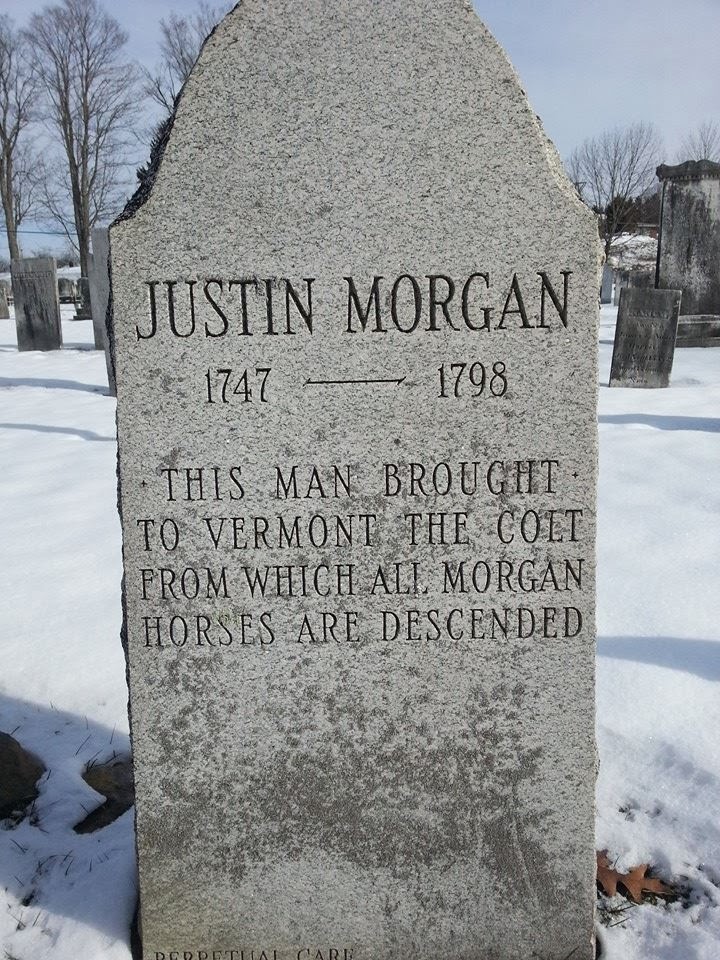

Justin Morgan (February 28, 1747 – March 22, 1798) was a U.S. horse breeder and composer.
He was born in West Springfield, Massachusetts, and by 1788 had settled in Vermont. In addition to being a horse breeder and farmer, he was a teacher of singing; in that capacity he traveled considerably throughout the northeastern states. He died in Randolph, Vermont, where he also served as town clerk.
Justin Morgan was the owner of a stallion named Figure, who became the sire of the Morgan horse breed. Morgan received Figure along with two other horses as payment of a debt. As Figure grew older, people began to recognise his skill in a variety of areas.
Figure became a prolific breeding stallion; his descendants, still noted for their versatility and friendly personality, became the first American breed of horse to survive to the present. Figure's grave is marked by a stone in Tunbridge, Vermont.
Justin Morgan's original 1798 gravestone is preserved in the Randolph Historical Society Museum. His burial site in the Randolph Center Cemetery is marked by a more recent stone.
Morgan was a composer, best known for his hymns and fuguing tunes. While not so famous as those by William Billings, his works share the same characteristic roughness, directness, and folk-like simplicity.
Publications containing his work include The Federal Harmony (New Haven, 1790), and The Philadelphia Harmony, 4th ed. (Philadelphia, 1791). The former collection includes what perhaps is his most famous composition entitled, "Amanda," a setting of Isaac Watts's poem based on Psalm 90. The tune "Despair," in the 1791 collection, cites the death of "Amanda" (referring to his wife, Martha Day, who died in childbirth in the same year) in a paraphrase of Alexander Pope's Ode on Solitude.
Morgan's setting of Psalm 63, entitled, Montgomery, was a popular fuguing tune, reprinted more than 50 times before 1811. Its voice-leading, as is common in works by early American composers, contains numerous unabashed parallel fifths, giving the music a folk-like quality. Another work of his, the Judgment Anthem, is tonally adventurous, moving back and forth between E minor and Eb major.
Morgan and his horse-breeding venture is the subject of a children's book by Marguerite Henry, Justin Morgan Had a Horse, that won the Newbery Medal in 1946. -wiki


In 1789, the same year that the United States Constitution was ratified, a colt was foaled in Springfield, Massachusetts. In 1792 the young horse became the property of Justin Morgan of Randolph, Vermont. Justin Morgan named the small horse Figure. Later the horse would simply be known as Justin Morgan.
It wasn't long until the unique qualities of the dark bay horse began to be known throughout the region. Figure was leased out for one year to Robert Evans and used to clear timber from hilly fields and could out pull horses much larger.
He also was a good race horse, often beating horses after a long day of pulling logs. On one occasion Justin Morgan beat two Thoroughbreds from New York in back to back races.
Between 1792 and 1817 he was advertised at stud many times. It seemed that no matter what type of horse he was paired up with, the foal would only have the desirable attributes of this remarkable horse.
Over the same period of time ownership of Justin Morgan changed many times. One of these owners used him in a 6-horse team hauling freight.
On July 22, 1817 Justin Morgan served as the parade mount for President James Monroe in Montpelier.
In 1819 Justin Morgan was sold to Levi Bean of Chelsea, VT and in 1821 he died from an injury he received when he was kicked by another horse.
It can be argued that no other horse in American history has had such an impact as Justin Morgan, a small horse that was strong, smart and spirited. -championhill.com


