{ font: $(body.font); color: $(body.text.color); background: $(body.background); padding: opx; $(body.background.override) } expr:class='"loading" + data:blog.mobileClass'>

Tuesday, December 24, 2013

Santa Claus is Coming to Town - You Better Watch Out!


You better watch out 

You better not cry 
You better not pout 
I'm telling you why 


Santa Claus is coming to town 

Santa Claus is coming to town 



He's making a list, 
Checking it twice; 
Gonna find out who's naughty or nice. 


Santa Claus is coming to town


Santa Claus is coming to town 

Santa Claus is coming to town 


He sees you when you're sleeping 
He knows when you're awake 
He knows if you've been bad or good 
So be good for goodness sake 


With little tin horns and little toy drums
Rooty toot toots and rummy tum tums


Santa Claus is coming to town 


He sees you when you're sleeping 
He knows when you're awake 
He knows if you've been bad or good


So be good for goodness sake 
Goodness sake 


You better watch out 
You better not cry 
You better not pout 
I'm telling you why 


Santa Claus is coming to town 
Santa Claus is coming
Santa Claus is coming to town 


(Coming to town)
Santa's a busy man he has no time to play
He's got millions of stockings to fill on Christmas day


(Santa Claus is coming to town)
(Coming to town)
(Santa Claus is coming to town)
(Coming to town) 


Saturday, December 21, 2013

End of Year Post from your Host

Today marks the Winter Solstice.  A good day to reflect upon the present year before it is gone for good.  I don't know why, but I am feeling very blue today.

Professionally - I'm tired.  Exhausted.  Metaphorically, the year has been filled with putting out fires. It is as if the fire will be temporarily extinguished, but  in the smoldering ashes, a spark ignites anew, and this blaze threatens to burn the house down.  I feel scattered, unfocused and down-right fried.  There are simply not enough hours in the day.  

Like most of us, I work a 40+ hour work week, and am faced with trying to "keep house," as well. I am just plain tired.  Well, that was depressing, wasn't it?  On a lighter note, I honestly feel that with all the work that I mentioned, it has definitely been very rewarding., too.  Especially when the people with whom I work with are grateful and can witness their own self-sufficiency and growth.  That is the ultimate reward, and creates a beautiful balance.

Mother Theresa said, "This is the meaning of true love, to give until it hurts."  Well, it hurts.  The hardest lesson I learned this year was one that I should have heeded long ago.  "Denise, you are too nice." I do enjoy giving, but when one gives to the point that one is hurting oneself, then it is time to re-think being too nice.  Please, don't get me wrong, I love to give and share and pass things along when possible, I think that it is simply the time for me to take a step back and attempt to give people other solutions rather than just trying to rush to the rescue.  

My mantra for 2014 will be to love myself enough not to be taken advantage of.  And - before you can shake a finger at me and tell me that it is my own fault - I will admit that is true!  I simply am saying that I am going to "reel it in", starting now.


Blogging has been my escape and my solace.  There has been so much creative release in writing, and I see blogging as my personal therapy.  I have learned over the years that I thrive on using art, in some form, as my ultimate expression and though vermontdeadline may have a morbid or dark foundation,  I have tried to intersperse history and educational information along with lots of crazy pictures, to each post.  I hope you have enjoyed it, thus far. Suggestions, comments and any stories that you would like to share with me, are always welcome!  vermontdeadline@gmail.com


I have one big plan for the new year which I hope to share with you, in due time.  There is much work to be done, and of course, the best plans are laid step by step.  


Thank you for stopping by and I would like to wish you all a very happy and safe holiday season.


~Denise


Tuesday, December 17, 2013

Pennies to Heaven

Cheron, The Ferryman to the Underworld
In Greek mythology, Charon, is the ferryman of the dead. The souls of the deceased are brought to him by Hermes, and Charon ferried the corpses across the river Acheron. Charon only accepts the dead which were buried or burned with the proper rites being given.  If they pay him an "obolus" (coin) for their passage, they could pass to the other side.  For that reason a corpse had always an obolus placed under the tongue.


Those who could not afford the passage were not admitted by Charon.  The dead were doomed to wander the banks of the Styx for a hundred years. Living persons who wished to go to the underworld need a golden bough obtained from the Cumaean Sibyl, who was the Greek guide to Hades (Hell or the Underworld).  

Cumaean Sybil 
During the Victorian era, when someone died with the eyes opened, the eyelids were gently closed by an attendant.  But the eyes would frequently open again. Silver coins were placed on the deceased's eyelids.  Other times, cotton wool was used.   It was believed that the weight of the coins on the eyelids kept the eyes closed. 


This custom is believed to have begun for cosmetic reasons. When a person died, in a short time their eyes would sink far back into their head as dehydration was a factor.  This caused an appearance that people found disturbing. 


Placing coins over the eye sockets covered the eyes and made the visage less unpleasant for the bereaved. Today, plastic fillers are used behind the eyelids to eliminate this effect, and eyes are glued shut by the mortician.


Sunday, December 15, 2013

Sugar Sweet Death

If you live in Vermont, you probably are aware that its name means basically “Green Mountains”.  [I suspect that it was named in the summertime, as it could very well have been dubbed Mount d’Orange if Samuel de Champlain first viewed our state in the fall or Montagnes Blanches in the winter.]


The Green Mountains are mostly made up of a variety of coniferous trees, yellow birch, American beech and the sugar maple (Vermont’s state tree).  It’s the latter three trees that dominate our landscape; however, the recipe also includes a dash of black cherry, basswood, red sumac and a splash of red oak at lower elevations and a pinch of lilacs and apple trees. This combination makes springtime blossoms in Vermont a very desirable place to be!


By about 1820, Vermont farmers were well enough established on the land that they had time to pay attention to their front yards, and a tradition was born.  


When a house was purchased or built for a newly married couple, Sugar Maple saplings were planted on either side of the yard, which signified the growth of their relationship.  One was planted for the husband, and one for the wife.


Known for being thrifty and penny-pinchers, Vermonters who settled these hills found another use for these plantings.  Tapping the tree during the spring to boil down for maple syrup. 


The frugal Vermonter would find it's final use for the trees - since one tree was planted for the husband and one for the wife -  these trees would be cut down when one of the spouses died, and used to build their coffin. - A special thanks to Allison Silvera Joyal for giving me this story. 


The Magical Maple


"Sacred to the Autumnal Equinox because of its fiery red and orange colors as its leaves turn -- a bold celebration of the season and the cycle of death and rebirth. Poised on the equinox, it is linked to both Libra and Virgo, Hazel and Ash. 


Maple's sacred bird is the Great Horned Owl who is herald of the coming Feast of Samhain with its magic and mystery. The owl is a bird associated with wizards and wisdom, and the bearing of messages in the night. 


In North America, especially in its northern parts, the Maple is a dominant tree with many varieties, including the sugar maple from which maple syrup was made by the Native Americans. 


As such it is associated with the life-giving sap of the trees, providing food and sweetness for those who treat it with respect and care.  The Autumnal Equinox is also known as the Feast of Mabon, dedicated to the reborn son-consort of the Great Mother, and to the Dying God of Norse myth, from whose body the world was made. 


Maple is a strongly masculine wood, somewhat rebellious and tough, but with a beautiful smooth grain; hard, yet excellent for carving. Well-suited to spells of sending and communication, binding, transmutations, creation, revolution, rebirth, healing, beauty, art, and abundance."


Sunday, December 8, 2013

From Boom to Bust

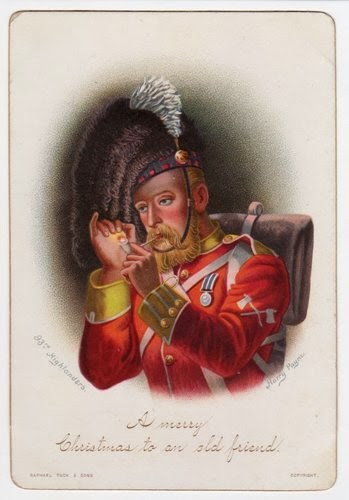
Raphael Tuck and Sons
Please note:  I am having issues with centering and sizing my fonts on this post!


I borrowed this book from my beau's sister-in-law.  Below are all of the wonderful and unique color illustration plates from the book: 


This is an antique British children's book entitled, "Granny's Stories".  There is no publication date. 

It was published by Raphael, Tuck & Sons, "Publishers to Their Majesties, The King & Queen, G.T.R.M. The Prince & Princess of Wales."  I looked online and discovered that this book is part of "Father Tuck's Golden Gift Series", so publication was somewhere between 1900 to 1910. 


The history of Raphael, Tuck & Sons is interesting, historic 


and ultimately, sad.  Raphael Tuck was an untrained artist, 


whose natural talent had a profound impact on not only the 


artist community, but around the world.  He married 


Ernestine Lissner in 1848.  Ernestine was a savvy business-


woman, and together they built an empire, later with the


help of their sons.


In 1866, Raphael and Ernestine opened a business in 

Bishopsgate (a ward of London, England) selling greeting 


cards, frames and pictures.  The business grew like wild-fire 


as they began to sell and distribute postcards.  As you can 


see, there was a vast selection of styles from which to choose.  


""  -Raphael had received training in graphic arts in his home


 country; and, although he was not an artist himself, he had 


a flare for commercial art that prompted his interest in this   


new field. Upon coming to England, he caught the 


imagination of the public in such a way that he was able to 


create a new graphic arts business. He was so successful at 


it that, according to the "London Times", he "opened up a 


new field of labor for artists, lithographers, engravers, 


printers, ink and paste board makers, and several other 


trade classes".  -tuckdb.org


In 1880, the firm opened at a

new location at 72-73 


Coleman Street.  The 


couple's son, Adolph 


initiated a contest for the 


best Christmas card designs,


offering 5,000 guineas.  This 


sky-rocketed the Christmas 


card industry which 


eventually lead to the custom of the Christmas card industry, 


respectfully.  At the end of this contest, the business had 


received over 5,000 entries from both amateur and 


professional artists.   An exhibition was displayed in the 


Dudley Galleries, and huge crowds attended.


"It might be recorded as one of the ironies of history that a 

Jew, a respected Talmudic scholar, would be remembered as 


the chief exponent and promoter of the Christmas card. 


Raphael discovered that Christmas card designs were mainly 


secular; and in spite of the increased religious consciousness 


of the Victorian age, these cards featured the gaiety and 


revelry of the holiday season. In 1871 Tuck supervised the 


design of Christmas cards featuring the religious aspects of 


the season: Jesus Christ, the Holy Pair, the Magi, the 


Nativity scene, as well as the traditional Santa Claus, holly 


and mistletoe." -tuckdb.org


Above:  Illustrations from "Granny's Stories"  - photos by Denise Hinckley
Tuck and sons also published postcards and greeting cards 

for other holidays such as Easter, Halloween, Thanksgiving, 


New Years, and so on.  Today, there are many online 


(vintage, ephemera) collectors of their work, which is 


frequently bought, sold through online auctions, or simply 


displayed online. 


In another amazing business measure at around 1900, 


Raphael began an 18-month postcard competition for 


"collectors".  This seemed to change the focus of the artist to 


the public, as the collector.  The ploy worked and the public 


reacted - one winner collected 20,364 postcards and another 


winner submitted a whopping 25,239 cards!   Other contests 


continued through about 1914.


One of Tuck's paper doll collections

The company also produced greeting cards and children's 

books, as well as paper dolls and puzzles.  "Movable Books" 


and raised designs, under the name of the Father Tuck 


series.  


Production was greatly 

reduced, but continued 


through World War I and 


into World War II, until the 


night of December 29, 1940,


 when the Nazi's "poured 


tons of bombs on London. 


By morning, Raphael 


House was  shell  


and rubbish. Records


 of seventy-four years and 


40,000 or more original 


pictures and photographs 


by the best artists were in 


ashes."